 How-to
Prevent Yellowing on Graded Card Cases: 7 Steps
Table of Contents
- Why Graded Card Cases Yellow: Understanding the Causes
- Step 1: Control UV Exposure and Light Damage
- Step 2: How to Store Graded Cards in a Stable Environment
- Step 3: Maintain Proper Graded Card Storage Temperature
- Step 4: Manage Humidity and Moisture Control
- Step 5: Use Protective Sleeves and Slab Cases
- Step 6: How to Clean Graded Card Cases Safely
- Step 7: Monitor and Inspect Your Collection Regularly
- Frequently Asked Questions
Last Updated: October 21, 2026
Why Graded Card Cases Yellow: Understanding the Causes
To prevent yellowing graded card cases, you must understand that yellowing is at least three separate problems, each with a different cause and fix. Before buying another desiccant packet, identify which material is changing color, that determines whether prevention can still work or the damage is permanent.
First, separate slab yellowing from card yellowing
Hold the slab at an angle under neutral white light and inspect three surfaces: the outer plastic shell, the paper card inside, and the printed label. They age on different timelines and for different reasons.
- Yellowed slab shell. The plastic itself has discolored. The tint looks uniform across the whole case, including the border and edges, and it doesn’t move when you tilt the slab. This is plastic aging and is usually irreversible.
- Yellowed card. The card stock or the white border has turned cream or brown while the plastic stays clear. This is paper oxidation and acid migration, often accelerated by the card's own composition or by the inner sleeve it sits in. The case is not the culprit.
- Yellowed label. The grading label paper or its adhesive has discolored. This is a labeling-materials issue, not a storage failure, and it does not mean the card is damaged.
Collectors often assume the slab is ruined when only the label has aged, or assume the card is fine when a yellowed shell masks its true color.
What actually makes the plastic yellow
Graded slabs are typically made from rigid plastics such as acrylic or polycarbonate blends. These polymers are not inert. Over years, three processes drive discoloration:
- UV-driven photo-oxidation. Ultraviolet energy breaks polymer chains and creates chromophores, molecular structures that absorb blue light and reflect yellow, the same chemistry that yellows vintage computer cases. Window glass blocks some UVB but passes meaningful UVA, so a slab near a window is exposed even without direct sun.
- Heat acceleration. Chemical reactions in plastic speed up as temperature rises, so a slab in a warm room ages faster than an identical one in a cool room, even in the dark. Heat alone can drive yellowing over long periods.
- Chemical contact and off-gassing. Label adhesives, plasticizers in soft inner sleeves, cardboard boxes, and some cleaning products release compounds that react with the slab surface. Stacking slabs against unfinished wood or acidic cardboard is a known contributor.
Moisture and temperature swings do not yellow plastic directly, but expansion and contraction create micro-cracks that let oxygen and light penetrate deeper.
Why the card inside can yellow independently
Card stock is paper, and paper yellows through acid hydrolysis and lignin oxidation. Vintage cards on high-lignin stock brown more readily than modern buffered stock. The slab doesn’t cause this, but it can slow it by limiting oxygen and moisture exchange.
What this means for prevention
Because the causes differ, the fixes differ, and knowing which part yellows tells you how to prevent yellowing graded card cases. Light and heat control protect the shell; humidity and desiccant control protect the card and label; chemical separation from acidic cardboard, soft PVC sleeves, and harsh cleaners protects all three.
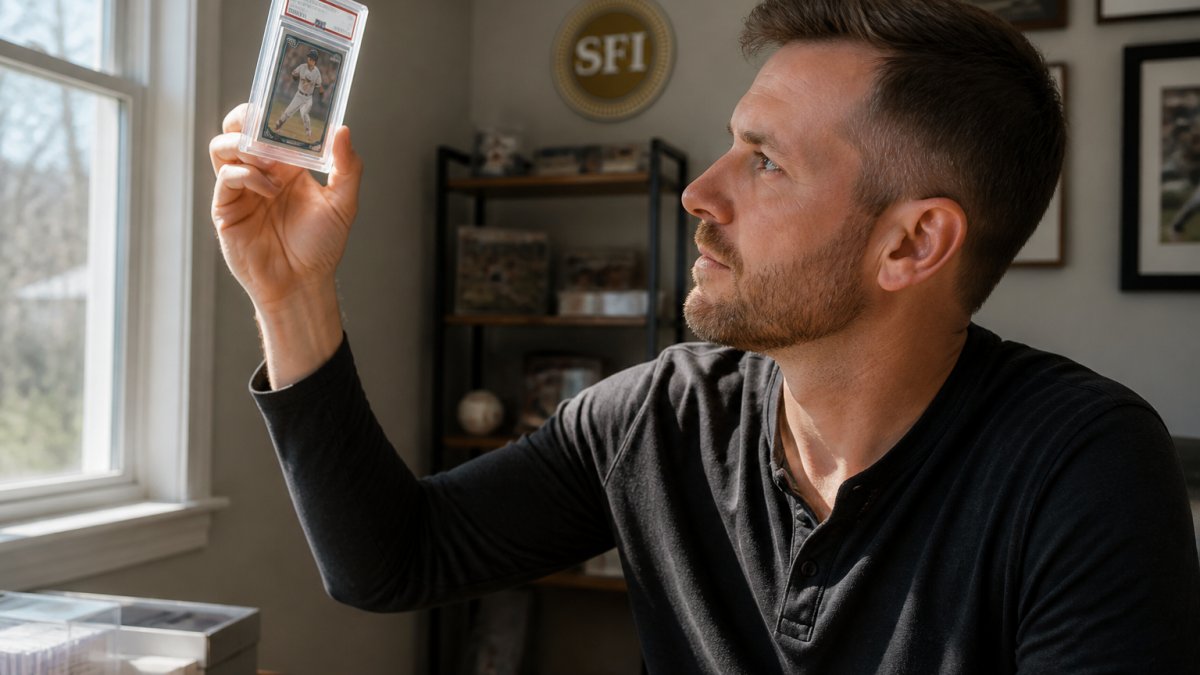
Step 1: Control UV Exposure and Light Damage
Direct sunlight is the fastest way to yellow a graded slab. UV rays penetrate standard plastic and trigger oxidation.
Store slabs in a dark room or closed cabinet. If display matters, use UV-filtering glass or acrylic. Fluorescent bulbs emit UV; LEDs are safer but still expose. Keep slabs dark most of the time and avoid windows; even without direct sun, ambient UV damages over months and years.
Step 2: How to Store Graded Cards in a Stable Environment
Stable storage means consistent conditions. Avoid basements, attics, and garages where temperature and humidity swing wildly. Choose an interior room and avoid exterior walls.
Keep the area dry: 30% to 50% humidity is ideal (Storing Your Books - Preserving Your Books).
Store slabs upright or flat, not at angles; pressure from incorrect positioning can stress the plastic and cause cracks.
Step 3: Maintain Proper Graded Card Storage Temperature
Temperature consistency matters more than the exact number. A stable 65 to 75 degrees Fahrenheit keeps plastic stable and slows oxidation; a room that stays at 70 beats one ranging from 60 to 80.
Climate-controlled storage units work if home space is limited. In climates with extreme seasonal swings, interior closets vary less than bedrooms. Monitor with a simple thermometer, weekly for the first month, then monthly.
Step 4: Manage Humidity and Moisture Control
Humidity is the silent killer of graded slabs. Target 30% to 50%, enough to prevent moisture buildup without the brittleness of extremely dry air.
Place a humidity meter in the storage area and check it weekly.
Never store graded slabs in plastic bags or sealed containers without humidity control; trapped moisture causes condensation inside the case and yellowing of the slab.
Step 5: Use Protective Sleeves and Slab Cases
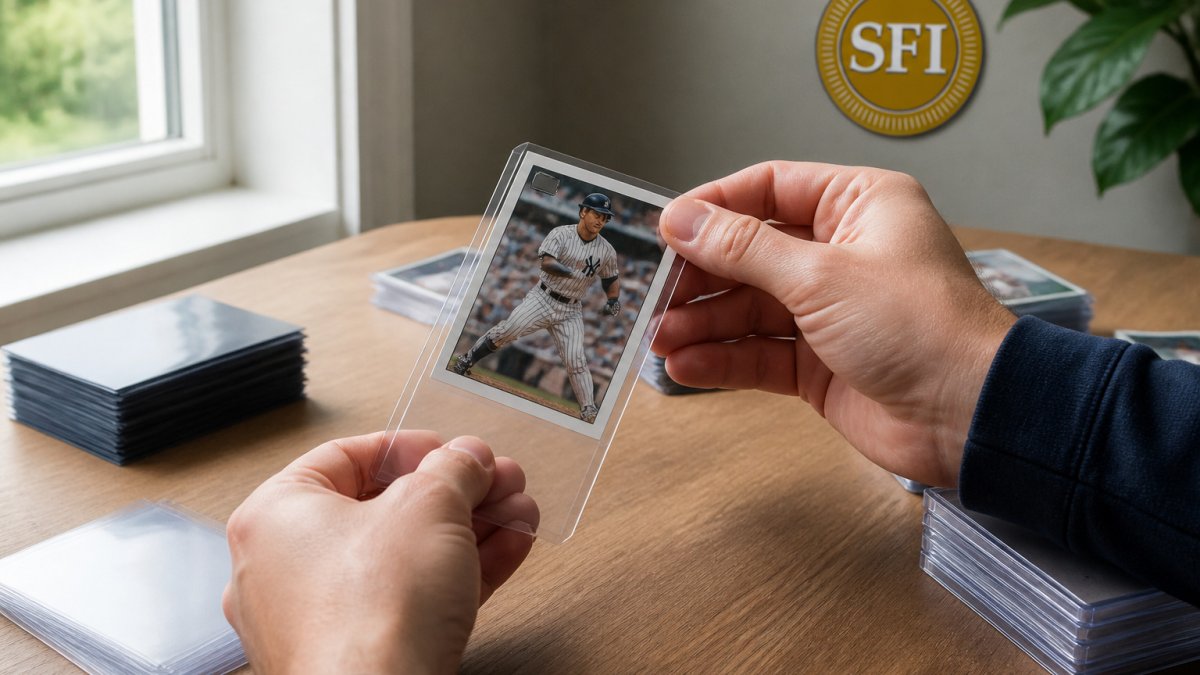
Protective sleeves defend against dust, scratches, and light exposure while reducing handling damage.
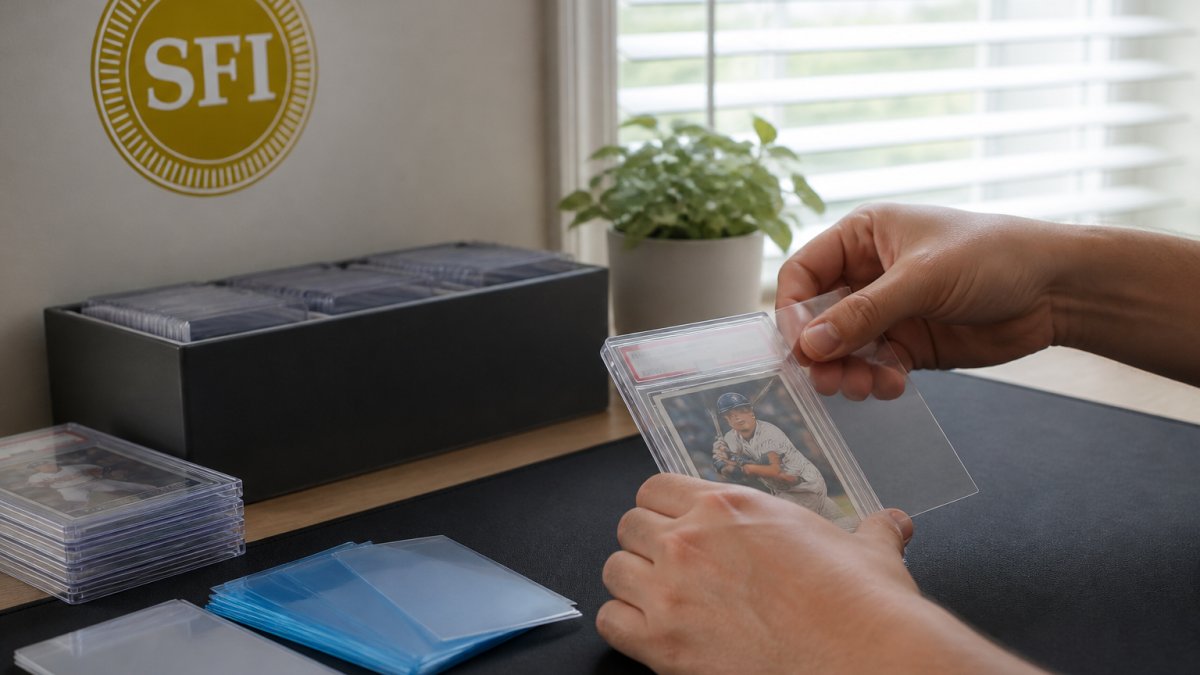
Precision-fit sleeves designed for your specific grading company work best: too loose allows movement and dust infiltration; too tight stresses the case. Graded Card Slab Sleeves are engineered for PSA, BGS, SGC, and CGC cases, with a tapered design that provides a snug fit with zero excess bulk while safeguarding against environmental threats.
Hard cases add impact and pressure protection for high-value or rare vintage slabs. Store sleeved slabs upright in a storage box to prevent pressure on any single card.
Protection Type | Best For | Benefit |
|---|---|---|
Protective sleeve | All graded slabs | Dust and light barrier |
Hard case | High-value cards | Impact and pressure protection |
Storage box | Organization | Dust containment and neatness |
Desiccant packet | Sealed containers | Moisture control |
Step 6: How to Clean Graded Card Cases Safely
Cleaning is where well-intentioned collectors do the most accidental damage. The goal is to remove exterior dust and fingerprints without clouding the plastic, scratching the surface, or driving liquid into the seams.
What is safe to use
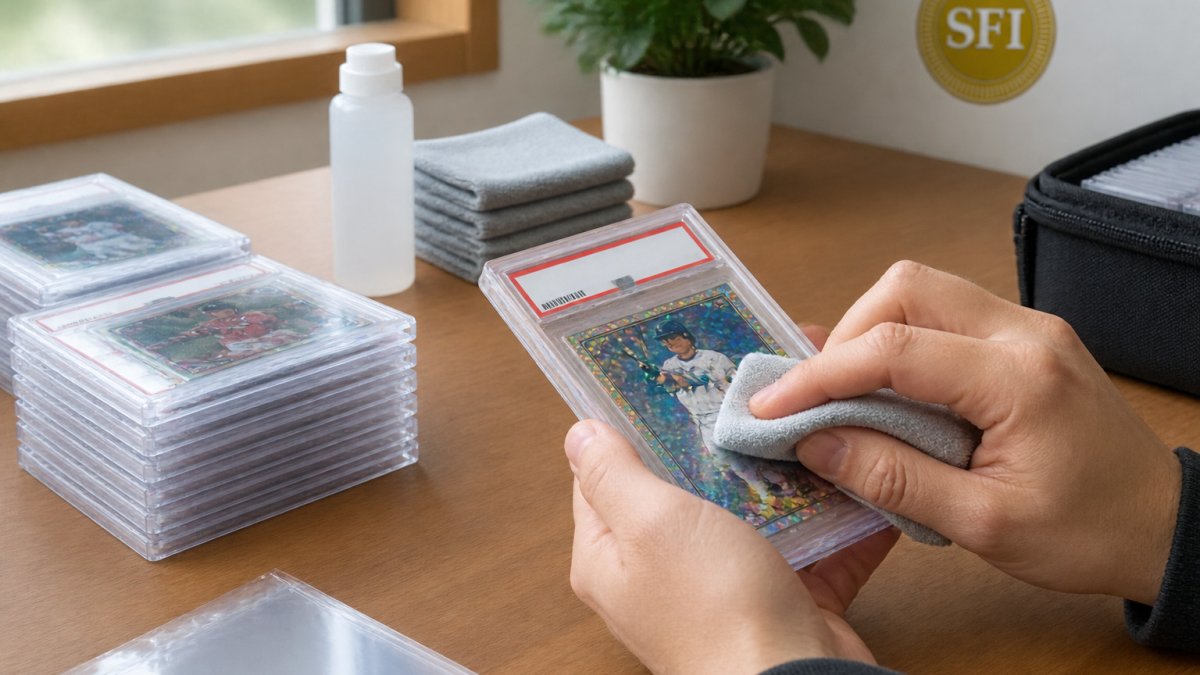
- Dry microfiber cloth. The default tool. Fold it into a pad and wipe in one direction rather than circles, which trap grit and drag it across the surface.
- Lint-free lens cloth. Good for the viewing window where fingerprints accumulate.
- Soft camel-hair or clean makeup brush. Lifts dust out of the seam between the slab halves.
What to avoid, and why
- Isopropyl alcohol, acetone, and nail polish remover. Alcohol can craze or cloud acrylic and polycarbonate over repeated use, and acetone attacks many clear plastics outright.
- Glass cleaner and ammonia-based sprays. Ammonia is aggressive toward many plastics and leaves a film that attracts dust.
- Paper towels and tissue. Wood fibers are microscopically abrasive and leave fine scratches that read as dullness mistaken for early yellowing.
The cleaning sequence that works
- Brush or blow loose dust off first; wiping a dusty slab grinds grit into the plastic.
- Wipe flat faces with a dry microfiber cloth, in one direction, with light pressure.
- For window fingerprints, breathe lightly on the surface and buff with a lens cloth, as on eyeglasses.
- For a stubborn exterior smudge, use the barely damp cloth, then immediately dry with a second microfiber cloth.
- Inspect the seam and label area; if anything looks wet, let the slab air-dry in a dry room before returning it to storage.
Never open the slab
Opening a graded slab voids the grading company's guarantee, destroys the grade's authenticity, and exposes the card to handling damage. If condensation forms inside, move the slab to a drier location and let it equalize.
Cleaning frequency
Displayed slabs pick up dust and fingerprints faster than stored ones. A quarterly exterior wipe for displayed slabs and an annual wipe for stored ones is a reasonable rhythm. Clean only when needed.
Prevention versus treatment: what cleaning cannot fix
Cleaning removes surface contamination; it does not reverse yellowing. Once the plastic has discolored through photo-oxidation or heat aging, the change is in the polymer structure, not the surface, and no cloth or polish restores clarity without removing material.
That leaves three realistic paths when a slab has yellowed:
- Preserve as-is. If the card inside is intact and the grade is sound, a yellowed shell is a cosmetic issue. Keep it out of light and heat to slow further change, and document the condition with photos.
- Seek professional advice. For high-value cards, a conservator or the grading company's customer service can tell you whether the discoloration is in the shell, the label, or the card, and whether reholding is an option.
- Consider regrading or reholdering. Some grading companies offer reholding services that replace the shell while preserving the grade. This is the only reliable way to restore a clear case, and it carries its own risks and costs.
The practical takeaway: focus on prevention, because treatment options are limited and often expensive. A clean, well-stored slab that never yellows is worth more than a yellowed one you are trying to rescue.
Step 7: Monitor and Inspect Your Collection Regularly
Regular inspection catches problems early. Once a month, pull out a few slabs, examine them under good lighting for yellowing, cracks, or moisture inside the case, and photograph valuable cards.
Check temperature and humidity at the same time to connect environmental data to what you observe.
Rotate displayed cards to spread light exposure, and keep a simple log of conditions and observations to show over time whether your environment is protecting your investment.
Task | Frequency | Why It Matters |
|---|---|---|
Check temperature | Monthly | Detects environmental changes |
Check humidity | Monthly | Prevents moisture damage |
Visual inspection | Monthly | Catches yellowing early |
Clean slabs | Quarterly | Removes dust and debris |
Rotate display cards | Quarterly | Spreads light exposure evenly |
Review storage area | Quarterly | Identifies new problems |
Preventing yellowing on graded card cases comes down to controlling your environment and using the right protection. Keep your slabs away from light, maintain stable temperature and humidity, and use protective sleeves designed for your specific grading company's cases. Graded Card Slab Sleeves provide archival-grade protection engineered specifically for PSA, BGS, SGC, and CGC slabs, with a precision-fit design that eliminates excess bulk while maintaining crystal-clear clarity to showcase your collection's true condition.
Frequently Asked Questions
Why do graded card cases turn yellow?
Graded card cases yellow due to prolonged exposure to UV light, heat, and oxidation of the plastic material itself. The polycarbonate or acrylic used in grading slabs can degrade over time, especially in unstable storage conditions. Direct sunlight accelerates this process significantly. Additionally, high humidity and temperature fluctuations can cause the plastic to break down chemically, leading to discoloration that may affect only the slab or both the case and the card inside.
Can protective sleeves prevent graded card cases from yellowing?
Yes, quality protective sleeves help prevent yellowing by adding a barrier against dust, UV exposure, and environmental contaminants. Precision-fit sleeves designed specifically for graded slabs keep cases in stable, enclosed conditions, reducing direct light exposure. Combined with proper storage in a dark, climate-controlled space, protective sleeves significantly slow the yellowing process. However, they work best as part of a complete prevention strategy that includes temperature control, humidity management, and minimal light exposure.
How should I store graded cards to keep their cases clear?
Store graded cards in a cool, dry, dark location away from direct sunlight and heat sources. Keep temperature stable between 60-75°F and humidity between 30-40%. Use a storage box or cabinet that blocks UV light, and store slabs vertically or horizontally in a way that prevents pressure on the case. Add silica gel packets to absorb excess moisture. Place protective sleeves on each slab for added protection. Avoid basements or attics where temperature and humidity fluctuate, and never store near windows, radiators, or air conditioning vents.
Does sunlight make graded card slabs yellow faster?
Yes, direct sunlight is one of the primary causes of yellowing in graded card slabs. UV rays break down the chemical bonds in the plastic case, causing discoloration that can develop within months of regular exposure. Even indirect sunlight through windows can contribute to yellowing over time. If you display graded cards, use UV-filtering glass or acrylic to block harmful rays, or keep your collection in a dark storage location. The longer slabs remain in direct or indirect sunlight, the faster visible yellowing will occur.