 ultimate-guide
How to Store Graded Card Slabs Safely Long Term
Table of Contents
- Why Proper Storage of Graded Card Slabs Matters
- Choosing the Best Storage Case for Graded Cards
- How to Pick a Graded Card Storage Box
- How to Protect Graded Card Slabs from Scratches
- Long-Term Storage for Graded Cards: Environment and Security
- Step-by-Step Storage Setup and Handling Practices
- Conclusion
- Frequently Asked Questions
Last Updated: October 6, 2026
Why Proper Storage of Graded Card Slabs Matters
Knowing how to store graded card slabs is the difference between a collection that holds its value and one that quietly loses it. A graded card slab is a sealed plastic holder that encases a professionally authenticated card, and that holder is the only thing standing between your card and years of environmental wear.
That's backwards. The holder takes the abuse.
Scratches cloud the window and hide the card's eye appeal. UV light fades labels and, in bad cases, the card itself. Library of Congress guidance on preserving collections is blunt about this: light, heat, humidity and physical handling are the four forces that degrade stored paper goods, and graded cards are paper goods inside plastic.
Get those four under control and a slab can sit safely for decades. Ignore them and you'll be reholdering cards you paid good money to grade.
Choosing the Best Storage Case for Graded Cards
The best storage case for graded cards depends on how you use the collection, not on which one looks toughest online.
Before you compare cases, measure your slabs. Slabs are not one universal size.
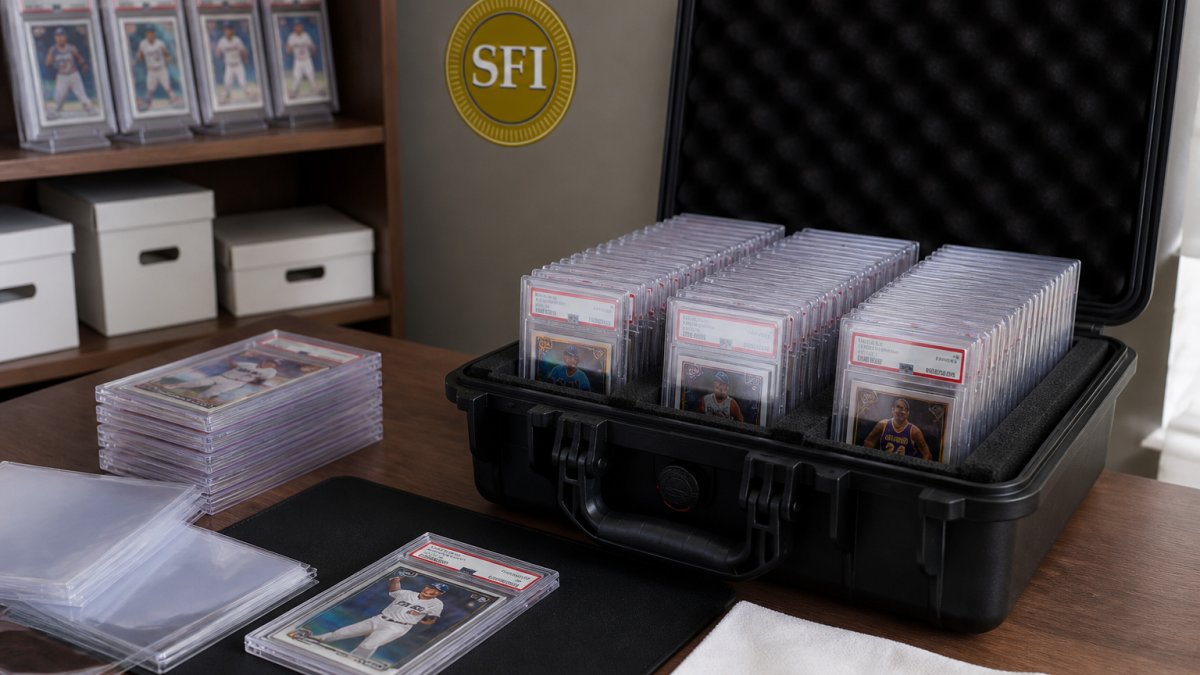
Hard cases win on protection. Rigid plastic and aluminum cases resist crushing, stacking and impact, and many come with foam inserts that hold slabs in place.
Soft cases win on flexibility. Padded fabric binders and zip cases hold more slabs per dollar and travel well.
Hard Cases vs Soft Cases
Case Type | Best For | Key Strength | Main Trade-Off |
|---|---|---|---|
Hard plastic case | Long-term storage, high-value cards | Crush and impact resistance | Bulk and weight |
Aluminum case | Transporting collections | Rigid shell with foam padding | Heaviest option |
Padded zip case | Mid-value collections, shows | Portability and capacity | Limited crush protection |
Binder with pages | Display and browsing | Easy access, organized viewing | Least impact protection |
A practical approach many collectors take is layering: a hard case for the vault, a padded zip case for the show, and sleeves on every slab in both.
Matching the Case to Your Collection
A simple decision framework keeps you from overbuying or under-protecting:
- Small, high-value collection (a handful of key cards). A hard case with closed-cell foam, stored indoors on a stable shelf. Fit matters more than capacity here.
- Mid-size collection you like to look at. A binder with slab pages or a display case with a UV-filtering lid, kept out of direct sun.
- Large bulk collection. Stackable cardboard or plastic bins sized to your slab dimensions, with slabs standing upright rather than piled flat.
One caveat that trips people up: a case rated for one grading company's slabs may not fit another's. If you own slabs from several companies, test-fit a few from each before committing to a case, or choose a case with adjustable dividers.
How to Pick a Graded Card Storage Box
A graded card storage box should match your slab dimensions first and your capacity needs second.
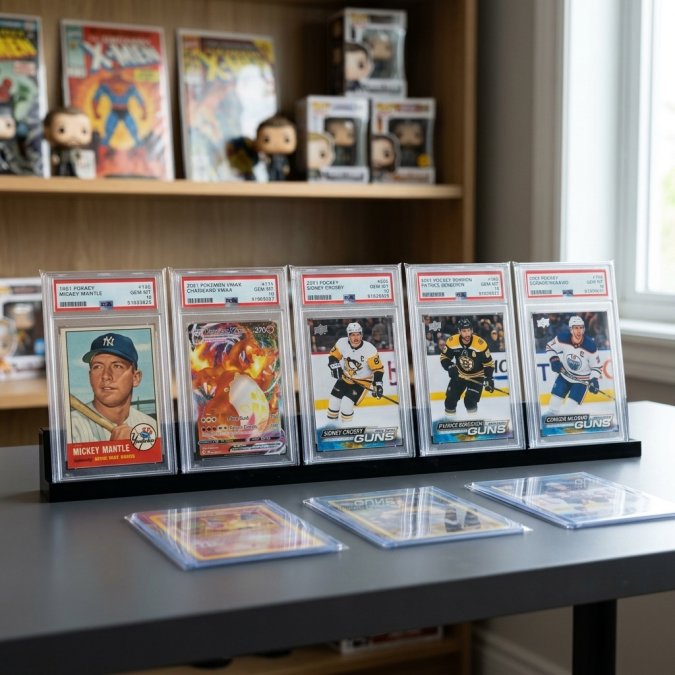
Cardboard boxes remain the workhorse of the hobby. The classic three-row box holds a row of slabs upright, which keeps them from stacking weight on each other.
For high-value cards, skip the open-top box entirely. A locking lid, a recessed handle and a snug interior fit all reduce the chance of a spill.
Capacity by Container Type
Approximate capacity matters when you're planning shelf space. Numbers vary by slab thickness and how tightly you pack, but these ranges hold for standard PSA-style slabs:
Container | Approximate Slab Capacity | Notes |
|---|---|---|
Single-row cardboard box | 25-40 slabs | Good for a small set |
Three-row cardboard box | 75-120 slabs | Hobby standard for bulk |
Vault box | 100-200 slabs | Sturdier walls, better stacking |
Graded card bin | 150-300 slabs | Suits large collections |
Zip binder or case | 60-200 slabs | Depends on page count |
How to Protect Graded Card Slabs from Scratches
Protecting graded card slabs from scratches comes down to one rule: nothing hard should ever touch the plastic window.
The simplest fix is a slab sleeve. Superior Fit Sleeves makes graded card slab sleeves with a tapered, resealable flap that gives a tight fit without excess bulk, sized for PSA, BGS, CGC and other major slab brands.
Beyond sleeves, a few habits do most of the work:
- Handle slabs by the edges, never the window
- Stack slabs flat in small numbers rather than tall towers
- Keep slabs out of loose bags with keys, coins or other hard objects
- Store upright in boxes so weight doesn't press on the face
If you also keep top-loaders or magnetic one-touch cases, the same logic applies, and we make sleeves for those too.
Long-Term Storage for Graded Cards: Environment and Security
Long-term storage for graded cards is an environment problem before it's a container problem. A perfect box in a hot, damp garage will still ruin a collection. Most collectors focus on the box and ignore the room, which is exactly backwards. This is the part most storage guides skip, so treat it as your preservation plan rather than an afterthought.
Temperature, Humidity, and Light
Aim for a stable, moderate environment and avoid swings more than absolute numbers. Rapid changes in temperature and humidity stress both the card and the holder more than a steady, slightly imperfect climate does.
- Temperature: keep it comfortable and consistent, roughly room temperature, and avoid attics and garages that swing hot and cold.
- Humidity: moderate and steady. Damp air invites moisture and mold; very dry air can dry out paper. A simple hygrometer is enough to monitor it, and a desiccant pack in any sealed container helps smooth swings.
- Light: store out of direct sunlight and away from UV. Light fades labels and cards over years, and UV damage is cumulative and irreversible.
- Water: keep shelves off the floor and away from pipes, windows and basements prone to flooding. A plastic bin with a gasketed lid adds a layer of water resistance that plain cardboard cannot.
Material and Chemical Safety
What touches the slab matters as much as where it sits. Look for sleeves and inserts described as archival grade and acid-free. Avoid adhesives, tape and rubber bands directly on the holder, and avoid PVC-based plastics, which can off-gas over time and leave a residue or fog the window. If a sleeve smells strongly of plastic or feels tacky, it is not a long-term storage material.
Fire, Flood, Theft, and Insurance
For high-value cards, plan for the worst case, not just the average day:
- Fire and theft: a home safe or a safe deposit box protects against both, but check the humidity inside any sealed safe and add a desiccant pack. Off-site storage at a bank or a climate-controlled facility is an option for the most valuable pieces.
- Flood: store nothing on the floor. Elevate shelves, keep collections out of basements and away from plumbing, and use water-resistant containers in any space that could take on water.
- Inventory: photograph every slab, record the certification number and grading company, and keep that record somewhere other than the collection itself, such as cloud storage or a safe deposit box.
- Insurance: check whether your homeowner's or renter's insurance covers collectibles or whether you need a separate rider or a specialized collectibles policy. An up-to-date inventory with certification numbers makes a claim far easier to support.
Step-by-Step Storage Setup and Handling Practices
A repeatable setup beats improvised storage every time. Here's how we'd set up a collection from scratch.
What you'll need: slab sleeves, a storage box or case sized to your slabs, a stable shelf, desiccant packs for enclosed spaces, and an inventory list.
- Inspect each slab. Check for existing scratches, cracks or label damage before storing. Note anything that needs reholdering.
- Sleeve every slab. Slide each graded card slab into a snug sleeve so the holder, not the card, takes handling wear.
- Sort by value and use. Keep high-value cards together for easy monitoring; group display cards separately from vault stock.
- Load the box upright. Stand slabs on edge in rows, leaving slack so they don't press together.
- Choose the location. A stable interior shelf, off the floor, out of sunlight and away from water sources.
- Add moisture control. Desiccant packs in sealed containers; swap them on a schedule.
- Document everything. Photograph slabs, record certification numbers, and store the inventory somewhere other than the collection.
- Review twice a year. Recheck fit, foam, sleeves and the storage environment, and rotate out anything showing wear.
Expected result: a collection that looks the same in five years as it does today, with a paper trail that supports insurance and resale.
Conclusion
Storage is the part of collecting nobody enjoys, and it's the part that decides whether your cards hold their value.
Superior Fit Sleeves builds archival-grade, acid-free sleeves with a precision-cut, tapered resealable flap and distortion-free clarity, made to fit PSA, BGS and CGC slabs snugly without excess bulk.
Get started with Superior Fit Sleeves and give every slab in your collection the fit it deserves.
Frequently Asked Questions
How do people store their PSA slabs?
Most collectors store PSA slabs in dedicated graded card storage boxes, often with dividers to keep slabs upright and separated. Many use three-row or vault-style boxes lined with foam or felt. For extra protection, slabs are placed in snug-fit sleeves before going into the box. Keeping the box in a cool, dry location away from direct sunlight prevents warping and fading. Some collectors also use locking cases for high-value slabs.
What is the best case for storing PSA slabs?
The best case depends on your collection size and value. For a few dozen slabs, a compact hard case with a hinged lid and foam padding works well. For larger collections, a three-row storage box or a vault box with locking lid offers more capacity and security. Look for cases made from acid-free, archival-grade materials that fit standard PSA slab dimensions (about 3.25 x 4.5 inches). Avoid cases that let slabs slide around.
Should you keep PSA slabs in plastic?
Yes, keeping PSA slabs in a protective plastic sleeve is recommended. The grading company's slab is already sealed, but the outer surface can still get scratched. A snug, archival-grade sleeve adds a layer of protection without trapping moisture. Avoid cheap PVC sleeves, which can off-gas and damage the slab over time. Use sleeves made from inert materials like polyethylene or Mylar. This also keeps the slab clean for display or resale.
Where is the best place to store PSA graded cards?
Store PSA graded cards in a cool, dry, dark place with stable temperature and low humidity. A closet or safe is ideal. Avoid basements, attics, and garages where moisture and temperature swings are common. Keep them off the floor and away from exterior walls. For high-value cards, a fireproof safe or safe deposit box adds security. Always use acid-free storage boxes and sleeves to prevent chemical damage.
How can you prevent scratches on graded card slabs?
Prevent scratches by handling slabs with clean, dry hands and holding them by the edges. Never stack slabs directly on top of each other without a soft barrier. Use snug-fit sleeves designed for graded slabs, and store them upright in a padded box. Avoid sliding slabs across rough surfaces. When transporting, use a case with individual compartments or foam padding. Regularly clean slabs with a microfiber cloth to remove dust that can cause abrasion.
Can graded card slabs be stored in a card storage box?
Yes, graded card slabs can be stored in a card storage box, but the box must be sized for slab dimensions. Standard card boxes for raw cards are too small. Look for graded card storage boxes with interior dimensions of at least 3.5 x 4.75 inches per slot. Three-row boxes and vault boxes are popular choices. Line the box with acid-free material and use dividers to keep slabs from shifting. Avoid overfilling, which can bend corners.