 How-to
Archival Testing for Card Sleeves: A Collector's Guide
Last Updated: November 18, 2026
Quick Summary
Archival testing for card sleeves checks whether a plastic sleeve is safe to store a collectible card for years without causing chemical damage. Plastic sleeves break down over time, releasing compounds that migrate into card stock, and that damage cannot be reversed. A simple home screen can flag a sleeve worth removing, but only manufacturer specifications or independent lab testing can confirm a sleeve is acid-free.
- The copper wire test takes about 24 hours, mostly waiting, and is a screen rather than proof of archival quality.
- A green or dark film on the copper points to corrosive vapor, and that sleeve does not belong near your collection.
- Polyester, often sold as Mylar, is the gold standard for preservation because it is stiff, clear, and chemically stable.
- PVC is the one to avoid, since its plasticizers are exactly what migrates into cards.
- Match a lab report to the product line or SKU, because a report for one thickness does not cover a different product.
Table of Contents
- Why Archival Testing for Card Sleeves Decides Long-Term Value
- How to Tell If Card Sleeves Are Acid-Free
- Plastic Sleeve Material Testing: Polyester, Polypropylene, Polyethylene, and PVC
- What Archival Testing Documentation Should Include
- Fit, Thickness, and Clarity: The Physical Side of Protection
- Card Sleeve Storage Best Practices After Sleeving
- A Decision Tree for Unknown or Vintage Sleeves
- Choosing Archival-Grade Sleeves for Your Collection
- Frequently Asked Questions
Why Archival Testing for Card Sleeves Decides Long-Term Value
Archival testing for card sleeves checks whether a plastic sleeve is safe to store a collectible card in for years without causing chemical damage.
Plastic sleeves break down over time, releasing compounds that migrate into card stock. The card absorbs them, and the damage cannot be reversed.
Below, we show you how to screen a sleeve at home, what those tests can and cannot prove, and how to decide what to do with an unknown sleeve you already own.
How to Tell If Card Sleeves Are Acid-Free
You cannot confirm a sleeve is acid-free by looking at it. Clarity and stiffness tell you nothing about chemical stability. The only reliable answer comes from the manufacturer's specifications or independent lab testing.
That said, a simple home screen can flag a sleeve worth removing from your collection. It will not certify a good one.
What "Acid-Free" Actually Means in a Plastic Sleeve
"Acid-free" is a paper term borrowed loosely by the plastics trade. In preservation work, the concern is broader than pH. A sleeve can be neutral on a pH strip and still be unsafe, because the real risks in plastic are additive migration, off-gassing, and gradual polymer breakdown.
Three mechanisms matter for card stock:
- Hydrolysis and oxidation. Over years, some polymers shed acidic byproducts as they degrade. Those byproducts can migrate into paper and coatings.
- Plasticizer migration. Flexible plastics carry additives to stay soft. Those additives can leach out, leave a tacky film, and stain or soften card stock.
- Off-gassing. Residual solvents and breakdown products escape as vapor and can react with inks, foils, and coatings inside a sealed enclosure.
The Copper Wire Test, Step by Step
The copper wire test is a basic screening method. It checks for one common sign of plastic degradation: corrosive vapor coming off the material.
Total time: about 24 hours, mostly waiting.
What you need:
- A short piece of bare copper wire
- The sleeve you want to test
- A clean glass jar with a lid
Steps:
- Clean the wire. Wipe the copper with a cloth until it is bright; tarnish will confuse the result.
- Set up the sample. Place the sleeve and wire inside the jar, keeping them from touching if you can.
- Seal and wait. Close the lid and leave the jar at room temperature for 24 hours.
- Check the wire. Open the jar and look at the copper.
- Check the card stock. Look for any change in color or sheen on the test card.
Expected result: bright copper stays bright in a stable sleeve.
Watch out: a green or dark film on the copper points to corrosive vapor coming off the plastic. That sleeve does not belong near your collection.
Reading an Ambiguous Result
Most home tests do not come back as a clean pass or fail. They come back in between, and that is where collectors get into trouble.
- Slight dulling, no color change. Treat as inconclusive. Retest with a fresh wire and a second sample of the same sleeve.
- Faint green tint at one spot. Likely contact between wire and plastic. Rerun with the two separated.
- Uniform green or dark film. Treat as a fail. Remove the sleeve from storage and replace it.
A single test on a single sleeve is a data point, not a verdict. If you are screening a batch, test at least two sleeves from different parts of the pack, because manufacturing variance within a run is real.
What the Test Can and Cannot Prove
The copper wire test is a screen, not a certificate. A clean result means the sleeve is not off-gassing something aggressive right now. It does not tell you what the plastic is made of, whether it contains plasticizers, or how it will behave in ten years.
- It can show: obvious off-gassing or corrosive vapor.
- It cannot show: the exact polymer, the additive package, long-term stability, or whether the sleeve is acid-free by specification.
- It cannot show: plasticizer content, which is the failure mode most likely to stain a card.
Treat a pass as "probably okay for now," a fail as "remove this immediately," and an ambiguous result as a reason to identify the material before trusting the sleeve with anything valuable.
Plastic Sleeve Material Testing: Polyester, Polypropylene, Polyethylene, and PVC
Material identification is the real answer to sleeve safety.
Polyester (often sold as Mylar) is the gold standard for preservation. Museums use it.
Polypropylene is the everyday sleeve plastic. It is soft, clear, and generally safe. Most good card sleeves are polypropylene.
Polyethylene is softer and slightly hazy. It works well for inner sleeves and bags.
PVC is the one to avoid.
Material | Clarity | Flexibility | Long-Term Risk | Best For |
|---|---|---|---|---|
Polyester | Excellent | Stiff | Very low | Slabs, display pieces |
Polypropylene | Very good | Moderate | Low | Everyday card sleeves |
Polyethylene | Fair | Soft | Low | Inner sleeves, bags |
PVC | Good at first | Very soft | High | Not card storage |
Reading Results by Material Type
- Polyester: a clean copper result plus a stiff, glassy feel is a strong signal. This is the safest bet.
- Polypropylene: a clean result is normal. Watch for clouding over the years.
- Polyethylene: expect a slight haze. That is the material, not damage.
A common mistake is judging a sleeve by how it feels. Soft does not mean safe, and stiff does not mean scratchy. The chemistry decides.
What Archival Testing Documentation Should Include
Ask for the paperwork before you trust a sleeve with a valuable card. Good archival testing documentation is specific, dated, and tied to the actual product you are buying.
The Standards Behind an Archival Claim
A supplier who cannot name any framework is not necessarily selling a bad sleeve, but one who claims "archival" with no method behind it is asking you to take it on faith.
What a Real Lab Report Looks Like
A genuine third-party report has a shape you can recognize. Look for these items:
- The exact polymer name, not just "clear plastic"
- A statement that the material is acid-free
- A statement that the material is PVC-free
What most guides miss is the SKU point. A lab report for one thickness does not cover a different product from the same brand. Match the document to the sleeve in your hand.
Watch out: a report that lists a method but no laboratory name, or a date older than the product line itself, is a red flag. Ask for the current report before you buy in quantity.
When Professional Testing Beats a Home Screen
A home screen is cheap and fast. It is also limited. There are clear situations where professional testing or supplier documentation is the better call:
- High-value cards. If a single card is worth more than a full pack of sleeves many times over, the cost of a documented sleeve is trivial next to the risk.
- Bulk storage. When you are sleeving hundreds or thousands of cards, a bad batch is a systemic problem, not a one-off.
- Vintage or unknown stock. If you cannot identify the material, a lab can, and that answer is worth more than a guess.
For everyday modern cards, a documented polypropylene or polyester sleeve plus good storage habits is usually enough.
Independent laboratory verification carries more weight than an in-house claim. If a manufacturer will not share the method behind an archival claim, treat that claim as marketing.
For a grounded look at whether the extra cost is justified, see our guide on whether expensive card sleeves are worth it.
Fit, Thickness, and Clarity: The Physical Side of Protection
Chemical safety is half the job.
A snug fit keeps the card from sliding. Sliding means abrasion, and abrasion means surface damage along the edges and corners.
Clarity is the third piece.
Point ratings describe thickness in the trade.
This is where fit gets tricky. A sleeve that is too tight stresses the holder. One that is too loose lets dust in.
If your sleeves are already looking cloudy, our breakdown of why trading card sleeves turn cloudy over time explains the causes and the fixes.
Card Sleeve Storage Best Practices After Sleeving
Sleeving is step one. Storage conditions decide whether that work holds up.
Follow these card sleeve storage best practices:
- Store cards upright in rigid boxes, not stacked under weight.
- Keep storage areas cool and dry, away from radiators and windows (Care, Handling and Storage of Works on Paper).
- Avoid attics, basements, and garages where heat and humidity swing.
Dust protection matters more than people think. A dusty sleeve gets wiped, and wiping causes scratches. Seal your storage and skip the wiping.
For a deeper look at boxes, binders, and climate control, read our guide to long term storage solutions for collectibles.
A Decision Tree for Unknown or Vintage Sleeves
Found a box of cards in old sleeves?
Step 1: Look at the sleeve. Yellow, cloudy, or sticky means remove it now.
Step 3: Unknown material? Run the copper wire test. A fail means remove and replace.
Step 5: When in doubt, replace. A new archival sleeve costs little next to the card.
Watch out: never test a valuable card inside a questionable sleeve.
Choosing Archival-Grade Sleeves for Your Collection
The safest path is to buy sleeves with a clear material spec and a snug, precision fit. That combination removes the guesswork.
At Superior Fit Sleeves, we build archival-grade, acid-free sleeves with a tapered, resealable flap.
We make dedicated fits for the holders collectors use:
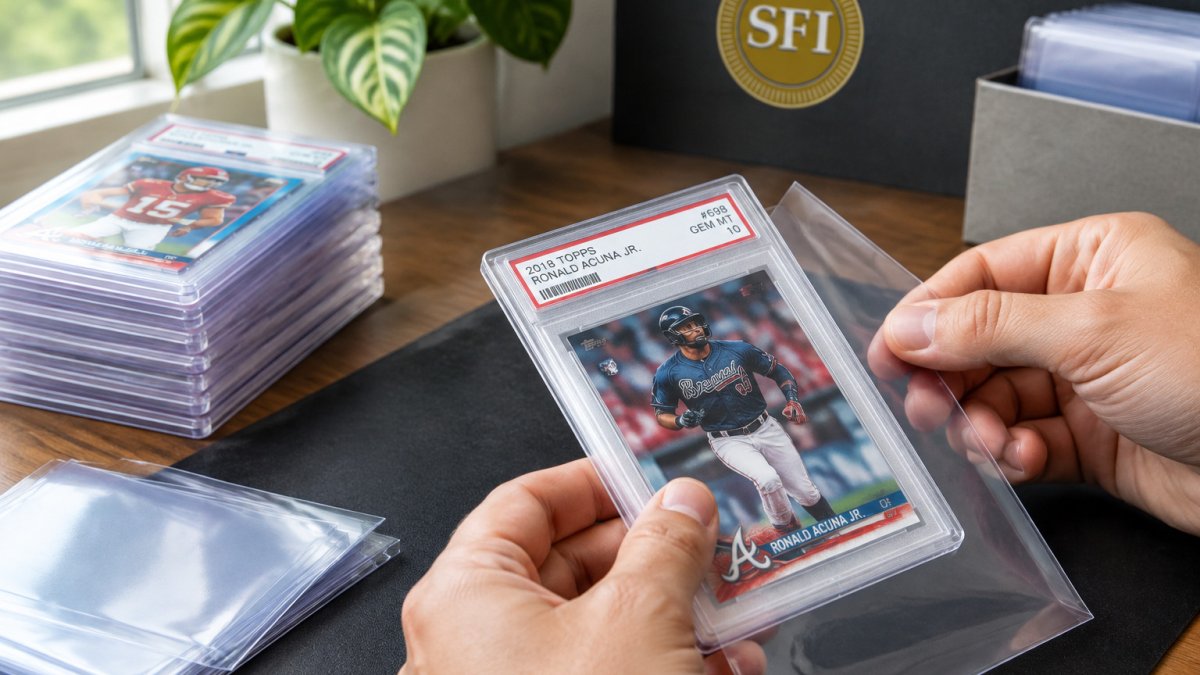
- Graded Card Slab Sleeves for PSA, BGS, SGC, and CGC slabs
- Top-Loader Sleeves for rigid top loaders
- Magnetic Card Case Sleeves for one-touch cases
For a curated shortlist, browse our roundup of the best archival sleeves for collection storage. See the full tapered-flap sleeve range for slabs, top loaders, and magnetic cases.
The real challenge is not finding a sleeve. It is knowing which sleeve deserves a place next to your best cards.
Frequently Asked Questions
How can I tell if card sleeves are acid-free without a lab?
A copper wire test is the standard home screen. Rub a clean copper wire on the plastic, wipe it, and let it sit for a day or two in a sealed container with a small piece of damp paper. A green or blue tint on the wire suggests acidic residue. Treat a negative result as a screen, not proof: it cannot detect plasticizers, and it says nothing about long-term stability. For valuable cards, ask the manufacturer for material specifications and independent test documentation before you trust a sleeve.
Which plastic materials are used for archival card sleeves, and which should I avoid?
Polyester and polypropylene are the common archival choices: chemically inert, PVC-free, and stable over time. Polyethylene is acceptable for some storage uses but is softer and less clear. Avoid PVC and any sleeve with a strong plastic odor, since PVC contains plasticizers that can migrate onto card stock and cause staining or yellowing. Material identification matters as much as an acid-free claim, because a sleeve can pass a simple acid screen and still contain additives that degrade over years.
What should archival testing documentation from a sleeve maker include?
Look for the specific plastic type, a statement that the material is PVC-free and non-adhesive, and results from an independent laboratory rather than an in-house claim. Ask whether the testing covers plasticizers and additives, not just acidity, and whether it addresses degradation over time. A manufacturer that names the material and the test method is giving you something you can verify. Vague wording like archival quality with no supporting data tells you very little.
Do acid-free sleeves guarantee a card will not be damaged?
No. Acid-free addresses one failure mode, chemical migration from the sleeve. Cards still suffer surface damage from abrasion, warping from humidity swings, and fading from UV light. Storage conditions do as much work as the sleeve: keep cards out of direct sunlight, in a stable temperature and humidity range, and avoid stacking heavy slabs on top of raw cards. Combine a tested, PVC-free sleeve with careful handling and controlled storage for real long-term protection.