 How-to
How to Clean Graded Card Slabs Without Causing Damage
Last Updated: November 19, 2026
Quick Summary
Clean graded card slabs with a dry microfiber cloth first, then a barely damp cloth misted with distilled water, wiping away from the label and seam. Dry and buff immediately, and stop after two passes if a mark does not lift, since more wiping removes plastic rather than dirt.
- Brush dust from edges and corners before any moisture touches the case.
- Mist distilled water onto the cloth, never directly onto the slab.
- Skip paper towels, acetone, ammonia glass cleaners, and abrasive creams.
- A gray tint on the cloth means you are removing plastic, so stop.
- Run a corner test before using any new polish on a slab face.
Table of Contents
- What to Use to Clean PSA Slabs and Other Graded Cases
- How to Clean Graded Card Slabs at Home: A Step-by-Step Routine
- How to Remove Scratches From a PSA Slab
- Safe Routine Cleaning Versus Scratch Repair
- Slab Material and Grading-Company Differences
- Graded Card Protectors That Prevent Future Marks
- Choosing the Right Sleeve for Your Slab Collection
- Frequently Asked Questions
What to Use to Clean PSA Slabs and Other Graded Cases
Learning how to clean graded card slabs starts with one rule: use less than you think you need. A graded card slab is a sealed plastic case, and the card inside never touches your cloth. That means every product you pick should be safe for clear plastic and gentle enough to leave no residue behind.
The supplies below are a practical starting point for handling PSA, BGS, CGC, and SGC holders.
Supplies That Are Safe for Slab Plastic
A short, boring supply list does the job better than a cabinet of chemicals:
- Two or three microfiber cloths. Keep one dry, one barely damp, and one reserved for buffing.
- A soft brush. A clean makeup brush or camera lens brush lifts dust from edges and cracks.
- Distilled water. Tap water can leave mineral spots on the slab surface.
Skip paper towels. They feel soft, but wood fibers can leave tiny scuffs on a plastic case.
Products and Chemicals to Avoid
Watch out: the wrong cleaner can fog or craze plastic, and that damage is hard to undo.
- Acetone, nail polish remover, and paint thinner. These attack clear plastic fast.
- Glass cleaner with ammonia. It can cloud the slab surface over repeated use.
- Abrasive creams and toothpaste. They grind away material instead of smoothing it.
If a product's label says "not for plastics," believe it.
How to Clean Graded Card Slabs at Home: A Step-by-Step Routine
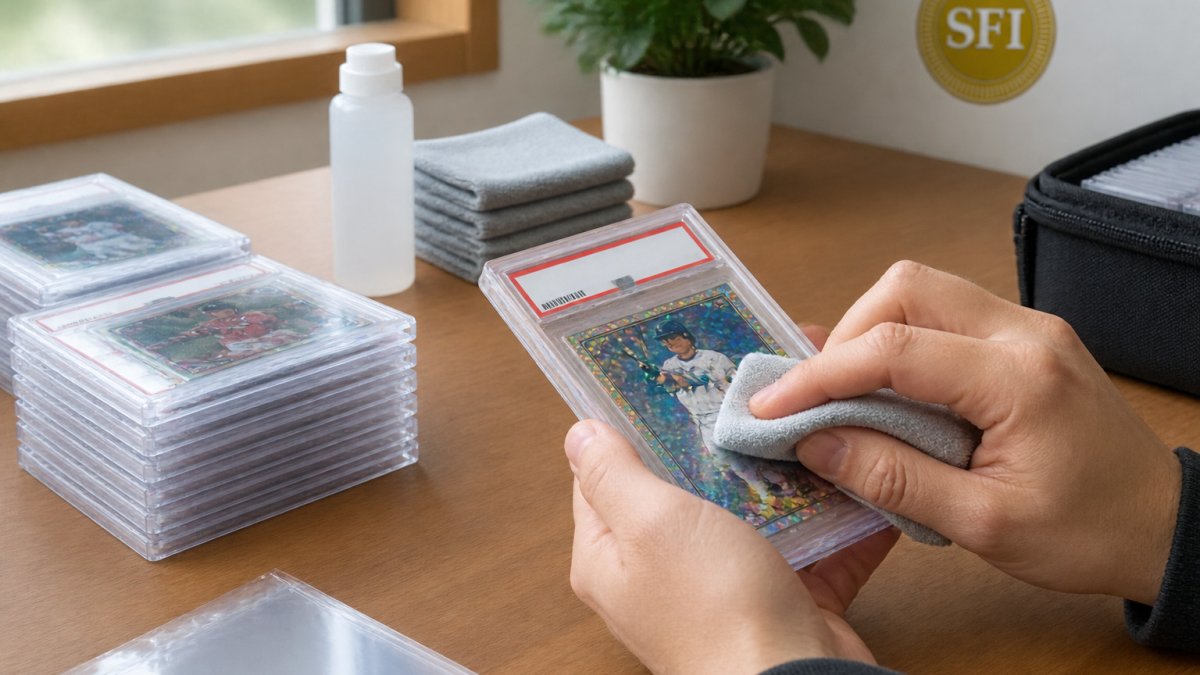
Cleaning graded card slabs at home takes about five minutes per holder and needs no special equipment. Work on a clean, flat surface with good light, and keep the slab in its sleeve until the moment you start. The routine below is deliberately conservative: it removes dust, fingerprints, and residue without touching the plastic's surface, and it stops well short of anything abrasive.
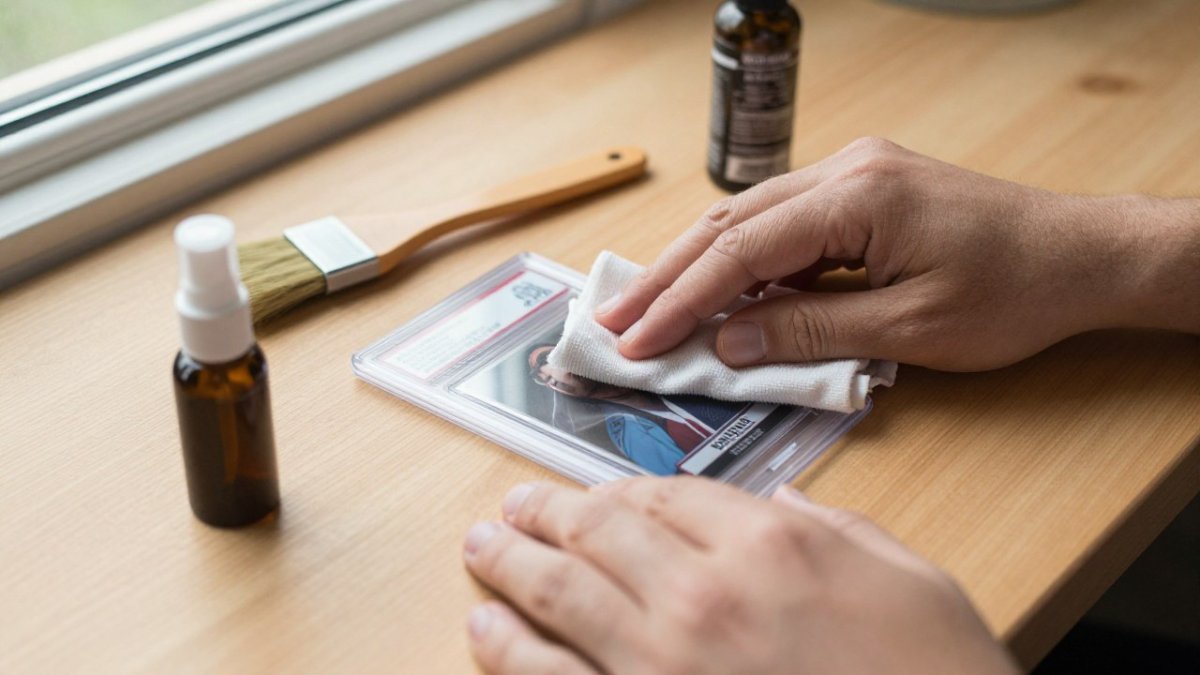
Step 1: Clear the Dust and Loose Debris
Dry work always comes first. Dust trapped under a damp cloth turns into a mild abrasive, and grit along the seams can migrate toward the label if you wipe across it.
- Brush the slab edges and corners with the soft brush, working from the sealed edge outward, not toward the label.
- Wipe the flat faces with a dry microfiber cloth using straight passes rather than circles; straight passes make it easier to see what you have already covered.
- Check the seams and cracks where grit collects, and tap the slab edge gently over a trash can to release loose particles before wiping.
Do this before any moisture touches the case. If the slab still has visible grit after dry brushing, brush again rather than reaching for a damp cloth.
Step 2: Wipe Smudges and Fingerprints With a Barely Damp Cloth
Fingerprints and smudges lift easily with the right touch. Mist distilled water onto a microfiber cloth, not onto the slab, until it is barely damp, then wring out any excess.
- Never spray directly at the label or the sealed edge.
- Keep moisture away from the card cavity and the seam where the two plastic halves meet.
- Use a fresh section of cloth for each pass so you are not redistributing oils.
For stubborn smudges, breathe on the plastic and buff with the dry cloth. It works more often than people expect, and it avoids adding more moisture near the seal.
Watch out: if a smudge does not lift after two light passes, stop. Repeated damp wiping near a seam is how water finds its way under the plastic and stains a label.
Step 3: Dry, Buff, and Inspect the Slab Surface
Dry the slab right away with a clean, dry microfiber cloth, starting at the label edge and working outward so any residual moisture is pushed away from the seal rather than toward it.
Hold the slab under a lamp at an angle. Any remaining haze is usually polish residue or water spotting, not damage. A second dry buff normally clears it.
Step 4: Know When to Stop
The most useful skill in slab cleaning is knowing when to put the cloth down. A common pattern among collectors is to keep wiping a stubborn mark until the plastic around it looks duller than the rest of the case.
- If the mark does not change after two cleaning passes, it is probably below the surface, and more wiping will not help.
- If the cloth starts picking up a gray tint, you are removing plastic, not dirt. Stop.
- If the label looks damp or the seam feels wet, stop and let the slab air-dry face up in a dry room before doing anything else.
A simple, repeatable workflow beats aggressive one-time fixes. Clean often, polish seldom, and treat any change in the plastic's sheen as a signal to stop rather than a signal to scrub harder.
How to Remove Scratches From a PSA Slab
Most marks on a scratched case are not scratches at all. Light scuffs and surface marks usually sit on top of the plastic and come off with polishing. Once the case is clean, keeping it protected from dust and pressure helps preserve its condition, and Noble Nerds covers safe storage for trading cards.
For the full method, our guide on how to remove scratches from card slabs safely walks through each pass in detail.
Safe Routine Cleaning Versus Scratch Repair
Routine cleaning and scratch repair are two different jobs, and mixing them up causes most slab damage. Cleaning removes dust, fingerprints, and residue from the surface. Repair removes plastic.
Here is how they compare:
| Task | What It Removes | Risk Level | Frequency |
|---|---|---|---|
| Dry dusting | Dust, grit, loose debris | Very low | Weekly or before display |
| Damp wipe | Fingerprints, smudges | Low | As needed |
| Dry buffing | Streaks, light haze | Low | After every damp wipe |
| Plastic polish | Light scuffs, surface marks | Medium | Rarely, spot treatment only |
| Scratch removal | Cut-in scratches | High | Avoid on sealed slabs |
A simple, repeatable workflow beats aggressive one-time fixes. Clean often, polish seldom.
Slab Material and Grading-Company Differences
Not every graded card case is built the same, and the differences matter more for cleaning than most guides admit. PSA, BGS, CGC, and SGC holders vary in plastic type, thickness, edge design, and how the label is set into the case. A method that works cleanly on one holder can leave haze on another, and a solvent that is fine on a thick outer shell can attack a thinner one.
What Actually Differs Between Holders
- Outer shell thickness. Thicker cases tolerate light polishing better because there is more material between the cloth and the card cavity. Thin cases show every pass.
- Edge and seam construction. Some holders have a pronounced seam where the two halves are joined; others are smoother. Seams are where liquid migrates, so the more pronounced the seam, the more conservative the wipe.
- Label placement. Labels sit at different depths and behind different amounts of plastic. A label set close to the surface is far more vulnerable to moisture and to polish residue creeping under an edge.
How to Check Compatibility Before You Clean
A corner test can help answer questions a product label may not. Before using any new polish or cleaner on a visible face, apply a tiny amount to a lower corner of the slab, buff it dry, and look at the result under angled light.
- Test on the edge first, not the face, when you are unsure.
- Give any liquid a full minute to dry before judging the result; some products look fine wet and haze once dry.
- Check the label through the plastic after the test. If the label looks darker or wavy at the edge, moisture has reached it and you should stop using that product near the label entirely.
Watch out: a product that passes a corner test on one company's holder is not automatically safe on another. Plastic formulations differ, and the only reliable test is the one you run on the slab in front of you.
Protect the Card, the Label, and the Seal
The card inside a graded slab is sealed away from your cloth, and that seal is the whole point of grading. Cleaning should never require opening the case, prying at a seam, or working a cloth into a gap.
- Keep every liquid away from the seam and the label edge.
- Never open a sealed slab to clean the inside; the grade and the holder's integrity depend on that seal.
- Do not press hard enough to flex the case. Flexing a seam is how hairline cracks start.
Our CGC vs PSA slab sleeve sizing guide covers how the cases differ in fit, which matters just as much when you store them, and the same dimensional differences explain why one sleeve or one cleaning approach does not suit every holder equally.
Graded Card Protectors That Prevent Future Marks
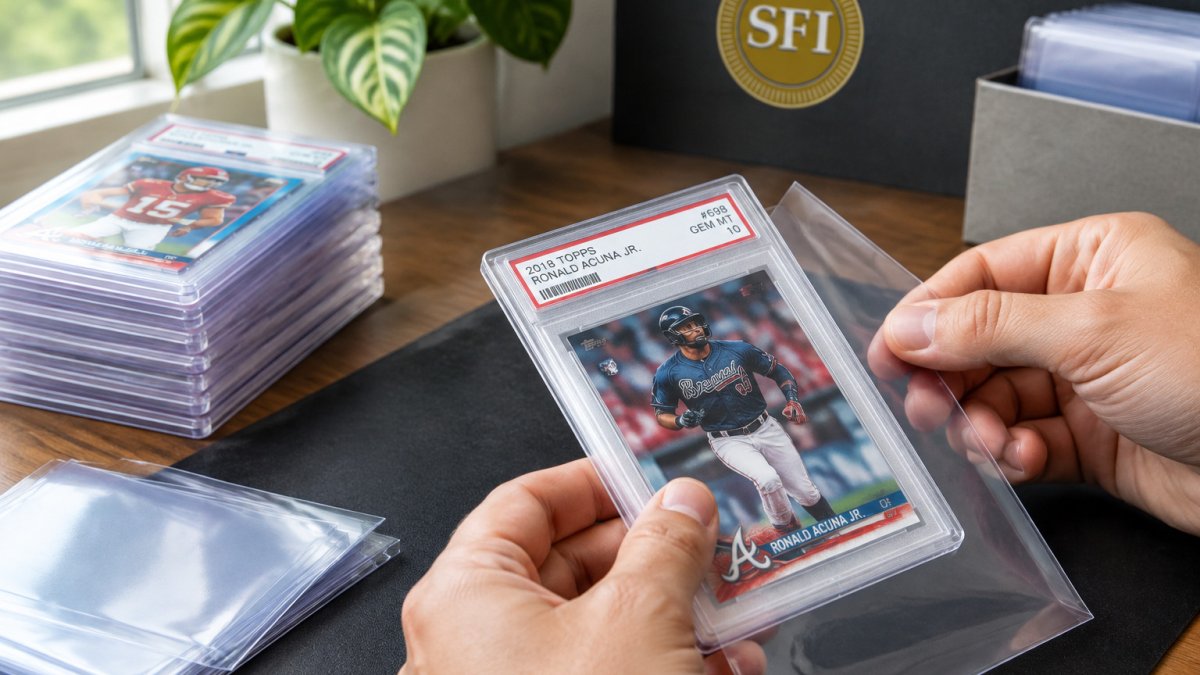
The best scratch removal is the scratch that never happens. Graded card protectors do the quiet work here: a snug slab sleeve keeps dust off the surface and stops cases from rubbing against each other in a box.
A few habits go a long way:
- Store slabs upright in a case, not stacked loose in a drawer.
- Keep a sleeve on every slab, even the ones on display.
- Handle slabs by the edges, never the faces.
Our breakdown of how to prevent graded slab scratches covers the storage side in more depth, and the steps to prevent yellowing on graded card cases are worth a read if your slabs sit near a window.
Choosing the Right Sleeve for Your Slab Collection
Fit is the whole game with slab sleeves. A loose sleeve lets dust in and looks sloppy on the shelf.
We build our graded card slab sleeves with a tapered, resealable flap, a design we originated in 2014 and still cut for PSA, BGS, CGC, and SGC holders. For collectors who want the full comparison, our crystal clear sleeve buyer's guide lays out the options side by side.
Best for: collectors who want a snug, clear sleeve that protects the slab surface between cleanings. Skip if: you store slabs loose in a drawer and never display them.
A cloudy, scuffed slab makes a great card look ordinary, and cleaning alone will not fix a holder that keeps collecting marks.
Frequently Asked Questions
Can you clean graded card slabs at home without damaging the card inside?
Yes, as long as moisture and chemicals stay off the sealed case. Work on the outside only, use a barely damp microfiber cloth rather than a wet one, and never spray liquid directly onto the slab. Keep the label and the sealed edges dry, since water seeping into the seam is the main way a home cleaning session puts the card at risk. If you are unsure about a product, test it on an empty or low-value case first.
What should you use to clean graded card slabs?
A soft microfiber cloth, a second dry cloth for buffing, and a gentle plastic-safe cleaner or plain water are enough for routine work. A soft brush helps lift dust from the edges and cracks before you wipe. Avoid paper towels, abrasive pads, and household cleaners with solvents or ammonia, which can cloud the plastic surface and leave residue in the seams.
How do you remove scratches from a PSA slab?
Light surface marks sometimes lift with a plastic polish applied in circular motions and buffed with a clean microfiber cloth. Deep or vertical scratches that you can feel with a fingernail usually cannot be removed safely at home, and aggressive polishing risks cloudiness or a thinner case. When a scratch is deep, leave it alone rather than trade a visible mark for a damaged slab.
Do graded card protectors really prevent scratches and cloudiness?
A snug archival sleeve takes the wear that would otherwise land on the slab itself. Scuffs from stacking, shelf edges, and repeated handling hit the sleeve first, and an acid-free, ultra-clear material keeps the case looking clean without fogging over time. Pairing sleeves with careful storage and a regular dusting routine is the simplest way to keep a scratched case from becoming a recurring problem.