 ultimate-guide
Archival Card Storage for Graded Slabs: 2026 Guide
Table of Contents
- Why Archival Card Storage for Graded Slabs Matters
- Graded Card Protectors: Materials That Prevent Damage
- Best Storage Boxes for Graded Cards: Capacity and Fit
- Preventing Slab Scratches During Handling and Transport
- Display vs. Long-Term Storage: Choosing the Right Setup
- Maintenance and Inventory Management for Your Collection
- Conclusion
- Frequently Asked Questions
Last Updated: September 13, 2026
Why Archival Card Storage for Graded Slabs Matters
A graded slab is only as safe as the environment you keep it in. Archival card storage for graded slabs is the practice of housing encapsulated cards in acid-free, PVC-free materials that block UV light, moisture, and physical impact over decades, not months.
That mismatch is the whole problem.
Grading protects the card inside the case. It does nothing for the case itself. PSA, BGS, and CGC slabs scratch, fog, and yellow when they sit against the wrong plastic. According to the Library of Congress preservation guidance on storage enclosures, unstable plastics off-gas and degrade adjacent materials over time. Slab plastic is no exception.
Below, we'll break down the materials, box dimensions, display setups, and maintenance habits that keep a collection intact for the long haul.
Graded Card Protectors: Materials That Prevent Damage
The right graded card protectors use inert plastics that won't react with the slab surface. Two material properties decide whether a protector helps or hurts: chemical stability and barrier performance.
Acid-Free and PVC-Free Plastics
Acid-free means the material has no free acidity that can migrate into whatever it touches. PVC-free means it contains no polyvinyl chloride, which releases hydrochloric acid as it breaks down (loc.gov). Polypropylene and polyester (Mylar) are the collector-grade standards.
Cheap sleeves fail here. A common mistake is buying soft vinyl sleeves because they feel thick and protective. Vinyl is exactly the material you want to avoid.
UV and Moisture Barriers
UV protection blocks the light wavelengths that fade inks and dull surfaces (nps.gov). Moisture barriers keep ambient humidity from reaching the slab, which matters because humidity swings cause condensation inside a case.
Slab sleeves and storage boxes work as a system. The sleeve handles surface contact and light; the box handles bulk moisture and impact. Neither one alone is enough for long-term preservation. For the sleeve half of that system, purpose-made Graded Card Slab Sleeves are cut to fit encapsulated cards rather than being adapted from other formats.
Best Storage Boxes for Graded Cards: Capacity and Fit
The best storage boxes for graded cards match interior dimensions to slab thickness, not just slab width. This is where most buying guides fall apart: they quote a single "standard slab size" and move on. In practice, slab dimensions vary enough between grading companies that a box built for one type can leave another rattling, tilting, or refusing to fit at all.
How Slab Dimensions Actually Vary. Check out SFI’s dedicated sleeves for each brand.
The three major grading services produce cases in roughly these ranges:
- PSA-style slabs: approximately 3.25 by 5.25 inches, with a relatively slim profile. These are the closest thing to a de facto standard and fit most slotted boxes.
- BGS-style slabs: similar footprint but noticeably thicker, because of the inner sleeve and the outer case construction. Boxes sized tightly for PSA slabs may not close over a BGS case.
- CGC-style slabs: comparable width and height but with its own edge geometry and thickness. Slot depth that works for one brand can pinch another.
SGC-style slabs: altogether a much larger Slab than the others.
On top of brand variation, the card inside changes the slab. A thick memorabilia card, a patch card, or a card in a one-touch magnetic holder before grading can push the finished slab past the "standard" thickness. That is why the single most useful measurement you can take is the depth of your thickest slab, not the average.
Matching Box Type to Slab Type
Box Type | Typical Capacity | Best For | Key Feature |
|---|---|---|---|
Slotted card box | 25-50 slabs | Active collections | Rail system keeps slabs upright |
Deep storage box | 100+ slabs | Long-term vault storage | Stackable, moisture barrier |
Display album | 12-24 slabs | Showcase pieces | Clear flip-top pages |
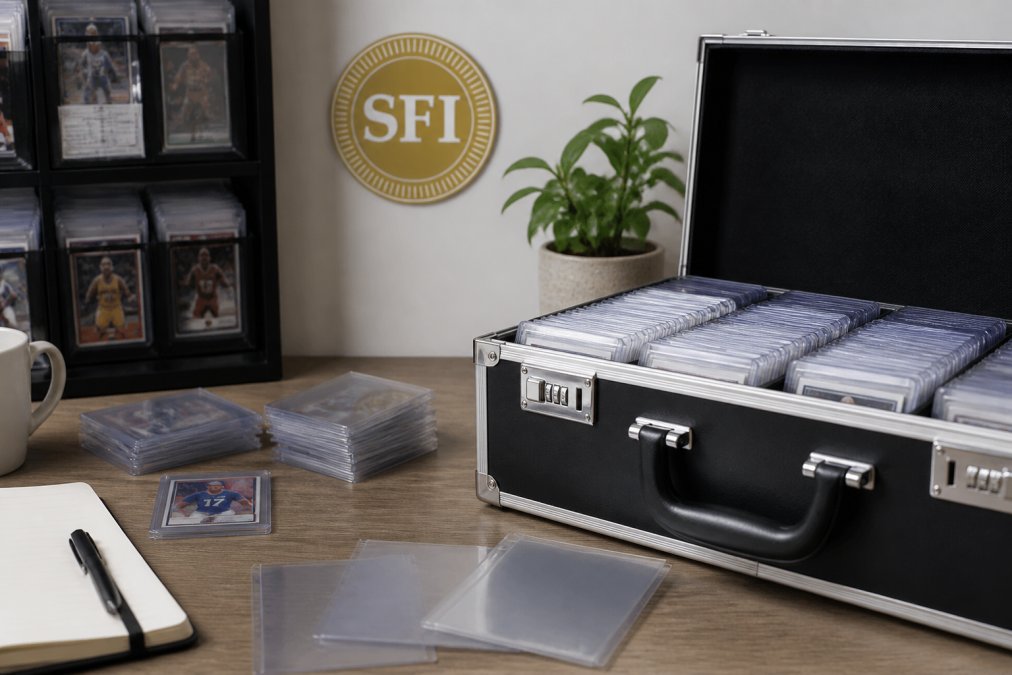
Travel case | 6-20 slabs | Transport and shows | Impact resistance, foam padding |
Capacity numbers depend on slab dimensions, so measure your thickest case before buying. A box that fits 50 thin slabs may hold 30 thick ones. When in doubt, size up: a slightly loose slot is far safer than a tight one, because a tight slot forces you to push the slab in and out, and that friction is what scratches faces and chips corners.
What to Look For in Any Box
- A slotted interior or rail system that holds each slab upright and separated
- Acid-free, PVC-free construction throughout, including any foam or padding
- A stackable design with a tight-fitting lid
- Enough depth for your thickest slab, plus a sleeve
Preventing Slab Scratches During Handling and Transport
Preventing slab scratches comes down to two rules: never let two slabs touch bare plastic, and never let a slab slide against a hard surface. Scratches on the slab face are the most common cosmetic complaint collectors raise, and they're almost entirely avoidable.
In practice, this means:
- Sleeve every slab before it goes in a box
- Use a case with individual slots instead of loose stacking
- Handle slabs by the edges, never the face
- Keep a dedicated soft cloth for wiping fingerprints
For transport, a hard case with foam or a fitted interior absorbs impact far better than a padded envelope. If you're shipping, sleeve the slab, then box it, then pad the box inside a second container.
Display vs. Long-Term Storage: Choosing the Right Setup
Display and long-term storage solve different problems, and mixing them up is where collections get damaged. Display setups prioritize visibility and UV shielding. Long-term storage prioritizes moisture control, impact resistance, and stackability. The mistake is assuming a display case is also a storage solution, or that a storage box is safe to leave in a sunlit room. Proper environmental management remains the foundational discipline for any hobbyist starting a collection, whether those assets are encased in acrylic slabs or preserved within archival comic book sleeves.
Why the Two Environments Are Not Interchangeable
A display stand holds a slab at an angle, exposed to room light, dust, and the daily swing of indoor temperature and humidity. A storage box holds slabs flat or upright, sealed from light and buffered from ambient changes. Those are opposite conditions, and each one has a failure mode the other does not.
- Display failure modes: UV fading of the slab label and any visible card surface, dust settling into the case seams, micro-scratches at the contact points where the stand touches the slab, and gradual yellowing of the slab plastic itself under light exposure.
- Storage failure modes: moisture trapped inside a sealed box, off-gassing from non-archival padding or dividers, warping of the box under stack weight, and the simple fact that you stop looking at what you cannot see.
A practical split: keep your top 10-20 pieces on display stands behind UV-filtering protection, and vault everything else in slotted boxes. Rotate pieces in and out rather than leaving everything exposed. Rotation also forces you to handle each slab periodically, which is when you notice haze, scratches, or label lifting before they get worse.
Concrete Display Setup Rules
If a display stand holds a slab at an angle, check that the contact points are felt or silicone-backed. Bare acrylic stands can micro-scratch the slab edge every time you set a card down. Beyond that:
- Keep display pieces out of direct sunlight and away from windows, even with UV-filtering protection. UV filtering reduces damage; it does not eliminate it.
- Use a stand with a wide base or a weighted foot. A slab is top-heavy, and a narrow stand tips.
- Dust display pieces with a microfiber cloth rather than a paper towel or tissue, which can leave fibers and micro-abrasions.
- If a piece is worth more than you would comfortably replace, it belongs in storage, not on a shelf.
Concrete Storage Setup Rules
- Store boxes off the floor and away from exterior walls, where humidity swings are largest.
- Keep boxes out of attics, garages, and basements unless those spaces are climate-controlled. Temperature and humidity extremes do more damage than light over a decade.
- Do not stack boxes so high that the bottom box deforms under the weight. Check the bottom box once a year for warping.
- Label every box on the outside with its contents and date. A box you have to open to identify is a box you will not check.
The collectors who avoid damage are not the ones with the most expensive supplies. They are the ones who understand that display and storage are different jobs, and who give each piece the environment it actually needs.
Maintenance and Inventory Management for Your Collection
Maintenance is the step almost every guide skips. Slabs don't need much, but they need something. A light dusting with a microfiber cloth every few months keeps surfaces clean without abrasion. Check stored boxes once or twice a year for any sign of moisture, warping, or off-gassing haze.
Inventory management matters just as much once a collection grows past a few dozen slabs. Track each card's grading company, certification number, slab thickness, and storage location. A simple spreadsheet works; so does dedicated collection software. The point is knowing what you own and where it lives.
Conclusion
Building a collection that survives decades takes the right materials, the right boxes, and a maintenance habit you actually keep. Superior Fit Sleeves has engineered precision-cut, archival-grade, acid-free sleeves for graded slabs since 2014, with ultra-clear, distortion-free options for PSA, BGS, SGC and other brands’ cases, plus sleeves for Top-Loaders and Magnetic One-Touch Cases.
Get started with Superior Fit Sleeves and give every slab in your collection a snug, professional, archival-safe home.
Frequently Asked Questions
What is the best way to store graded trading cards?
Store graded slabs upright in acid-free, PVC-free boxes with slotted interiors to prevent movement. Keep them in a cool, dry place away from direct sunlight and humidity. Use archival card storage for graded slabs, such as sleeves and boxes, to block dust, moisture, and UV light. Avoid stacking heavy items on top and handle slabs by the edges to prevent scratches.
Do graded card slabs need to be in sleeves?
Yes, graded card protectors add a layer of defense against scratches, dust, and moisture that can degrade the slab's clarity. Sleeves also prevent label fading and protect corners from chipping during transport. For long-term preservation, choose sleeves made from acid-free, PVC-free materials that fit snugly without being too tight.
Are plastic storage boxes archival safe for graded cards?
Not all plastic boxes are archival safe. Look for boxes made from acid-free, PVC-free materials like polypropylene or polyethylene. Avoid boxes with PVC, which can off-gas and damage slabs over time. Also ensure the box has a slotted interior or rail system to keep slabs upright and separated, reducing the risk of scratches and warping.
How do you prevent scratches on PSA and BGS slabs?
Preventing slab scratches starts with handling: hold slabs by the edges, never slide them across rough surfaces, and store them in individual sleeves. Use a storage box with a soft, slotted interior to keep slabs from rubbing against each other. For transport, place slabs in a padded case or use a clear flip-top sleeve for extra protection.