 comparison
CGC vs PSA Slab Sleeve Sizing: Fit Guide 2026
Table of Contents
- CGC vs PSA Slab Sleeve Sizing: What Actually Differs
- CGC and PSA Slab Dimensions Side by Side
- How to Measure a Graded Card Slab Before You Buy Sleeves
- Your Slab Sleeve Size Guide: Reading Tolerances and Clearance
- PSA Slab Sleeves: Fit, Tolerance, and What to Check
- CGC Slab Sleeves: Fit, Tolerance, and What to Check
- Storage, Stacking, and Shipping: Where Sleeve Sizing Matters
- Conclusion
- Frequently Asked Questions
Last Updated: October 20, 2026
CGC vs PSA Slab Sleeve Sizing: What Actually Differs
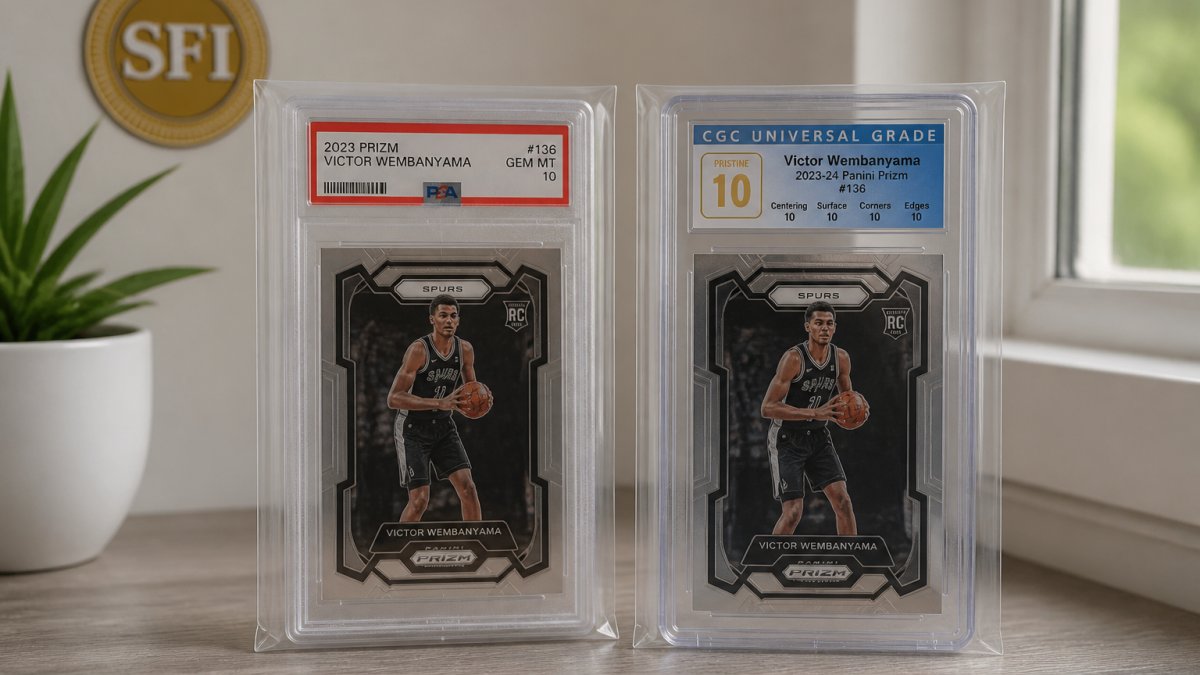
Graded card slabs from CGC and PSA are close enough in size that one sleeve design can serve both, but the fit is not identical. That small gap is what slab sleeve sizing comes down to, and it decides whether your holder slides in snug or rattles around.
Below, we break down the measured dimensions, how to check your own slabs with calipers, and where a snug fit versus a loose fit actually matters for storage, stacking, and shipping.
CGC and PSA Slab Dimensions Side by Side
Both companies build to a standard outer profile, and the numbers land within a few millimeters of each other. PSA's holder is the wider of the two by a small margin, while height and thickness track closely. Treat these as baseline figures and verify against your own holders, because manufacturing variation exists between production runs.
Dimension | PSA Holder | CGC Holder | Practical Effect |
|---|---|---|---|
Width | Roughly 3.25 in (about 82.5 mm) | Roughly 3.15 in (about 80 mm) | Width drives sleeve tightness; PSA runs a touch wider |
Height | Roughly 5.31 in (about 135 mm) | Roughly 5.31 in (about 135 mm) | Nearly identical; one sleeve height serves both |
Thickness | Roughly 0.25 in (about 6.4 mm) | Roughly 0.25 in (about 6.4 mm) | Same sleeve depth works for both |
Profile | Flat, squared corners | Flat, squared corners | Same insertion method |
Those figures are the commonly cited outer profiles, not a guarantee. The honest take: anyone telling you these holders are interchangeable is half right. A sleeve cut for PSA will accept a CGC slab, but a sleeve cut tight to CGC will fight a PSA holder on the way in.
Width, Height, and Thickness Compared
Width is where the two diverge. PSA holders run a touch wider, and that extra material is what a sleeve has to accommodate. Height is effectively a wash, and thickness matches closely enough that a single sleeve depth handles both. If you are sizing a collection with mixed holders, spec your sleeves to the PSA width and accept a little clearance on CGC.
Why the Numbers Drift Between Generations
The bigger variable is not the grading company, it is the production run. Both PSA and CGC have revised their holder tooling over the years, and older slabs can measure a fraction of a millimeter differently from newer ones. Special-label formats, autograph holders, and thicker card stock can also push the outer profile out slightly. That is why a sleeve that felt perfect on a slab from several years ago may feel different on a fresh submission. The practical rule: measure the widest slab in your collection, not the average, and size to that number.
How to Measure a Graded Card Slab Before You Buy Sleeves
Measure the outer holder, not the card inside it. You want the full outside width, height, and thickness of the plastic shell, taken at the widest point. A digital caliper gives you the cleanest reading; a ruler works if you are careful about parallax.
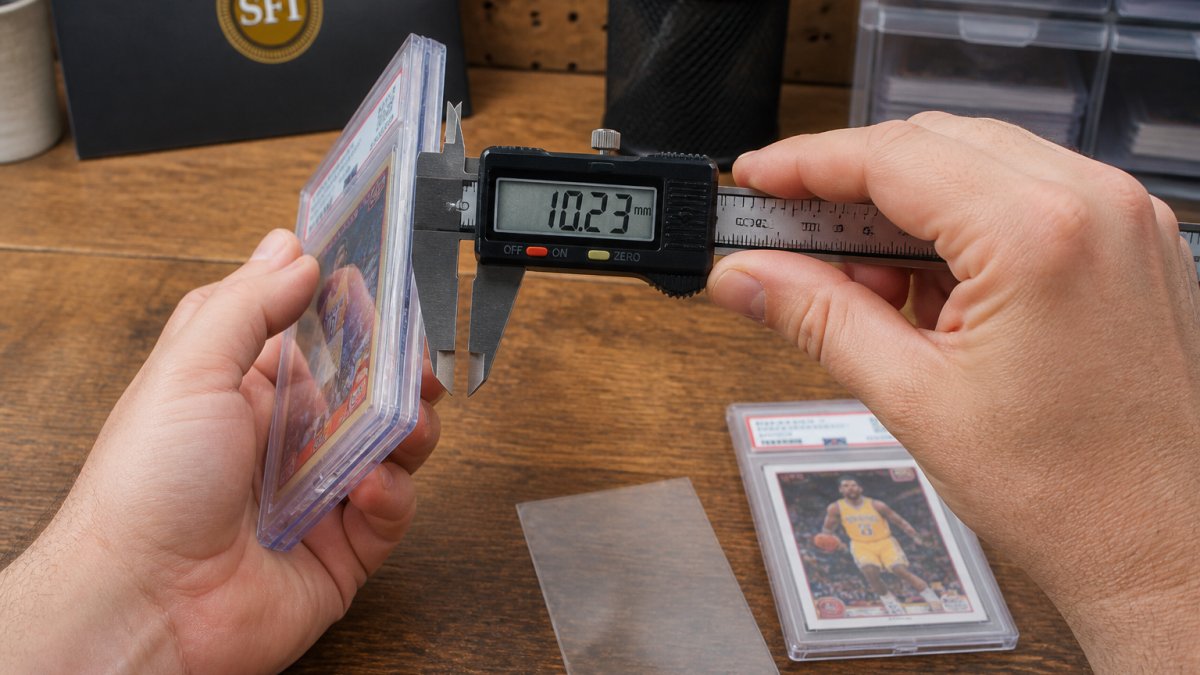
Here is the process we recommend:
- Set the caliper jaws across the full width of the holder and note the reading.
- Repeat at the top and bottom edges to catch any taper.
- Measure height from the top edge to the bottom edge.
- Measure thickness at the center and near one corner.
- Write the numbers down and compare them to the sleeve's stated internal dimensions.
Your Slab Sleeve Size Guide: Reading Tolerances and Clearance
Slab sleeve sizing is the practice of matching a sleeve's internal dimensions to a holder's outer dimensions with a controlled amount of clearance. Too little clearance and the sleeve fights you on insertion. Too much and the holder shifts, which is where scuffs and corner wear start. Most guides stop at that definition. The useful part is the numbers and a repeatable test, so here is both.
How Much Clearance Is Right
A sleeve's internal width needs to clear the holder's outer width by a small margin, enough to slide on without stretching, not so much that the slab slides around inside. In practice, a clearance of roughly 1/16 in (about 1.5 mm) per side is the sweet spot for a snug fit on a single holder type. Go tighter and you are forcing plastic; go looser and you are inviting movement. For a mixed PSA and CGC collection, size the sleeve to the wider PSA profile, which leaves a slightly larger gap on the narrower CGC holder, acceptable, because the flap and the sleeve's own tension keep the slab from sliding.
A Practical Sleeve-Selection Chart
Use this chart to map your holder and use case to a target fit. Internal sleeve dimensions are the number that matters; compare them to your measured slab, not to the card.
Holder / Use Case | Target Internal Width | Target Internal Height | Fit Rating | Caveat |
|---|---|---|---|---|
PSA, display or long-term storage | About 3.31 in (84 mm) | About 5.38 in (136.5 mm) | Snug | Verify against your widest PSA slab |
CGC, CGC-only collection | About 3.21 in (81.5 mm) | About 5.38 in (136.5 mm) | Snug | Will not comfortably accept PSA |
Mixed PSA and CGC | About 3.31 in (84 mm) | About 5.38 in (136.5 mm) | Standard | Slight movement on CGC |
Bulk or temporary storage | About 3.38 in (86 mm) or more | About 5.44 in (138 mm) or more | Loose | Dust and shift risk |
Treat the internal dimensions as targets, not specs, manufacturing variation in both slabs and sleeves means your measured numbers win. The fit rating is a starting point; the test below confirms it.
A Repeatable Fit Test
Before you commit a whole collection to one sleeve size, run this test on three slabs from each grading company:
- Slide the slab in with light, even pressure. It should go in without bowing the sleeve or requiring a shove.
- Turn the sleeved slab face-down and give it a gentle shake. A snug fit holds position; a loose fit lets the slab slide.
- Press the flap closed and check that the sleeve sits flat against the face with no bunching at the corners.
- Remove the slab and inspect the sleeve for creases or stretch marks. Any creasing means the fit is too tight.
- Repeat on your widest slab. If it passes there, the narrower holders will pass too.
A snug fit is the goal for anything you plan to display or hold long term. Standard fit is the practical choice when your collection mixes holders. Loose fit is a compromise you should only accept when you are moving cards in and out often.
PSA Slab Sleeves: Fit, Tolerance, and What to Check
PSA slab sleeves are cut to clear the wider holder, which makes them the safer universal choice for a mixed collection. The tolerance that matters is width: a PSA sleeve should slide on with light resistance and sit flat against the face, with no bunching at the corners. Check that the flap closes cleanly and that the sleeve does not bow the holder when sealed.
What most guides miss is that PSA holders have shifted slightly across production generations. A sleeve that fit a holder from several years ago may feel different on a newer one. Measure before you reorder in bulk.
CGC Slab Sleeves: Fit, Tolerance, and What to Check
CGC slab sleeves can be cut tighter because the holder is narrower, and that is where you get a genuinely tailored fit. The trade-off is that a CGC-specific sleeve will not comfortably accept a PSA holder. If your collection is CGC-only, a tighter cut is worth it. If it is mixed, buy the PSA-size sleeve and let CGC slabs sit with a small amount of clearance.
Our graded card slab sleeves are cut for PSA, BGS, SGC, and CGC holders, with a tapered resealable flap that keeps excess material off the edges. That flap is the difference between a sleeve that looks custom and one that looks like a bag.
Storage, Stacking, and Shipping: Where Sleeve Sizing Matters
Sizing stops being academic the moment you stack, store, or mail slabs. Stacking sleeved holders puts the sleeve under compression, and a loose fit lets holders slide against each other, which is exactly how surface scratches happen. A snug sleeve holds position and spreads the load.
For binders and cases, check the internal pocket or slot dimensions against the sleeved holder, not the bare slab. A sleeve adds measurable thickness, and a case that fits a bare holder may not close on a sleeved one. For shipping, a snug sleeve plus a rigid outer mailer is the combination that keeps corners intact in transit.
Conclusion
The gap between CGC and PSA holders is small, but it is real, and it shows up the moment you try to slide a slab into a sleeve that was cut for the other. Measure your own holders, buy to the wider profile, and accept a little clearance on the narrower one.
Superior Fit Sleeves has been cutting precision sleeves for graded holders since 2014, with archival-grade, acid-free material and an ultra-clear finish that keeps your slabs looking sharp. Our graded card slab sleeves cover PSA, BGS, SGC, and CGC holders, and our tapered flap design keeps the fit clean with zero excess bulk. Start with a measurement, then get the sleeve that matches it.
Frequently Asked Questions
Is a CGC slab the same size as a PSA slab?
They are close but not identical. PSA and CGC holders share a similar overall profile, and many collectors find PSA-size sleeves fit CGC slabs, though the fit can range from snug to slightly loose depending on the holder generation. Always measure your specific slab's width, height, and thickness before buying, and check the sleeve's stated dimensions against those numbers rather than assuming the two are interchangeable.
Do CGC slabs need a different sleeve size than PSA slabs?
Often a PSA-size sleeve will work on a CGC slab, but the margin is tight enough that manufacturing variation matters. If your CGC holder measures wider than the sleeve's stated width, the sleeve will be too tight and hard to insert. Use the slab sleeve size guide: measure your slab, compare it to the sleeve's listed dimensions, and leave a small clearance so the sleeve slides on without stretching or scratching the case.
How do you measure a graded card slab for a sleeve?
Use digital calipers for accuracy. Measure the width at the widest point of the holder, the height from top to bottom, and the thickness at the thickest edge. Write the numbers down and compare them to the sleeve's published dimensions. A slab sleeve sizing match needs the sleeve to be slightly larger than the slab on width and height, with enough thickness clearance to slide on without force.
How much extra room should a slab sleeve have?
Enough to slide on and off without stretching, but not so much that the sleeve feels loose or bunches at the corners. A snug fit with a small clearance protects the surface from scratches and dust while keeping the presentation clean. If the sleeve requires force to insert the slab, it is too tight; if it slides around freely, it is too loose and offers less surface protection.
Are graded card sleeves compatible across different grading companies?
Compatibility varies. PSA and CGC holders are close in size, so sleeves often cross over, but BGS and other holders can differ more in thickness and profile. Before buying, confirm the sleeve's stated dimensions cover your holder's measured width, height, and thickness. For mixed collections, a size guide and a quick fit test on one slab from each grading company saves returns and protects every case.