 How-to
How to Choose the Right Size Sleeves for Cards
Last Updated: October 30, 2026
Quick Summary
The right size sleeves are the ones whose internal width and height clear your card by about 1 to 2 mm on each axis. Measure the card's width, height, and thickness at several points with a caliper, then compare those numbers to the sleeve's internal dimensions. Do not rely on the format name alone.
- Measure width and height at three points each, and record the largest value.
- Measure thickness at the center and edges, and use the largest reading.
- Aim for internal sleeve dimensions about 1 to 2 mm larger than the card per axis.
- Confirm the sleeve's thickness rating exceeds your card's thickest point.
- If the card is within 0.5 mm of the sleeve's maximum on any axis, size up.
Table of Contents
- Why Sleeve Size Matters for Card Protection
- How to Measure a Card Before You Buy Sleeves
- Card Sleeve Size Chart: Standard, Japanese, and Other Formats
- Standard Size Card Sleeves: When They Fit and When They Don't
- Japanese Size Card Sleeves and Small-Format Cards
- Matching Sleeves to Top Loaders and Storage Cases
- Choosing Your Sleeves: Your Next Step With a Fit Check
- Frequently Asked Questions
Why Sleeve Size Matters for Card Protection
Choosing the right sleeve size is the simplest way to keep a card safe, and getting right size sleeves for your collection matters more than any other single choice.
The right fit is the foundation of good protection.
Most collectors think about sleeves only after they buy cards. Measuring first saves money and frustration. The sections below walk you through how to measure, what the common sizes are, and how to match a sleeve to the holder you plan to use.
How to Measure a Card Before You Buy Sleeves
Most sleeve mistakes are measurement mistakes. A card listed as 63 x 88 mm can vary by a millimeter or more between print runs, and a sleeve listed as "standard" can vary just as much. The goal of measuring is not to confirm a label, it is to find the card's real dimensions and then pick a sleeve whose internal dimensions clear those numbers with a small, controlled margin.
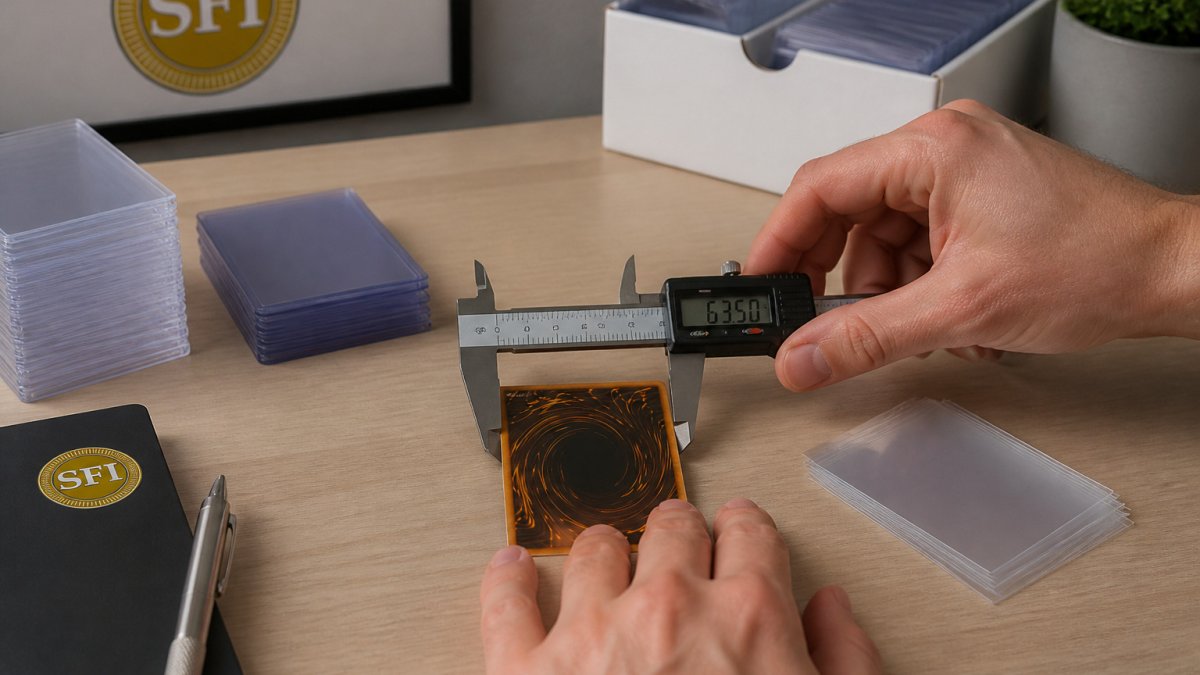
What you need
- A digital caliper that reads to 0.1 mm (a ruler marked in millimeters works for width and height, but not for thickness)
- A clean, flat, hard surface
- A pencil and paper, or a notes app, to record each number
The measurement procedure
- Lay the card flat. Do not press down on it. Bowed or curled cards read wider or narrower than they actually are.
- Measure width at three points, near the top edge, at the middle, and near the bottom edge. Record the largest of the three. Width is measured side to side, parallel to the top and bottom edges.
- Measure height at three points, near the left edge, at the middle, and near the right edge. Record the largest. Height is measured top to bottom.
- Measure thickness at the center and at each edge. Use the caliper jaws gently; do not squeeze. Record the largest reading. A card that measures 0.30 mm at the center and 0.32 mm at the edge should be treated as 0.32 mm.
- Repeat the whole set once. If any number moves by more than 0.2 mm between passes, measure again, the card may be warped, or the caliper may be resting on a burr.
Write the numbers down as width x height x thickness, largest value in each slot. That triple is what you compare against a sleeve's internal dimensions.
Handling rounded corners and unusual shapes
Rounded corners are the most common source of bad measurements. The corner radius does not change the card's true width or height, but it does change where the card contacts the sleeve. Measure the longest straight run across the card in each direction, not the diagonal between opposite corners.
For die-cut, oversized, or shaped cards:
- Measure the bounding box, the smallest rectangle that fully contains the card.
- Note any protrusion (a tab, a pointed corner, a die-cut window) separately, with its own width and height.
- If the card has a bulge in the middle from a relic or memorabilia insert, measure thickness at the bulge, not at the flat edge.
Why internal dimensions matter more than the label
Sleeve packaging usually lists the card format ("standard," "Japanese," "small") and sometimes an external size. External size tells you how big the sleeve is on the outside; it says nothing about the pocket the card actually sits in. Two sleeves labeled "standard" can have internal widths that differ by 1-2 mm, which is the difference between a snug fit and a card that slides.
When you compare, use this rule of thumb:
- Width and height: look for internal dimensions roughly 1-2 mm larger than the card on each axis. Less than 1 mm and the card catches at the corners; more than 2-3 mm and it rattles.
- Thickness: the sleeve's stated thickness capacity should exceed the card's measured thickness by a small margin. A 0.32 mm card fits comfortably in a sleeve rated for cards up to about 0.4 mm.
A quick sanity check before you buy
Once you have your width x height x thickness triple, do three things:
- Compare it to the sleeve's internal dimensions, not the format name.
- Confirm the sleeve's thickness rating covers your card's thickest point.
- If the card is within 0.5 mm of the sleeve's stated maximum on any axis, size up rather than gamble.
That triple, not the game name, not the format label, is the number that decides whether a sleeve fits.
Card Sleeve Size Chart: Standard, Japanese, and Other Formats
Use the chart below as a starting reference to find the right size sleeves, then confirm against the sleeve's internal dimensions before you buy. Card sizes vary by manufacturer and print run, and sleeve sizes vary by brand, so treat every number here as a typical value, not a guarantee.
Trading card and collectible formats
| Format | Typical card size (W x H) | Typical sleeve internal size (W x H) | Common use |
|---|---|---|---|
| Standard trading card | 63 x 88 mm | about 64-66 x 89-91 mm | Most sports cards, Magic: The Gathering, Pokémon, Flesh and Blood, Lorcana |
| Japanese / small TCG | 59 x 86 mm | about 60-62 x 87-89 mm | Yu-Gi-Oh!, Cardfight!! Vanguard, many Japanese-printed TCGs |
| Mini / small format | about 43 x 65 mm | about 44-46 x 66-68 mm | Some board game cards, mini promos |
| Oversized promo | varies (often 3.5 x 5 in or larger) | sized to the specific card | Oversized promos, box toppers, display cards |
Board game and nonstandard formats
Board games are where the format-name approach breaks down most often. A single game can ship with three different card sizes in the same box. Measure each distinct card type separately.
| Format | Typical card size (W x H) | Notes |
|---|---|---|
| Mini American | about 41 x 63 mm | Common in strategy and family games |
| Mini European | about 44 x 68 mm | Slightly taller than Mini American |
| Standard American | about 56 x 87 mm | Common in card-driven board games |
| Standard European | about 59 x 92 mm | Taller than standard American |
| Square | varies (often 65 x 65 mm or 70 x 70 mm) | Tile and token games |
| Tarot | about 70 x 120 mm | Some deluxe and legacy games |
Thick, relic, and memorabilia cards
Thickness is its own axis. A card that matches a standard 63 x 88 mm footprint can still be too thick for a standard sleeve.
| Card type | Typical thickness | Sleeve consideration |
|---|---|---|
| Base paper card | about 0.20-0.30 mm | Standard sleeve |
| Foil or premium stock | about 0.30-0.40 mm | Standard sleeve, check thickness rating |
| Relic / memorabilia | about 0.50-1.00 mm | Thicker sleeve or top-loader-specific sleeve |
| Patch / booklet | 1.00 mm and up | Rigid holder, not a soft sleeve |
How to read the chart
- Match on width and height first. Find the row whose card size is closest to your measured triple.
- Then check thickness. If your card is thicker than the row's typical stock, move to a thicker sleeve even if width and height match.
- Then check internal dimensions. The sleeve's internal width and height should clear your card by roughly 1-2 mm per axis.
When no row fits
If your card does not match any row, a die-cut promo, a shaped token, an unusually tall import, measure the bounding box and look for a sleeve whose internal dimensions clear it on every axis. If nothing standard fits, a slightly oversized sleeve plus an inner sleeve is usually a better outcome than forcing the card into a snug pocket that catches at the corners.
Standard Size Card Sleeves: When They Fit and When They Don't
Standard card sleeves fit most modern sports and trading cards. If your card measures close to 63 x 88 mm, a standard sleeve is usually the right choice.
They work less well in a few situations.
Here is a quick check:
- The card slides in with light resistance
- The card does not rattle when you tilt the sleeve
- The sleeve closes without bulging
If the card rattles, try a snugger sleeve. If it will not slide in, check whether the card is thicker than the sleeve allows.
Japanese Size Card Sleeves and Small-Format Cards
Japanese size cards are a little smaller than standard cards.
Sleeves made for this narrower format can hold the card more snugly and reduce movement.
Small-format cards, such as some board game and promotional cards, need the same care.
Watch out: buying a sleeve based only on the game name can lead to the wrong size. Always confirm the card's measurements.
Matching Sleeves to Top Loaders and Storage Cases
Top loaders are rigid holders, and their internal size varies by thickness. A sleeve should fit inside the top loader without forcing the card in or leaving it loose.
Match the sleeve to the holder's inside dimensions. For ticket-size holders, shop ticket size top loader sleeves sized to their internal width and height. For thick cards in a 130-180 PT holder, choose a sleeve sized for that thickness range so the card stays protected without being squeezed. If you are storing graded cards, Graded Card Slab Sleeves are a product line worth checking against your holder's internal size.
Best for: collectors storing standard and thicker cards in rigid holders. Skip if: you only keep cards in binders, where a standard sleeve is usually enough.
Choosing Your Sleeves: Your Next Step With a Fit Check
Measure one card, compare it with the chart above, and confirm the sleeve's internal size matches. Our guide to storage boxes for graded cards covers which boxes suit sleeved cards.
Read the product details before you order. Pay attention to internal dimensions and thickness, not just the card format name.
Frequently Asked Questions
Do I need a different sleeve for every card game? Not always.
Can a standard sleeve work for Japanese cards? It can, but it will leave extra room.
What happens if the sleeve is too tight? A tight sleeve can make the card hard to slide in and out.
Frequently Asked Questions
What size sleeves are Magic cards?
Magic: The Gathering cards are standard-size cards, measuring about 2.5 by 3.5 inches (63 by 88 mm). Standard-size card sleeves are designed for this format, so they are the right starting point for Magic cards. Check the internal dimensions listed on the sleeve packaging against your card measurement, and allow a little room so the card slides in without forcing it. If a sleeve feels tight enough to bend the card edges, try a slightly larger size.
How tight should a card sleeve fit?
A good sleeve fit is snug enough that the card does not shift or slide around inside, but loose enough that you can slide it in and out without bending the corners. Snug fits reduce movement and wear on card edges during handling. Loose fits are easier to use but can allow the card to move. Test a sleeve with a card before sleeving a full stack, and avoid sleeves that require force to insert.
What is the difference between standard-size and Japanese-size sleeves?
Standard-size sleeves fit cards measuring about 2.5 by 3.5 inches (63 by 88 mm), which covers most trading card games. Japanese-size sleeves are made for smaller cards, typically around 59 by 86 mm, used in some Japanese card games. Using the wrong size can cause cards to slide, bend, or fail to fit. Measure your card first, then compare that measurement to the sleeve's internal dimensions rather than the external size.
How do I choose sleeves for cards in top loaders?
Top loaders are rigid holders with a set internal size, so the sleeve must fit inside that space without adding excessive bulk. Choose a sleeve that is designed for top loaders and that matches your card size. Check the sleeve's thickness, since a thick sleeve can make the card difficult to slide into the loader. Measure the loader's internal width and height if you are unsure, and confirm the sleeve fits comfortably before sleeving a full collection.