 blog
What's the Best Way to Organize Card Slabs?
Last Updated: November 14, 2026
Quick Summary
To organize card slabs, match storage to your collection size, keep slabs upright in slotted or padded boxes, and separate every slab with a snug sleeve so faces never touch. Pick one sorting rule, label dividers, and record each slab's location code.
- Collections of 50 slabs or fewer fit in one padded box kept away from sunlight.
- Stackable boxes with labeled dividers suit collections of 50 to 500 slabs.
- Store slabs upright in a cool, dark, dry place to remove weight from faces.
- Sort by set, era, value, or player, and write the rule inside the box lid.
- Review your inventory quarterly and after any large purchase.
Table of Contents
- Why Organizing Card Slabs Matters More Than You Think
- Choosing the Right Storage Based on Collection Size
- Storage Cases and Slab Boxes: What to Look For
- How to Protect Card Slabs From Scratches and Surface Damage
- The Best Storage for PSA Slabs: Upright, Cool, and Dark
- The Best Way to Display PSA Slabs Without Risking Damage
- Are Slab Binders a Good Option for Your Collection?
- Sorting and Labeling: Set, Value, Player, or Era
- Start With One Box and One Rule
- Frequently Asked Questions
Why Organizing Card Slabs Matters More Than You Think
The best ways to organize card slabs start with one idea: every time a graded card moves, it risks a scratch.
Organization is protection. When each slab has a fixed home, it stops sliding, stops touching its neighbors, and stops collecting surface wear.
Below, we break down storage by collection size, the cases worth buying, and a sorting system you can set up this weekend.
Choosing the Right Storage Based on Collection Size
Storage should match your collection today, with a little room to grow. A case built for ten times your current count wastes space and money; one that's too small leaves you stacking slabs on a shelf.
Use this as a starting point:
| Collection Size | Storage Approach | Key Priority |
|---|---|---|
| 50 slabs or fewer | One padded box or a small display case | Easy access and dust control |
| 50 to 500 slabs | Stackable boxes with labeled dividers | Sorting system and upright storage |
| 500+ slabs | Dedicated shelving plus archival boxes | Climate control and inventory records |
Small Collections: 50 Slabs or Fewer
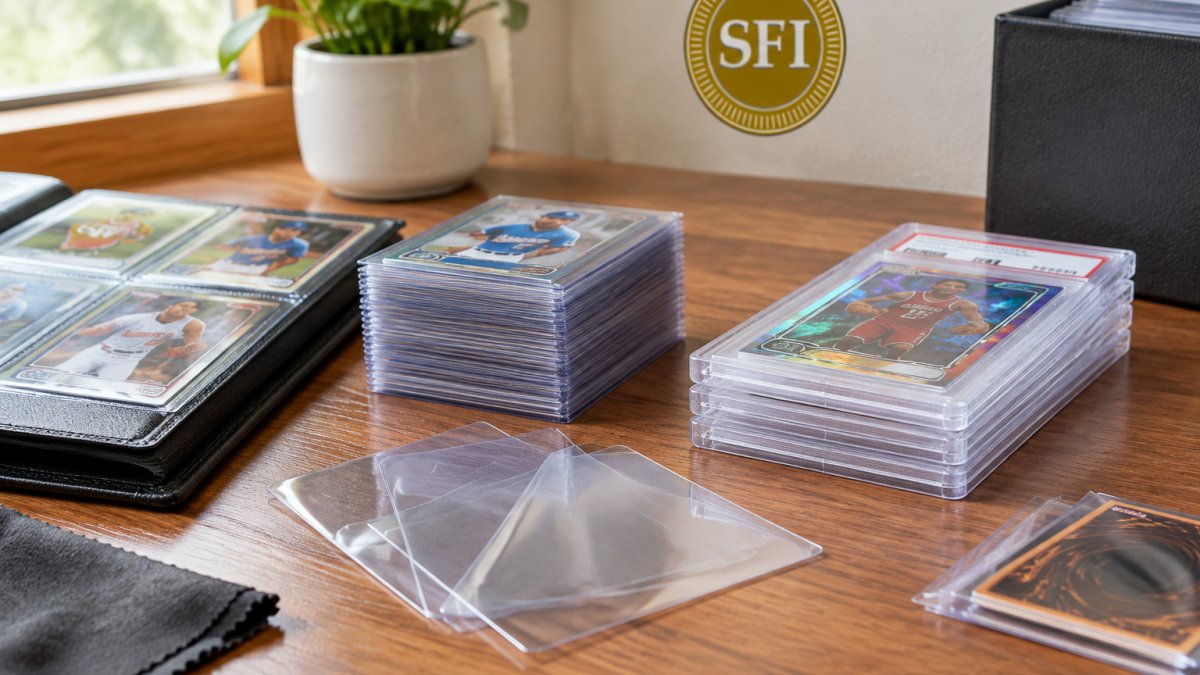
A single padded storage box handles most small collections. Look for foam or soft lining and a lid that closes firmly, and keep the box on a shelf away from sunlight rather than in a garage or attic.
This is also the stage where sleeves pay off immediately. Every slab gets its own cover, so daily handling stops touching the case itself.
Mid-Size Collections: 50 to 500 Slabs
Once you pass a few dozen slabs, sorting becomes the real job. Stackable boxes with labeled dividers let you separate sets, sports, or value tiers without digging. Keep boxes upright and avoid stacking heavy boxes on top of each other for long periods.
Large Collections: 500+ Slabs
Big collections need a system, not just containers. If you are sizing up boxes for a large graded collection, our guide to the best storage boxes for graded cards covers specific options that fit slabs properly.
Storage Cases and Slab Boxes: What to Look For
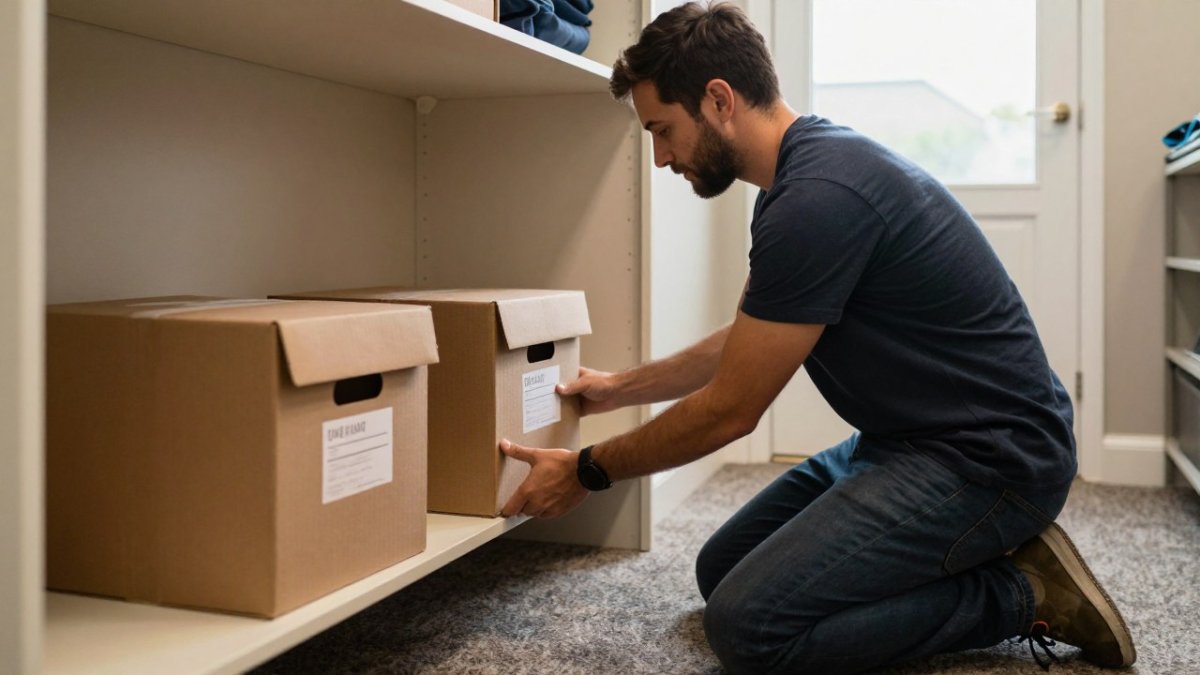
A good slab box holds slabs upright, cushions them, keeps dust out, and lets you find a card without emptying the whole box. Use the comparison below to pick the right format before you shop, then check the feature list against the specific product.
| Storage Format | Typical Capacity | Portability | Protection | Visibility | Relative Cost | Best For |
|---|---|---|---|---|---|---|
| Padded cardboard box | 25-100 slabs | High | Moderate | Low | Low | Small collections, closet storage |
| Rigid plastic case | 50-200 slabs | Moderate | High | Low to moderate | Moderate | Mid-size collections, stacking |
| Slotted wooden or acrylic box | 50-150 slabs | Low to moderate | High | Moderate | Moderate to high | Display-adjacent storage, upright fit |
| Slab binder | 20-40 slabs per binder | High | Low to moderate | High | Low to moderate | Browsing mid-tier cards |
| Safe or locking cabinet | 100+ slabs | None | Very high | Low | High | High-value cards, security |
| Display case or wall mount | 1-20 slabs | None | Low to moderate | Very high | Varies | Rotating showcase pieces |
Read the table by use case, not by price alone.
Features to Check Before You Buy
- Rigid walls that will not bow when the box is full
- Soft interior lining or foam inserts to absorb bumps
- A snug lid that stays closed if the box tips
Skip anything with sharp interior edges or a loose-fitting lid. A cheap box that lets slabs rattle around defeats the purpose.
Match the Box to Your Slab Dimensions
Slabs are not one size. PSA holders run roughly 3.25 by 4.25 inches, while thicker holders from other grading companies and oversized or thick-card slabs can run wider and deeper.
Watch out: forcing a slab into a slot that is too tight can crack the holder or scuff the face, and a slot that is too loose lets the slab slide and rub against its neighbors.
What to Skip
Avoid shoeboxes, soft-sided bags, and open trays for long-term storage. They offer no rigidity, no dust control, and no separation between slabs. Also skip any container with unfinished wood or strong chemical odors, since off-gassing can cloud or haze plastic over time.
How to Protect Card Slabs From Scratches and Surface Damage
Most slab damage comes from friction and contact, not drops. Two slabs rubbing together in a box create fine scratches over months. Dust and grit trapped between cases act like sandpaper.
The fix is simple: separate every slab from its neighbors and cover the surface. Here is the handling routine we recommend:
- Hold slabs by the edges, never by the face
- Set slabs down on a soft surface, not a hard table
- Never stack slabs directly on top of each other
- Wipe cases with a dry microfiber cloth, not paper towels
- Store slabs upright so weight does not press on the faces
Sleeves and Wraps for Everyday Protection
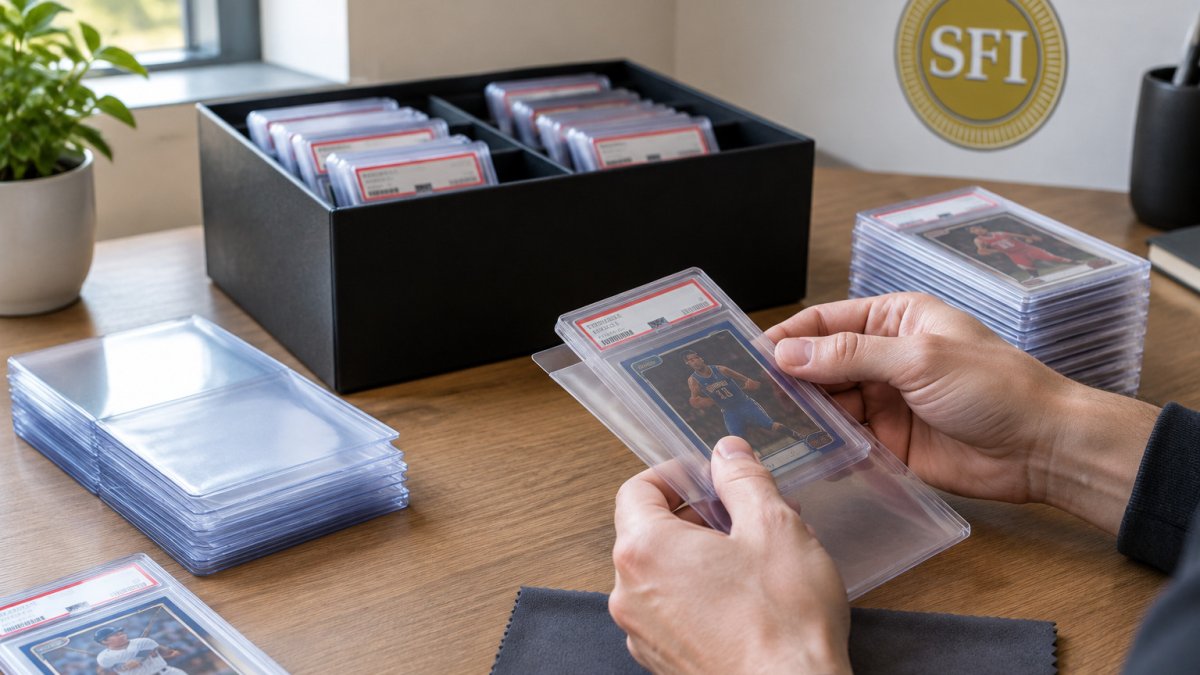
A snug sleeve is the first line of defense. It keeps dust off the case, absorbs light handling, and stops two slabs from touching.
Our Graded Card Slab Sleeves are precision-cut for a snug fit, with a tapered resealable flap and archival-grade, acid-free material. If you are weighing options, our guide to choosing resealable sleeves for card slabs walks through fit and material questions.
Padding and Dividers That Prevent Movement
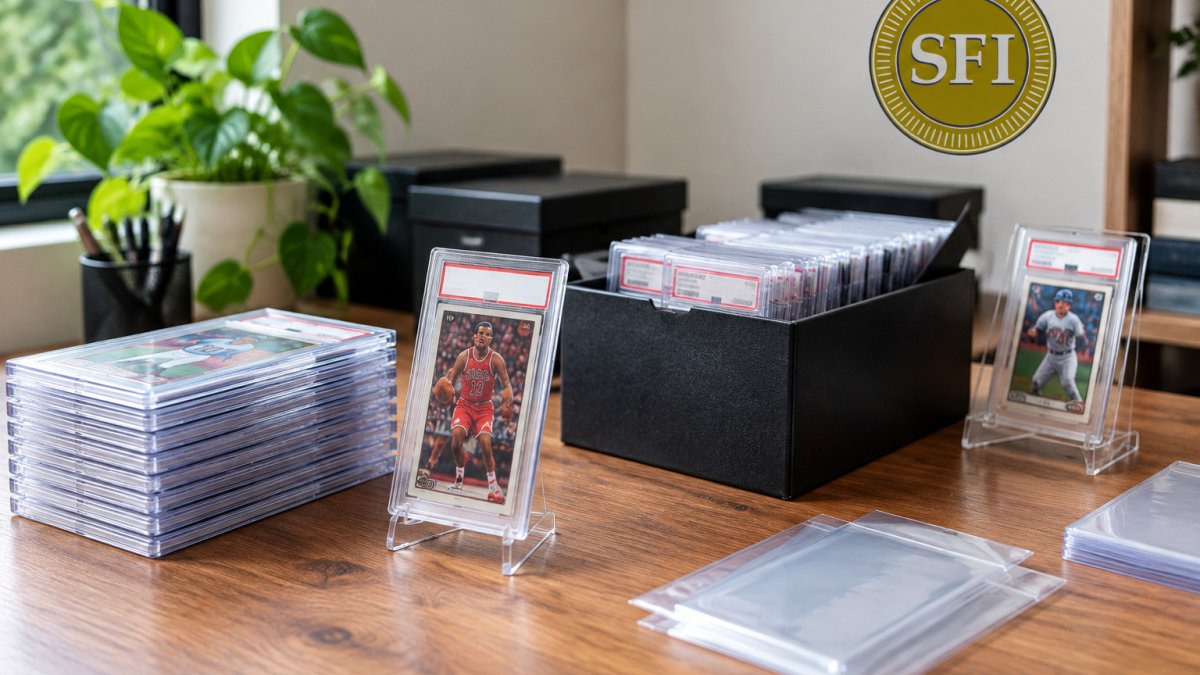
Dividers do more than label a section. They hold slabs upright and stop them from tipping into each other. Foam blocks work the same way in boxes without slots. Fill empty space at the back of a partially full box so slabs cannot slide forward when you carry it.
The Best Storage for PSA Slabs: Upright, Cool, and Dark
The best storage for PSA slabs is upright, in a cool, dark, dry place with stable conditions.
Upright storage matters because a stack of slabs puts weight on the bottom cases, and that pressure plus friction between faces adds up.
Keep humidity low and steady. For a full prevention routine, see our seven steps to prevent graded slab scratches.
The Best Way to Display PSA Slabs Without Risking Damage
The best way to display PSA slabs is to keep them out of direct sunlight and off unstable surfaces. Display and protection can coexist, but not if you treat a shelf as storage.
A few rules that save cases:
- Keep displays away from windows and heat vents
- Use stands or wall mounts that grip the slab by the edges
- Rotate displayed cards so no single slab sits in light for months
For a deeper look at stands, lighting, and wall setups, our guide to displaying graded card slabs covers safe display from start to finish.
Are Slab Binders a Good Option for Your Collection?
A slab binder works for mid-tier cards you want to flip through, not for high-value pieces. Pages hold slabs upright and protect faces, but the binder offers less cushioning than a rigid box.
Use binders as a browsing layer and keep your top cards in boxes. That split keeps your best slabs protected while the rest stay accessible.
Sorting and Labeling: Set, Value, Player, or Era
Pick one primary sorting method and stick to it. Mixed systems fail because you cannot remember which rule applies to which box. The four workable options:
- By set: best for set builders and player collectors
- By era: separates vintage from modern cards cleanly
- By value: puts high-value cards in one protected location
Sorting by Set and Era
Set and era sorting suits large collections with clear categories. Label each divider with the set name and year, then keep sub-categories in order. Vintage cards deserve their own section, stored in the coolest, darkest spot you have.
Sorting by Value and Importance
Value sorting protects your best cards first. Create three tiers: high-value, mid-tier, and bulk. High-value slabs go in the most protected box, ideally with sleeves and padding. Keep a simple written or digital record of what sits in each box. For broader organization ideas, our guide to graded card collection organization covers labeling and inventory in more detail.
A Repeatable Organization Workflow
Sorting once is easy; keeping the system intact is the hard part. Run this workflow in order and repeat it whenever you add a batch of slabs.
- Inventory first. Before you sort anything, list every slab: card, grade, grading company, certification number, purchase price, and current estimated value. A spreadsheet, notes app, or printed sheet all work, the point is a single source of truth you can update.
- Choose one primary rule. Decide whether set, era, value, or player drives the main split. Write the rule down and tape it inside the lid of your main box so future-you does not improvise.
- Assign a location code. Give every box, binder, and shelf a short code (for example, A1, A2, B1), and add the code to each inventory row so you can find a card without opening boxes.
- Label dividers consistently. Use the same format everywhere: set name, year, and a sub-category if needed. Avoid abbreviations you will not remember in six months.
- Set an update cadence. Review the inventory quarterly, after any large purchase, and before a show or trade. Update values and move cards between tiers as needed.
Labeling That Survives Handling
Put the label on the outside of the box and on the divider it describes, keeping the format identical across the collection. If you sort by value, label the tier (high, mid, bulk) and the location code together so a glance tells you both what and where.
Inventory Fields Worth Tracking
A minimal record covers card name, set, year, grade, grading company, certification number, purchase price, current estimated value, storage location code, and date last updated.
Watch out: a sorting system with no written rule and no location codes tends to collapse within a few months, and cards end up back in loose stacks.
Start With One Box and One Rule
The hardest part of organizing card slabs is starting. Pick one box, one sorting rule, and one sleeve for every slab, and the rest follows.
Superior Fit Sleeves makes precision-cut, ultra-clear sleeves for graded slabs from PSA, BGS, SGC, CGC, and more, plus Top-Loader Sleeves and magnetic cases. Every sleeve uses acid-free, archival-grade material with our signature tapered resealable flap, the design we originated in 2014.
Frequently Asked Questions
What is the best way to organize graded card slabs?
Start by sorting slabs into groups that match how you use your collection: by set, by value, or by grading company. Store high-value slabs upright in a padded, acid-free box in a cool, dry place, and keep the rest in labeled cases or binders. Add dividers so slabs cannot slide and scuff each other. A simple inventory list, whether a spreadsheet or an app, makes it easy to find any slab and track your collection as it grows.
Are slab binders a good way to organize graded cards?
Slab binders work well for collectors who want to flip through their cards often and keep a mid-size collection portable. Look for pages sized to your specific slab brand, since PSA, BGS, and CGC cases vary slightly in thickness. Binders offer less impact protection than a rigid slab box, so keep your highest-value cards in a hard case and use the binder for cards you display or trade regularly.
How do you protect card slabs from scratches while storing them?
The plastic surface of a graded slab scratches easily when slabs rub together. Use labeled dividers or foam blocks to keep slabs from sliding, and place each slab in a snug, archival-grade sleeve before it goes into a box or binder. Store slabs upright rather than stacked flat, and avoid sliding them across hard surfaces. A tight-fitting sleeve with a tapered flap keeps dust and grit away from the slab face without adding bulk.
How should you store Pokémon slabs and other high-value cards?
Treat Pokémon slabs the same way you would any high-value graded card. Keep them upright in a padded case, away from direct sunlight, heat, and humidity swings. A closet shelf or a safe works better than a garage or attic. For cards you want on display, use a UV-protected case and rotate pieces out of the light regularly. Pair each slab with a precision-fit sleeve to guard against surface scuffs during handling.