 listicle
Best Storage Boxes for Graded Cards: 2026 Guide
Table of Contents
- What to Look for in the Best Storage Boxes for Graded Cards
- Comparison Table: Top Storage Boxes for Graded Cards
- Top Storage Boxes for Graded Cards: Reviews and Pricing
- Graded Card Protectors: Sleeves, Foam, and Dividers That Fit
- How to Organize Graded Card Collection for Quick Access
- Best Practices for Card Slab Storage: Climate, UV, and Security
- Frequently Asked Questions
Last Updated: September 24, 2026
What to Look for in the Best Storage Boxes for Graded Cards
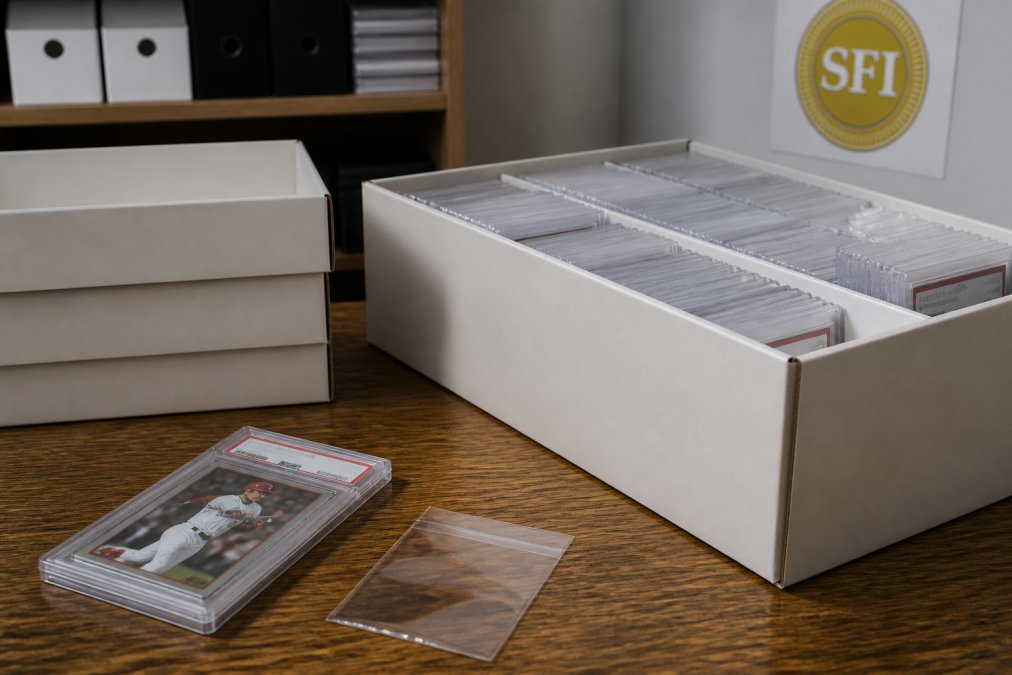
The best storage boxes for graded cards protect slabs from impact, moisture, dust, and UV light while keeping your collection organized and easy to access. Fit matters more than brand name: a box that lets slabs slide around causes more damage than one that holds them snug.
- Slab dimensions. PSA, BGS, SGC, CGC, and GMA slabs differ in thickness and height. Measure before you buy.
- Material. Cardboard is cheap and light. Hard-shell aluminum or plastic cases cost more but resist crushing and water.
- Interior protection. Foam inserts, dividers, and soft linings stop slabs from shifting during transport.
- Capacity. Match the box to your collection size, not the collection you hope to have someday.
- Security. Locking latches matter if your collection is valuable or you travel to shows.
Comparison Table: Top Storage Boxes for Graded Cards
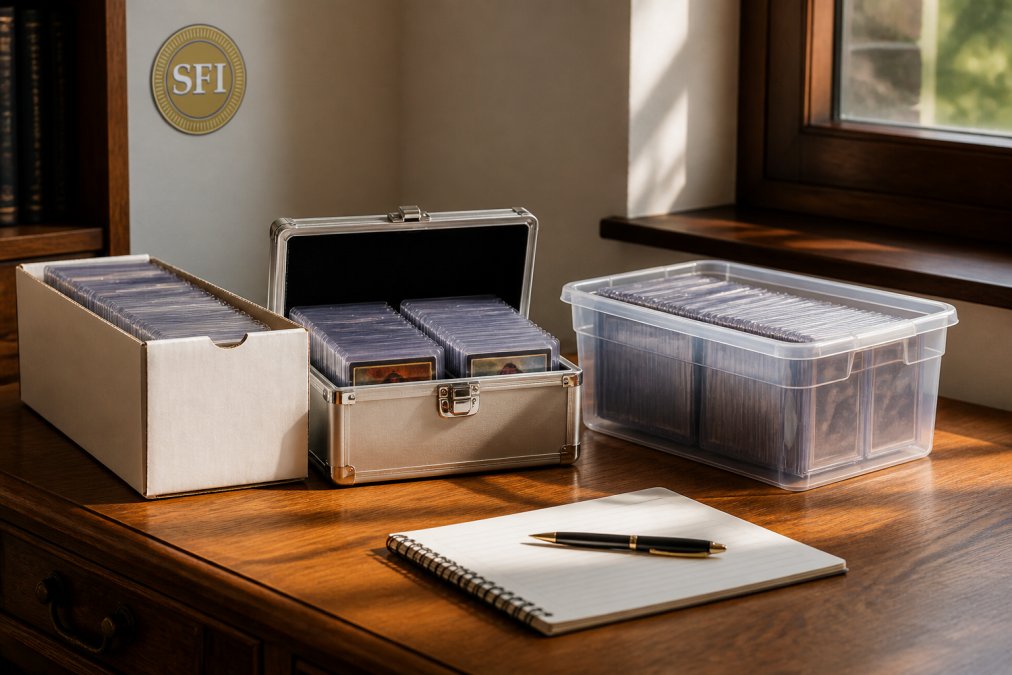
This table summarizes the options reviewed below so you can scan capacity, materials, and starting prices at a glance.
| Storage Box | Material | Starting Price | Best For |
|---|---|---|---|
| Superior Fit Sleeves | Archival sleeve protection | Varies by quantity | Slab protection and display |
| CASEMATIX Waterproof Case | Hard-shell, waterproof | $59.99 | Maximum protection |
| VEVOR Storage Case | Aluminum alloy | $45.00 | Bulk storage |
| Sidio Crates | Stackable plastic | $25.00 | Display and organization |
| Bofoho Card Storage Box | Locking portable | $35.00 | Transport to shows |
| Vaulted 4-Row Card Case | Armored shell | $85.00 | High-end collections |
| ZLCA Storage Box | Fabric/plastic | $28.00 | Budget versatility |
| PREZA Graded Card Case | Durable plastic | $30.00 | PSA-only collectors |
| 3D-Printed Display Box | Custom printed | $40.00 | Display plus storage |
Top Storage Boxes for Graded Cards: Reviews and Pricing
Prices below come from manufacturer listings and may change. Always confirm current pricing before ordering.
CASEMATIX Waterproof Graded Card Case
CASEMATIX builds a heavy-duty hard-shell case with a waterproof, airtight seal and custom foam-separated rows. It holds roughly 90 or more BGS or PSA slabs. At $59.99, it's the pick for collectors who need serious impact and moisture resistance. The trade-off is bulk and weight once loaded.
VEVOR Graded Card Storage Case
VEVOR's aluminum alloy case holds 162 or more PSA graded cards with reinforced corners and a locking mechanism. Starting around $45.00, it's the best value for large, growing collections. It gets heavy when full, so plan a permanent shelf rather than a travel bag.
Sidio Crates
Sidio Crates uses a modular, stackable plastic design that works with various slab sizes. The open-top build makes access quick. Starting at $25.00, it suits collectors who care about organization and a clean display. It won't match a hard-shell case for impact protection.
Bofoho Card Storage Box
Bofoho makes a compact, locking box with foam inserts that hold standard PSA, BGS, and CGC slabs in place. At $35.00, it's built for portability. Capacity is limited compared to larger cases, so it works best as a travel box, not primary storage.
Vaulted 4-Row Card Case
The Vaulted 4-Row Card Case uses an armored exterior shell, soft interior lining, and a reinforced handle. Four internal rows keep a high-end collection organized. At $85.00, it's the most expensive option here, but the build quality justifies it for valuable slabs.
ZLCA Trading Card Storage Box
ZLCA offers adjustable dividers and a lightweight body that fits multiple slab sizes and top-loaders. Starting around $28.00, it's a solid budget pick. Durability falls short of hard-shell cases, so treat it as light-duty storage.
PREZA Graded Card Case
PREZA engineered its case around PSA slab dimensions specifically. The stackable design and clear labeling area make it space-efficient. At $30.00, it's ideal if you collect PSA only. Thicker slabs from other grading companies may not fit.
3D-Printed Display Storage Box
Custom 3D-printed boxes combine external display slots for about six slabs with internal storage for roughly 25 more. Starting near $40.00, they offer a unique aesthetic and a compact desktop footprint. Capacity is the clear limitation.
Graded Card Protectors: Sleeves, Foam, and Dividers That Fit
A storage box is only half the job. The layer touching your slab matters just as much. Graded card protectors are the sleeves, foam, and dividers that sit between your slab and the box, and they determine whether your case actually prevents scratches.
How to Organize Graded Card Collection for Quick Access
Learning how to organize graded card collection starts with one rule: group by grading company first, then by set or value. Mixed-size slabs in one row always end up shifting, and a shifted slab is a scratched slab.
A simple physical system that works:
- Sort slabs by grading company (PSA, BGS, SGC, CGC, GMA).
- Within each group, order by set, then card number.
- Assign one row per group in your storage box.
- Label each row or crate with a removable sticker.
- Keep your highest-value slabs in the most protected case, not the most convenient one.
- Log every slab in a spreadsheet or collection app with its grade and location.
Building a Trackable Inventory Without Buying Software
You do not need a paid app to run a usable inventory. A free spreadsheet with six columns covers almost every collection:
- Grading company (PSA, BGS, SGC, CGC, GMA)
- Set and card number
- Grade and qualifier (for example, a 9 with an off-center qualifier)
- Certification number from the slab label
- Storage location (case name, row, and slot)
- Acquisition date and cost for insurance and tax records
Labeling Systems That Survive Real Use
Stickers fall off. Tape yellows. A labeling system only works if it survives a year of handling.
- Removable label tape on the outside of a crate or case works for row-level labels and peels clean if you reorganize.
- Color-coded dots on the slab holder (not the slab itself) let you sort by value tier at a glance: one color for slabs worth insuring separately, another for everything else.
- QR codes printed on a label and stuck to the case can link to a cloud spreadsheet row or a folder of photos. Scan the code, see the contents. This is the fastest way to reconcile a case against your inventory after a show or a move.
Organizing by Set, Player, or Value: Pick One Primary Sort
Collectors argue about whether to sort by set, by player, or by value. The honest answer is that you need one primary sort and one secondary sort, and the primary sort should match how you actually use the collection.
- Set collectors should sort by set, then card number. This makes set-completion gaps obvious.
- Player collectors should sort by player, then year. This keeps a player's career arc together.
- Investors should sort by value tier, then grading company. High-value slabs go in the most protected case regardless of set.
Best Practices for Card Slab Storage: Climate, UV, and Security
Best practices for card slab storage come down to three threats: humidity, light, and theft. None of them announce themselves until damage is done, and all three are cheaper to prevent than to reverse.
Climate Control: Why Stable Beats Dry
The goal is not the driest room in the house. The goal is a room that stays stable. Card stock and slab labels expand and contract with humidity, and repeated swings do more damage than a steady moderate level.
- Target range. Most preservation guidance for paper-based collectibles points to roughly 45 to 55 percent relative humidity and a temperature in the low 60s to low 70s Fahrenheit. You do not need a laboratory. You need a room that does not swing wildly between seasons.
- Avoid basements and attics. Basements run damp and attics run hot. Both see the largest seasonal swings in a typical home, which is exactly the pattern that warps card stock and lifts labels.
- Use a hygrometer. A cheap digital hygrometer costs less than a single mid-grade slab and tells you whether you actually have a problem. Check it monthly.
- Dehumidify, do not over-dry. A small dehumidifier in a damp room helps. Running one continuously in an already-dry room can dry out and crack the slab's plastic over years.
UV Protection: What Actually Fades
Direct sunlight fades slab labels and card images over time. The mechanism is ultraviolet light breaking down the dyes in the ink and the card stock, and the damage is cumulative and irreversible.
- Keep storage boxes out of direct sun. A closed cabinet beats open shelving for anything you plan to hold for years.
- Choose opaque cases over clear ones for long-term storage. Clear cases are for display, not for archiving.
- Fluorescent and LED lighting emit far less UV than direct sun, but a display case sitting under a bright lamp for years will still show fading on the exposed face of a label.
Security and Insurance: Ratings, Not Vibes
Locking cases like the VEVOR and Bofoho options add a physical barrier, but a locked box in a visible room is not real security. For high-value collections, the meaningful questions are fire and water ratings, not latch strength.
- Fire ratings. A safe or case rated for fire resistance is tested to keep its interior below a damage threshold for a specified time at a specified external temperature. A box with no rating offers no tested protection. If you are storing slabs worth more than a few thousand dollars, a rated safe is the single highest-value upgrade you can make.
- Water ratings. Waterproof cases like the CASEMATIX protect against a burst pipe or a flooded floor, but only if the seal is intact and the case is closed. Check gaskets annually and replace any that are cracked or stiff.
- Insurance. Photograph your collection, keep your inventory sheet current, and check whether your homeowner's or renter's policy covers collectibles. Many standard policies cap collectible coverage at a relatively low limit, so a separate rider or a dedicated collectibles policy is often worth the cost. Insurers typically want the cert numbers and photos you already built into your inventory.
- Off-site backup. For a collection with real value, keep the highest-value slabs in a bank safe deposit box or a rated home safe, and keep a copy of the inventory in the cloud. A fire that takes the collection should not also take the record of what was in it.
Vertical Storage for Small Spaces
If floor space is tight, stackable crates and upright cases let you build upward. Just make sure the base is stable and slabs sit flat, not leaning. A leaning slab puts continuous pressure on one edge of the case, and over years that pressure can bow the plastic.
Frequently Asked Questions
What is the best box for storing graded cards?
The best box depends on your priorities. For maximum protection, a waterproof hard-shell case with foam inserts and locking latches is ideal. For high-capacity storage, an aluminum case with reinforced corners holds over 160 slabs. For organization and display, modular stackable crates work well. Always check that the interior dimensions match your slab sizes, especially if you have a mix of PSA, BGS, and CGC slabs.
How should I store my graded cards to prevent damage?
Store graded cards in a cool, dry place away from direct sunlight. Use archival-grade, acid-free sleeves and foam inserts to prevent scratches and movement. Avoid stacking heavy boxes on top of each other. For long-term preservation, consider a locking case with a seal to keep out dust and moisture. Rotate your collection periodically to check for any signs of wear.
Do graded card storage boxes provide UV protection?
Most standard storage boxes do not provide UV protection on their own. However, you can add UV protection by using archival-grade sleeves or placing the boxes in a dark cabinet. Some hard-shell cases have opaque exteriors that block light. If UV exposure is a concern, look for cases with solid, light-blocking materials or store your collection in a room without direct sunlight.
How many slabs can a standard graded card storage box hold?
Capacity varies widely. A compact portable box may hold 20-30 slabs, while a large four-row case can hold over 160. For example, the VEVOR case holds 162+ PSA slabs, and the CASEMATIX case fits approximately 90+ BGS/PSA slabs. Always measure your slabs and compare to the box's interior dimensions before buying.
Your collection deserves storage that protects it as carefully as you built it. Superior Fit Sleeves makes archival-grade, acid-free sleeves with a precision fit for PSA, BGS, and CGC slabs, plus matching sleeves for top-loaders and magnetic cases. Pair them with a quality storage box and you get protection that holds up for years. Get started with Superior Fit Sleeves and give every slab a snug, professional fit.