 blog
blog
Graded Card Collection Organization Tips for 2026
Table of Contents
- Why Graded Card Organization Decides What Your Collection Is Worth
- Sorting Criteria That Actually Work: Set, Year, Player, and Grade
- How to Protect Graded Card Slabs From Scratches, Dust, and UV Damage
- Graded Card Storage Ideas: Boxes, Binders, and Display Cases
- Build a Graded Card Collection Spreadsheet That Tracks Everything
- Using a Graded Card Inventory Template for Insurance and Security
- Climate Control, Labeling, and Maintenance for High-Volume Collections
- Conclusion
- Frequently Asked Questions
Last Updated: October 8, 2026
Why Graded Card Organization Decides What Your Collection Is Worth
A graded card collection is only as valuable as the records and protection behind it. Lose track of what you own, or let slabs sit in a hot closet, and the holder grade stops mattering.
Grading companies seal a card and assign a grade, but they don't insure it, store it, or catalog it for you. That work is yours.
Sorting Criteria That Actually Work: Set, Year, Player, and Grade
Pick one primary sort, then use the others as filters. Trying to sort by everything at once creates chaos. Most collectors do best with set and year as the backbone, then player and grade as secondary layers.
Sorting by Set and Year
Group by release set first, then by year within each set. This mirrors how most set registry checklists are built, so your physical order matches the digital one.
- Sort by set name, then year
- Keep rookie-year cards together within each set
- Label each row or box with set and year range
Sorting by Player, Character, and Grade
Player or character sorting suits collectors chasing a specific PC. Grade sorting suits sellers who price by tier.
- Player or character: great for personal collections
- Grade: great for insurance and resale
- Combine both: player within grade tier
A simple rule: sort by whatever you search for most often. If you hunt by player, sort by player.
How to Protect Graded Card Slabs From Scratches, Dust, and UV Damage
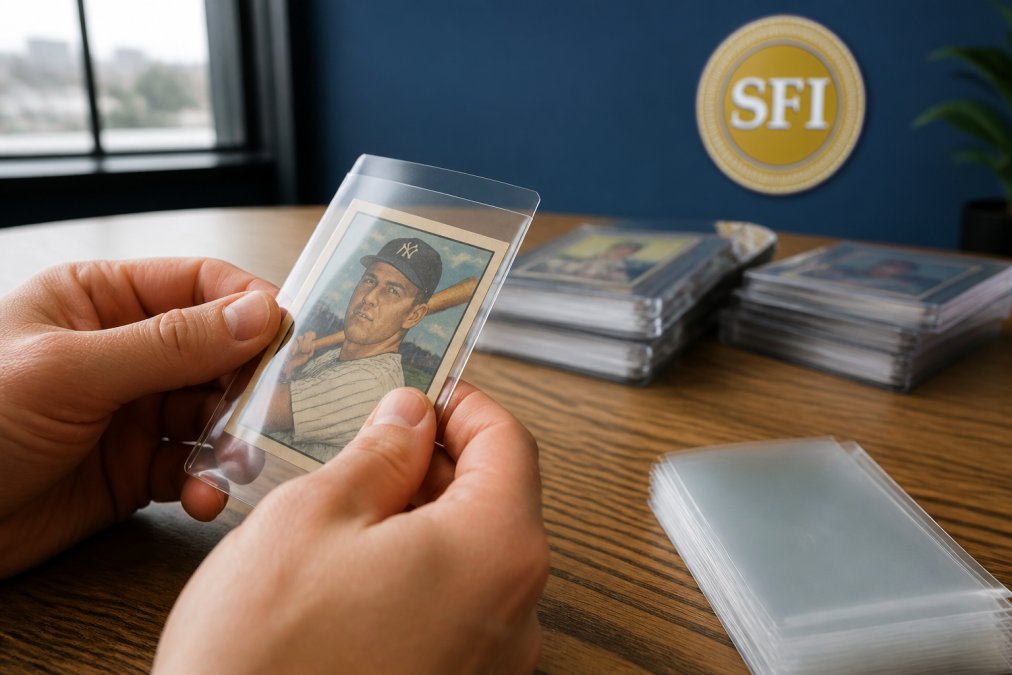
The slab is the shield, but it scratches, fogs, and yellows if you leave it exposed. Protecting graded card slabs means blocking three things: physical contact, dust, and light.
- Scratches: sleeves and cases stop slab-on-slab rubbing
- Dust: sealed storage keeps grit out of seams
- UV damage: keep slabs out of direct sun and bright display light
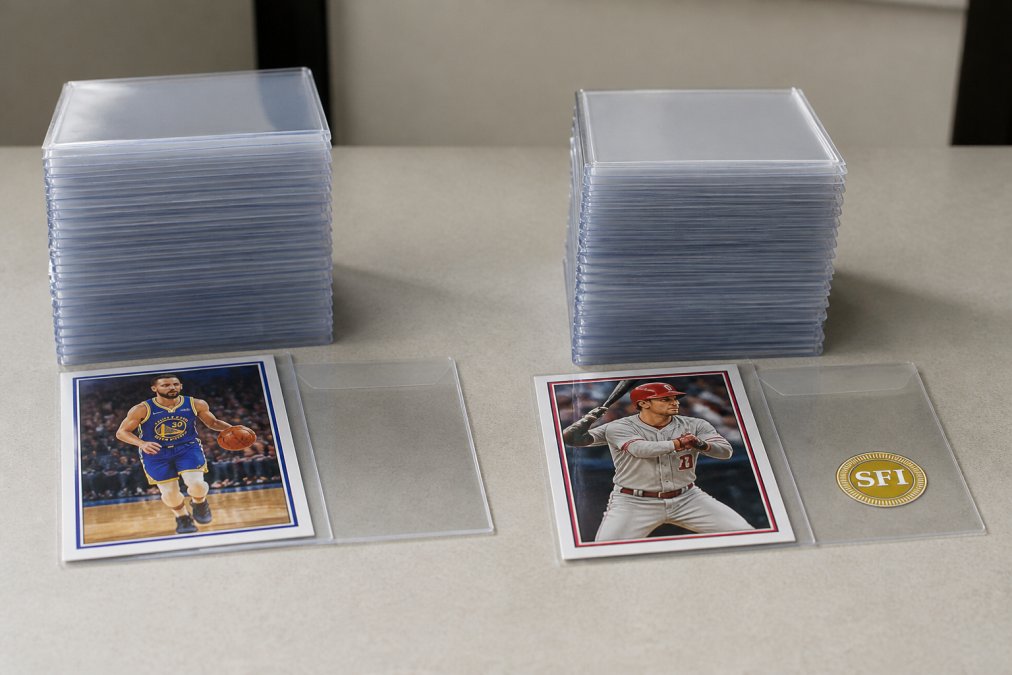
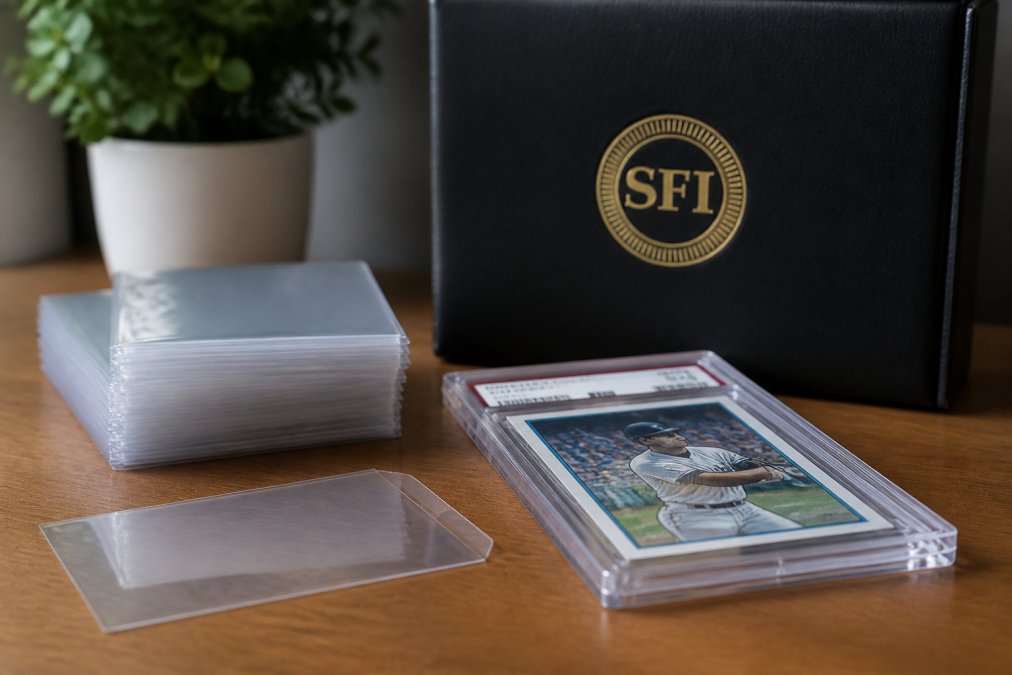
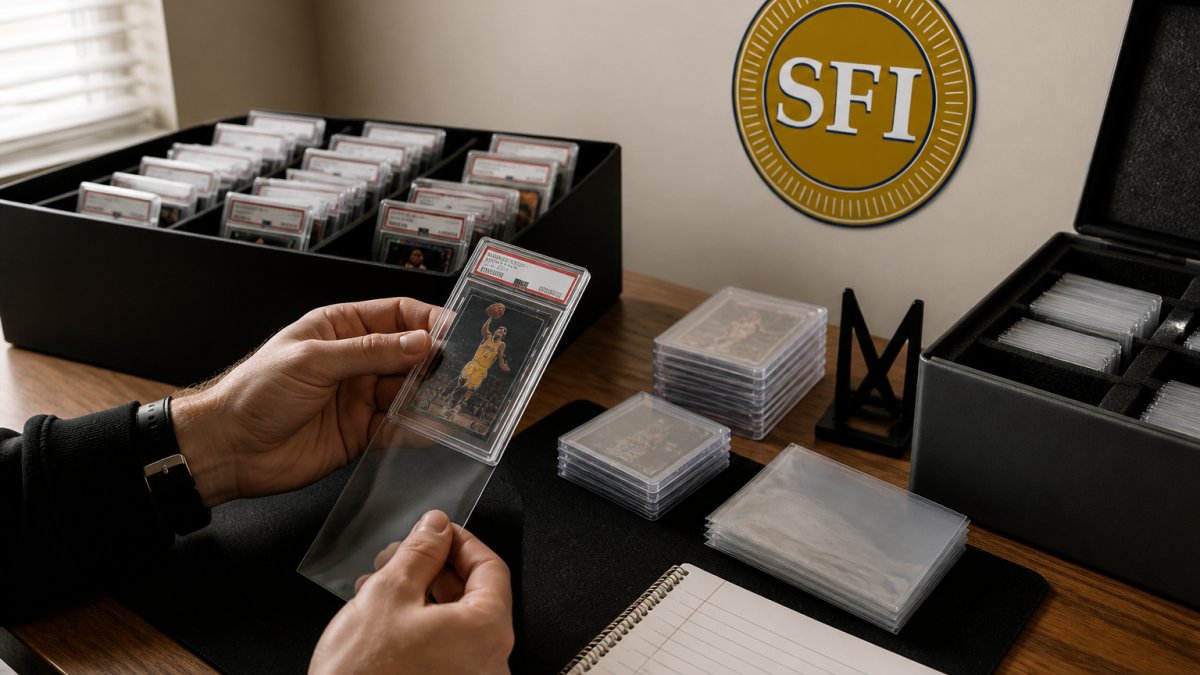
Slab dimensions vary by grading company, so a loose bag leaves gaps where dust settles. Superior Fit Sleeves builds precision-cut Graded Card Slab Sleeves for graded slabs, so the fit stays tight across major holders.
Graded Card Storage Ideas: Boxes, Binders, and Display Cases
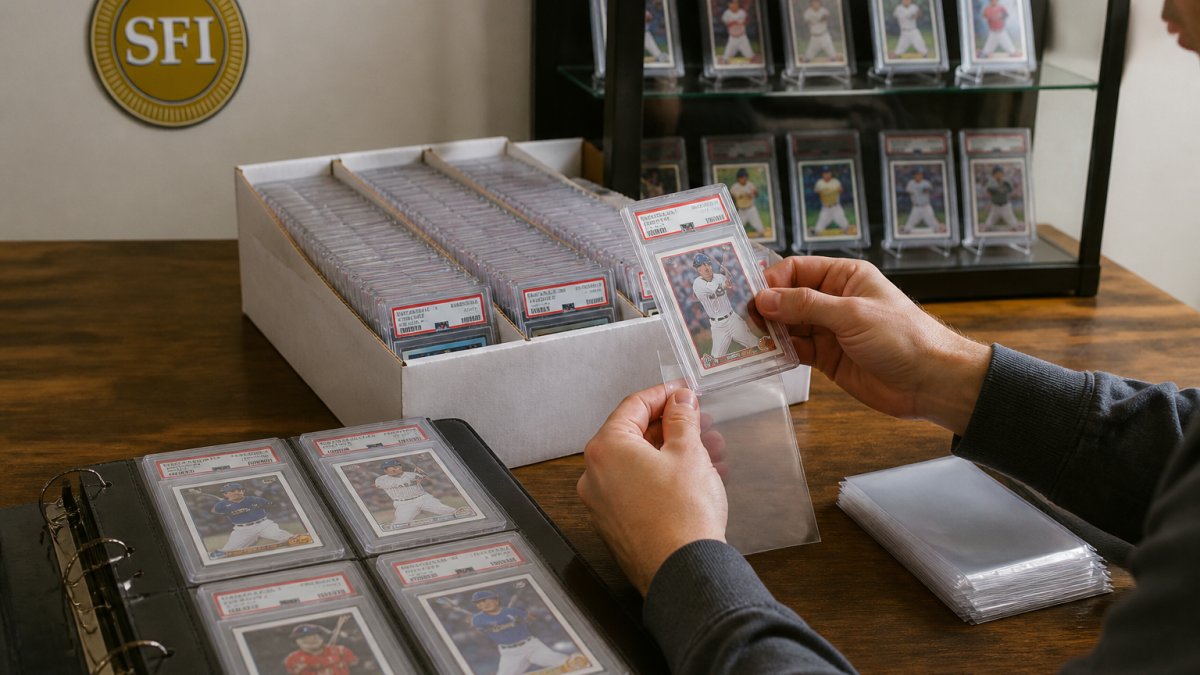
Good graded card storage ideas come down to three jobs: bulk storage, browsing, and showing off. Match the container to the job, not the other way around.
Storage Boxes and Stacking Stability
Boxes handle volume and stacking stability. Choose rigid, acid-free boxes sized to your slab type, and store them upright rather than flat where possible.
- Rigid walls resist crushing
- Acid-free liners protect slab surfaces
- Label every box on the end, not the top
Binders and Display Cases for Slabbed Cards
Binders suit browsing; display cases suit showing. Slabbed cards need pages built for slab thickness, not standard card pages.
- Slab pages: sized for graded holders, not raw cards
- Display cases: UV-filtered glass or acrylic
- Rotate displayed slabs to limit light exposure
Storage Type | Best For | Watch Out For |
|---|---|---|
Rigid box | Bulk, long-term | Crushing if stacked wrong |
Slab binder | Browsing a PC | Page sag over time |
Display case | Showing off | UV and dust buildup |
Build a Graded Card Collection Spreadsheet That Tracks Everything
A graded card collection spreadsheet turns a shelf into a searchable asset. Start with the fields you'll actually use, then expand.
- Card name, set, year, and card number
- Grading company and grade
- Cert number from the label
Keep the cert number in the sheet. It's the one field that ties your record to the grading company's own database.
Using a Graded Card Inventory Template for Insurance and Security
A graded card inventory template is your proof of ownership when you file a claim. Insurers want specifics, not a general list, and the difference between a paid claim and a denied one usually comes down to documentation you built months earlier.
The Fields That Actually Matter for a Claim
Most collectors build a sheet with card name and grade and stop there. That is not enough to establish ownership or value. A claim-ready record needs:
- Card name, set, year, and card number
- Grading company and numeric grade
- Cert number from the label (this is the anchor field)
A common pattern is to keep two tabs: one master inventory, one "disposed" log for cards you sold or traded. If a card leaves your collection and you don't remove it from the master sheet, your total insured value inflates, and an adjuster who spots the discrepancy will question the rest of the record.
Why the Cert Number Is the Backbone
The cert number is the one field that ties your record to the grading company's own public database. PSA, Beckett (BGS), and CGC all maintain searchable cert lookups, so an adjuster or a buyer can independently verify that the slab in your photo matches the grade you claim. Without cert numbers, your spreadsheet is a list of assertions.
Photograph the slab label straight-on so the cert number is legible, then photograph the full slab front and back. Store those images in the same cloud folder as the spreadsheet, named by cert number, so a claim can be assembled in minutes instead of days.
Scheduling, Riders, and the Coverage Conversation
A homeowners or renters policy typically caps collectibles coverage under a sub-limit, and that cap is often far below the value of a serious graded collection. Two common paths exist:
- Scheduled personal property endorsement (a rider): you list individual items or categories with agreed values, and coverage sits outside the standard sub-limit.
- A standalone collectibles policy: a dedicated policy built for cards, often with broader perils and fewer exclusions.
Most practitioners find that insurers ask for the same documentation either way: an itemized schedule, cert numbers, photographs, and evidence of value. Build the sheet once, and it serves both paths. Talk to your agent about whether your collection needs a rider or a standalone policy; that is a coverage decision, not a spreadsheet decision.
Security: Organizing So Theft Is Harder
Organization and security overlap. A collection that is inventoried, photographed, and stored in labeled boxes is harder to steal cleanly and easier to recover.
- Keep high-value slabs in a locked safe or a locked cabinet, not on an open shelf.
- Do not post real-time photos of a full display case on social media; post after the layout changes, not during.
- Keep the master inventory in the cloud, not only on the device you store at home.
A spreadsheet stored on only one laptop isn’t a record. If that drive fails or the laptop is stolen along with the cards, your proof of ownership is lost. Keep an encrypted cloud copy and a second copy on a drive stored off-site.
Updating the Record
Set a cadence and stick to it. A practical rhythm is:
- Update the sheet the day you buy, sell, or trade a card.
- Re-check market values quarterly.
- Re-photograph any slab that gets re-holdered or re-graded.
That annual review is where most collections drift. Cards get moved, boxes get reorganized, and the sheet quietly stops matching reality. An hour once a year keeps the record claim-ready.
Climate Control, Labeling, and Maintenance for High-Volume Collections
High-volume collections fail on maintenance, not on storage. Once you are managing hundreds or thousands of slabs, the system that worked for fifty stops scaling, and the failure mode is always the same: you lose track of what is where, and you stop trusting your own records.
Climate Targets for Long-Term Slab Storage
Paper, cardboard, and the adhesives inside a slab all respond to temperature and humidity. Archival and museum preservation guidance is a useful reference point: cooler and drier is better, and stability matters as much as the absolute number.
- Temperature: aim for a stable, cool room. Avoid attics, garages, and unfinished basements, which swing widely with the seasons.
- Relative humidity: keep it in a moderate range and, more importantly, keep it steady. Very dry air can make paper brittle; very humid air invites mold and warping.
- Light: keep slabs out of direct sun and away from bright display lighting. UV accelerates yellowing of the slab and fading of the card.
A cheap hygrometer and thermometer in the storage room tell you more than any guess. Check them monthly and note the readings alongside your inventory.
Moisture Control in Sealed Storage
If you store slabs in sealed bins or cases, moisture control packs (silica gel desiccant) help buffer humidity swings. A few practical rules:
- Use rechargeable desiccant packs and follow the manufacturer's recharge schedule.
- Don’t overpack a bin; air circulation inside the container helps.
- Replace packs on a calendar reminder, not when you remember.
Labeling That Scales Past a Few Hundred Slabs
The labeling system is what makes a large collection usable. A flat scheme like "Box 1, Box 2, Box 3" breaks down fast. Use a hierarchical scheme instead:
- Box ID: a short code for the physical container (e.g., B-014).
- Section: the sort category inside the box (set, year, player, or grade tier).
- Slot: the position within the box, if you want to find a single slab without emptying it.
Label every box on the end, not the top, so you can read it on a shelf. Keep a master index that maps every box ID to its contents; that single document is what turns a wall of boxes into a searchable collection.
A Maintenance Routine for Thousands of Slabs
At volume, maintenance has to be scheduled, not remembered. A workable cadence:
- Monthly: check hygrometer and thermometer readings; dust shelves and case exteriors.
- Quarterly: recharge desiccant packs; spot-check a random box against the master index.
- Annually: full inventory audit; rotate displayed slabs; re-check market values.
Rotate displayed slabs on a schedule so no single card sits under light for months. A simple rotation log- date in, date out- keeps the display fresh and spreads light exposure across the collection.
Accessibility: Making a Big Collection Findable
The point of organizing thousands of slabs is being able to pull any one of them on demand. Two habits make that possible:
- Keep the master index digital and searchable, with box IDs as the primary key.
- Cross-reference the index to your inventory spreadsheet by cert number, so a search for a cert number tells you both the card's details and its physical location.
That cross-reference is the piece most large collections are missing. It is also the piece that makes insurance documentation, resale, and day-to-day browsing all work off the same record.
Conclusion
A collection worth real money deserves a system, not a shelf. Superior Fit Sleeves makes archival-grade, acid-free sleeves with a precision fit for PSA, BGS, and CGC holders, plus Top-Loader Sleeves and sleeves for magnetic cases. Search Superior Fit Sleeves and give your graded cards the protection their grade deserves.
Frequently Asked Questions
What is the best way to organize graded cards?
Start with one primary sorting criterion: set and year for set builders, player or character for PC collectors, or grade for investors tracking condition tiers. Then add a secondary layer, such as value or acquisition date. Whichever system you pick, keep it consistent across the whole collection and mirror it in a graded card collection spreadsheet so physical and digital order match.
Should I organize graded cards by set, player, character, or grade?
It depends on what you do with the collection. Set builders benefit from sorting by set and year because it maps directly to set registry progress. Player and character collectors sort by name for quick access. Investors often sort by grade first, since condition drives valuation. Many collectors combine two criteria, for example set then grade, which keeps slab dimensions and storage needs predictable.
How should I store graded cards to prevent scratches?
Graded card slabs scratch easily when they slide against each other or sit exposed to dust. Use archival-quality protective sleeves sized to each slab type, store slabs upright or in snug boxes so they cannot shift, and keep them out of direct sunlight. A graded card inventory template helps you note which slabs are cased, boxed, or displayed so nothing sits unprotected for long.
How often should I review and update my card collection inventory?
Review your graded card collection spreadsheet at least twice a year, and after every buying or selling session. Update values quarterly using recent sales data, confirm insurance documentation matches current holdings, and check stored slabs for dust, moisture, or sleeve wear. High-volume collections benefit from a monthly spot check of one storage box or binder section.