 blog
Organizing Slabbed Cards: Best Storage and Display Methods
Last Updated: November 16, 2026
Quick Summary
The best ways to organize slabbed cards are upright drawer storage with labeled dividers, slab binder pages for browsing, and compact boxes for overflow, all with each holder in a snug protective sleeve. Sort by sport, then set and year, then grade, and mirror that system in your inventory spreadsheet.
- Store PSA slabs upright in a dust-free, temperature-stable spot inside a snug protective sleeve.
- Sort a sports card collection by sport, then set and year, then grade within each set.
- Label each drawer with a location code, set, year, and grade band matching your spreadsheet.
- Measure a holder's length, width, and thickness before committing it to any storage slot.
- Plan capacity using a 12-month buffer of monthly additions rather than today's pile.
Table of Contents
- Storage Options for Slabbed Cards Compared
- The Best Way to Store PSA Slabs and Other Graded Holders
- How to Organize a Sports Card Collection by Set, Year, and Grade
- Build a Graded Card Inventory Spreadsheet That Tracks Value
- Slabbed Card Display Ideas That Protect While They Show
- Plan Your Storage Capacity Before the Collection Outgrows the Room
- Choosing Your Slab Storage Setup
- Frequently Asked Questions
Storage Options for Slabbed Cards Compared
Organizing slabbed cards starts with one hard truth: a graded holder isn’t a raw card, and what works for one will scratch the other. Collectors often build beautiful raw-card setups and then jam their PSA and BGS holders into the same pages, only to find scuffed corners and cracked cases a few months later. The best ways to organize slabbed card collections come down to matching each holder to a storage method built for its size and weight.
Below is a side-by-side look at the four methods most collectors actually use, with the trade-offs that matter.
Storage Method | Best For | Protects From | Main Drawback |
|---|---|---|---|
Binder pages | Browsing and showing off | Dust, light scratches | Bulky; limited capacity |
Drawer storage | Dense, hidden storage | Light, dust, bumps | Needs dividers to stay tidy |
Compact boxes | Overflow and transport | Dust, impact | Hard to browse quickly |
Shelf and closet | Display and long-term | Dust with covers | Space-hungry; light exposure |
Binders and Slab Binder Pages
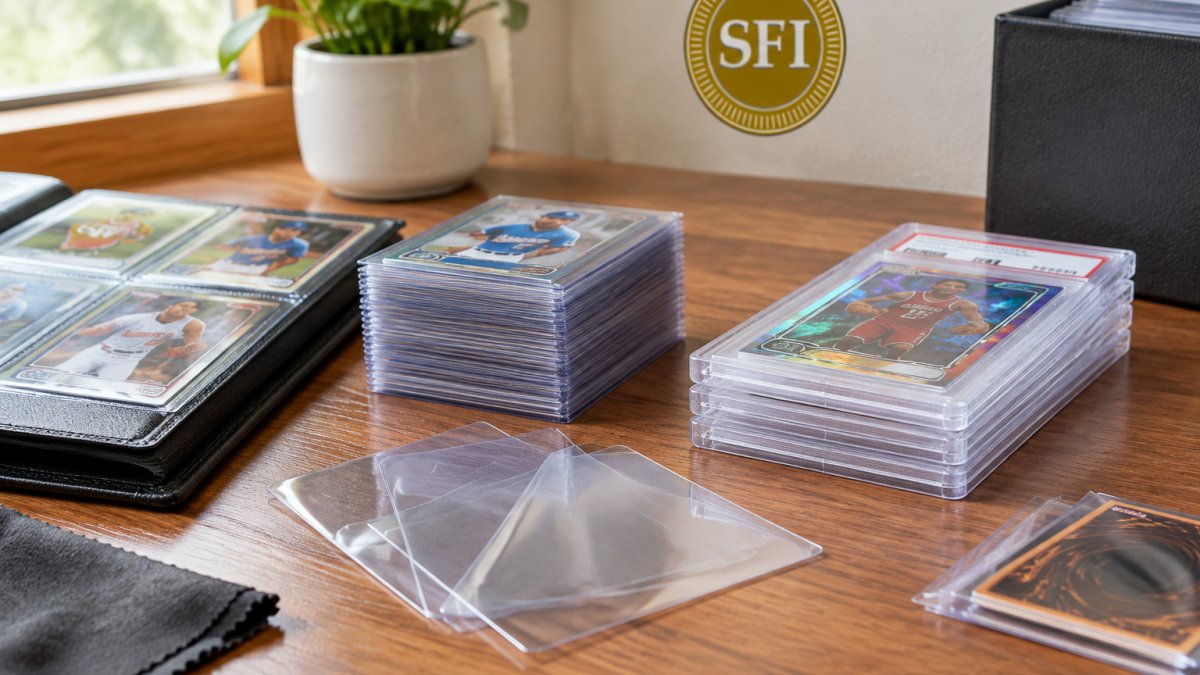
Slab binder pages hold graded holders in a fixed grid, so a whole set stays in one place and flips open like a book. They suit collectors who like to browse and show their collection at card shows. The catch is bulk: a full binder of thick slabs gets heavy. Keep the binder upright on a shelf, not stacked under weight.
Drawer Storage and Compact Boxes
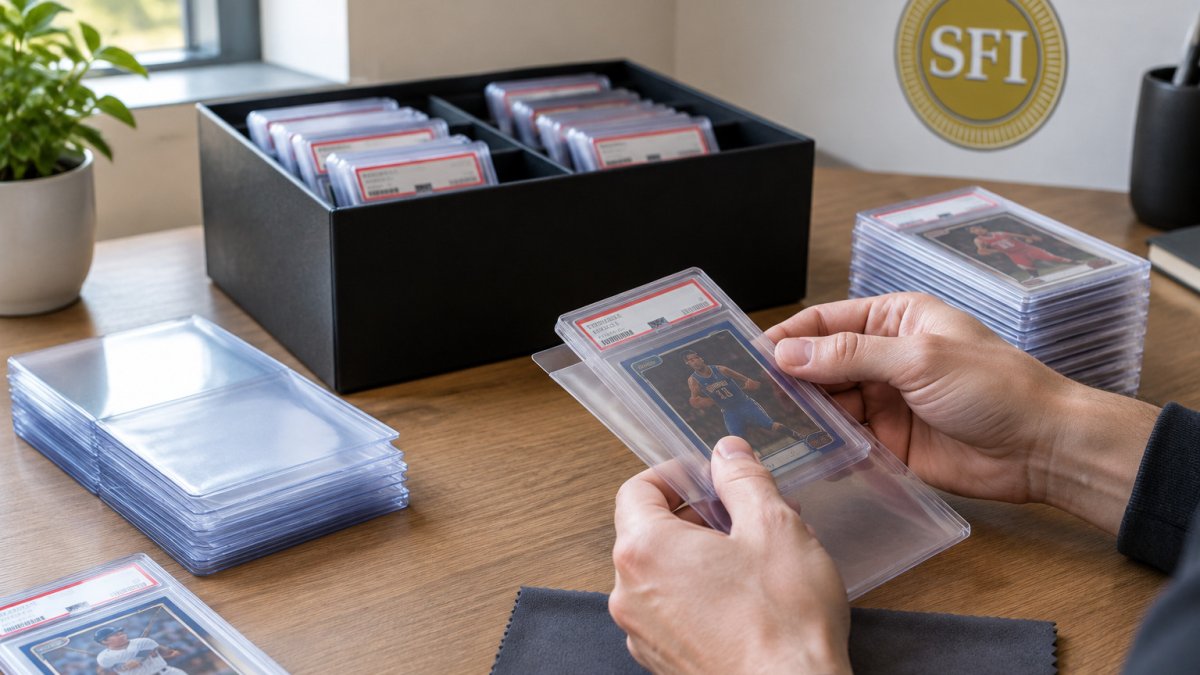
Drawer storage is the workhorse for a growing graded card collection. A shallow drawer lined with partitions keeps slabs upright, easy to access, and out of sunlight. Compact storage boxes handle overflow and travel. For a closer look at buying the right box, see our guide to the best storage boxes for graded cards. Label each drawer by set or grade so you never dig through the whole stack to find one holder.
Shelf and Closet Storage
Shelf storage puts your collection on view, while closet storage keeps it out of the light. Both work well if you keep slabs upright and add a dust cover over open shelving. A common mistake is stacking slabs flat in a closet, which puts pressure on the cases and invites scratches on the faces. Stand them on edge, spine out, like books.
The Best Way to Store PSA Slabs and Other Graded Holders
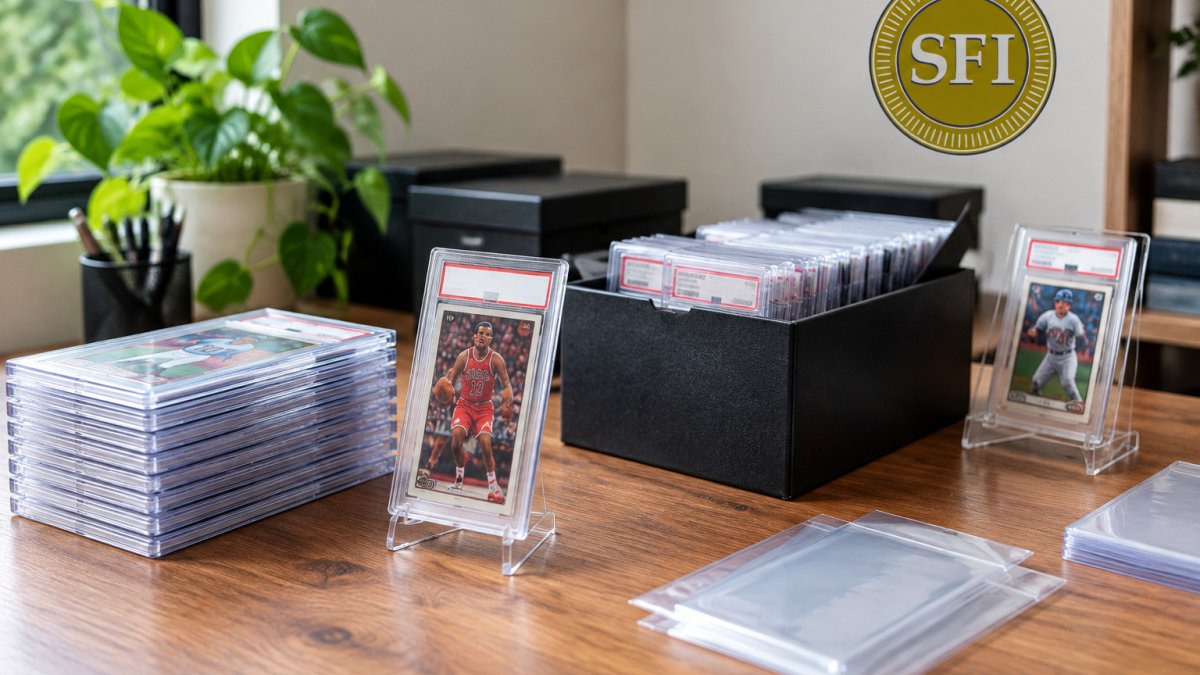
The best way to store PSA slabs is upright, in a dust-free, temperature-stable spot, with the holder inside a snug protective sleeve. That combination guards against the three things that most damage graded holders: surface scratches, dust settling into seams, and pressure from stacking.
Graded card holders vary by company, and fit matters. A sleeve that is too loose lets the slab slide and scuff; one that is too tight strains the seams. Our precision-cut Graded Card Slab Sleeves are engineered for a snug, professional fit across PSA, BGS, SGC, and CGC holders. For a deeper walkthrough of long-term storage, read how to store graded card slabs safely long term.
Watch out: storing slabs in a garage or attic exposes them to heat swings and moisture that can fog cases and warp cardboard inside. Keep the collection in a climate you would be comfortable in.
How to Organize a Sports Card Collection by Set, Year, and Grade
To organize a sports card collection, sort first by sport, then by set and year, then by grade within each set. This three-level system means you can find any card fast and spot gaps in a set at a glance.
- Group by sport and manufacturer.
- Within each group, order by release set and year.
- Inside each set, sort by grade, highest to lowest.
- Assign each group its own drawer, box, or binder section.
- Label everything with the same naming you use in your inventory.
A workable label has four parts: a location code, the set, the year, and the grade band. For example, a drawer label might read "D2, 2018 Topps Chrome, Grades 9-10," and the matching spreadsheet row carries the same location code. Use the same code on dividers inside the drawer so a card pulled for a show can go back to the right slot without guesswork. Keep the codes short and consistent; a scheme you can type quickly is a scheme you will actually maintain.
Custom sections and partitions make this practical. A collector chasing a single release set can give it a dedicated drawer, while a mixed collection benefits from dividers labeled by year.
Before you commit a slab to a slot, check that it fits. Graded holders vary by company and by generation, and a storage method built around one holder's dimensions may not seat another cleanly. Measure the holder's length, width, and thickness, then confirm the binder pocket, drawer partition, or box channel clears all three with a little room to spare.
Watch out: mixing grading companies in one tightly partitioned drawer without checking dimensions can wedge a thicker holder against a thinner one, and the pressure shows up later as scuffed faces or stressed seams. Group by holder type inside each set when sizes differ, and keep a divider between them.
Finally, mirror the physical system in your inventory. If the drawer is labeled by set and grade band, the spreadsheet should sort the same way, so a search for a card returns both its value data and the exact place it lives.
Build a Graded Card Inventory Spreadsheet That Tracks Value
A graded card inventory spreadsheet turns a pile of holders into a tracked collection. At minimum, log the card name, set, year, grade, grading company, certification number, and what you paid. Add a column for current card prices so you can watch value move over time.
- Card details: name, set, year, variation
- Grade data: company, grade, cert number
- Money: purchase price, current estimate
- Location: which drawer, box, or binder holds it
Update the value column every few months using recent sales, not asking prices. This habit makes insurance and resale far simpler, and it pairs naturally with a physical sorting system that mirrors the spreadsheet.
Slabbed Card Display Ideas That Protect While They Show
Slabbed card display ideas work best when the display protects as much as it shows. A wall shelf with a clear dust cover, a shadow box with UV-filtering glass, or a rotating stand on a desk all keep favorites visible without exposing them to scratches.
For collectors planning a full display, our step-by-step guide on how to display PSA slabs walks through mounting and lighting. If your cases are already up, how to keep dust out of graded card display cases covers the upkeep. Rotate which slabs are on display so no single holder sits in direct sun for months.
Plan Your Storage Capacity Before the Collection Outgrows the Room
Storage capacity is the part most collectors skip, and it’s why collections sprawl across closets. Before you buy another box, work out three numbers: how many slabs you own now, how many you add each month, and how many your current setup actually holds.
Capacity is easier to estimate once you count in rows rather than in "boxes." A shallow drawer holds a fixed number of upright slabs per row, and the row count depends on slab thickness, not just drawer width.
Binder capacity works the same way. A slab binder page holds a fixed grid, and the page count per binder is set by the ring size, so a full binder's capacity is pages times pockets. Because thick slabs make a full binder heavy, plan on more binders with fewer pages each rather than one overstuffed binder that strains its rings.
A simple growth plan looks like this:
- Count current slabs by storage location.
- Estimate monthly additions from your buying and grading habits.
- Multiply monthly additions by 12 for a one-year target.
- Compare the target to current capacity and note the shortfall.
- Buy storage for the shortfall plus a small buffer, not for today's pile.
Watch out: buying one large bin to "solve" capacity usually backfires, because a deep bin invites flat stacking, and flat stacking is what puts pressure on cases and scuffs the faces. Capacity you cannot access upright is not real capacity.
Space planning is the other half. Go vertical where the room allows: shelf storage up the wall, drawer units under a desk, and labeled boxes on the top shelf. Keep the heaviest, most-browsed storage at waist height so you are not lifting a loaded binder or drawer off a high shelf.
Choosing Your Slab Storage Setup
Choosing a setup means matching storage to how you use the collection. If you browse and trade often, lead with binders and a display shelf. If you are building a long-term graded card collection, lead with upright drawer storage and snug sleeves. Many collectors run both: display the favorites, store the rest.
Whatever you pick, the holder deserves a protective sleeve before it goes in. Our premium sleeves for BGS graded card holders and sleeves for PSA, SGC, and CGC slabs give every holder a clean, archival-grade, acid-free layer. Start with the sleeves, then build the storage around them.
A collection is only as protected as the layer touching the holder. Superior Fit Sleeves, the original inventor of the tapered perfect-fit sleeve, makes precision-cut, ultra-clear sleeves for graded slabs, top-loaders, and magnetic cases, so your slabs stay scratch-free and display-ready. Get started with Superior Fit Sleeves and give every graded holder a snug, archival-grade fit.
Frequently Asked Questions
What is the best way to organize slabbed cards?
Start with a sorting rule you can repeat: set, then year, then grade. Group slabbed cards by release set, order each group by year, and within each year sort by grade so your best examples sit together. Store the sorted groups upright in binders, drawers, or boxes, and record each card in a spreadsheet with its certification number. A consistent system matters more than which container you pick, because it lets you find any card in seconds and spot gaps in a set before you buy duplicates.
Should graded cards be organized by player, set, or grade?
Set and year first, grade second, works for most collectors. Set-based sorting mirrors how checklists are built and makes it easy to see what a set still needs. Grade-based sorting suits investors who track value tiers, and player-based sorting suits personal favorites. Many collectors use set order for storage and a graded card inventory spreadsheet to filter by player or grade when they need a different view. Pick one primary rule for the physical collection and let the spreadsheet handle the rest.
How do you keep track of a graded card collection?
Use a graded card inventory spreadsheet with one row per slab. Include the card name, set, year, grade, grading company, certification number, purchase date, purchase price, and current estimated value. Add a column for storage location so you know which binder or drawer holds it. Update values quarterly using recent sold listings, and back the file up to cloud storage. The certification number is the most important field because it links your record to the grading company's verification database.
How can you display slabbed cards safely?
Keep displayed slabs out of direct sunlight and away from heat sources, since ultraviolet light fades labels and cases over time. Use a display case with a UV-filtering front, mount shelves so slabs stand upright rather than leaning, and add a dust cover or protective sleeve to limit surface scuffs. Rotate pieces back into storage every few months so no single slab sits in light year-round. For high-value pieces, a locked case that also serves as storage solves display and security in one piece of furniture.