 How-to
7 Steps to Safely Ship Graded Trading Cards
Last Updated: November 11, 2026
Quick Summary
To safely ship graded cards, sleeve the slab, wrap it in bubble wrap with bubble side in, and place it in a snug corrugated box with rigid cardboard on both faces. Never ship a bare slab in a bubble mailer, and add tracking, insurance, and signature confirmation for high-value slabs.
- Cut bubble wrap about three times the slab's width and fold it bubble side in.
- Skip bubble mailers as the outer package for valuable slabs because they bend.
- Take photos of the slab label and sealed box before shipping to defend against eBay claims.
- Declare the full card value on insurance and customs forms to keep coverage valid.
- Add signature confirmation for high-value slabs to create a delivery record.
Table of Contents
- Step 1: Protect the Slab Before It Ever Touches a Box
- Step 2: Wrap the Slab in Cushioning and Stop Movement
- Step 3: Choose the Right Graded Card Shipping Box
- Step 4: What Size Bubble Mailer for Graded Cards Fits Safely
- Step 5: How to Ship Graded Cards on eBay Without a Claim
- Step 6: The Cheapest Way to Ship Graded Cards Without Cutting Corners
- Step 7: Insure, Track, and Document Every Valuable Card Shipment
- Build Your Packing Station With Slab-Ready Protection
- Frequently Asked Questions
Step 1: Protect the Slab Before It Ever Touches a Box
The safest way to ship graded trading cards starts with the slab itself, not the box. A graded card holder is rigid, but its clear plastic face scratches easily and its corners chip on impact. Once that surface is scuffed, the grade inside is untouched but the presentation is damaged for good.
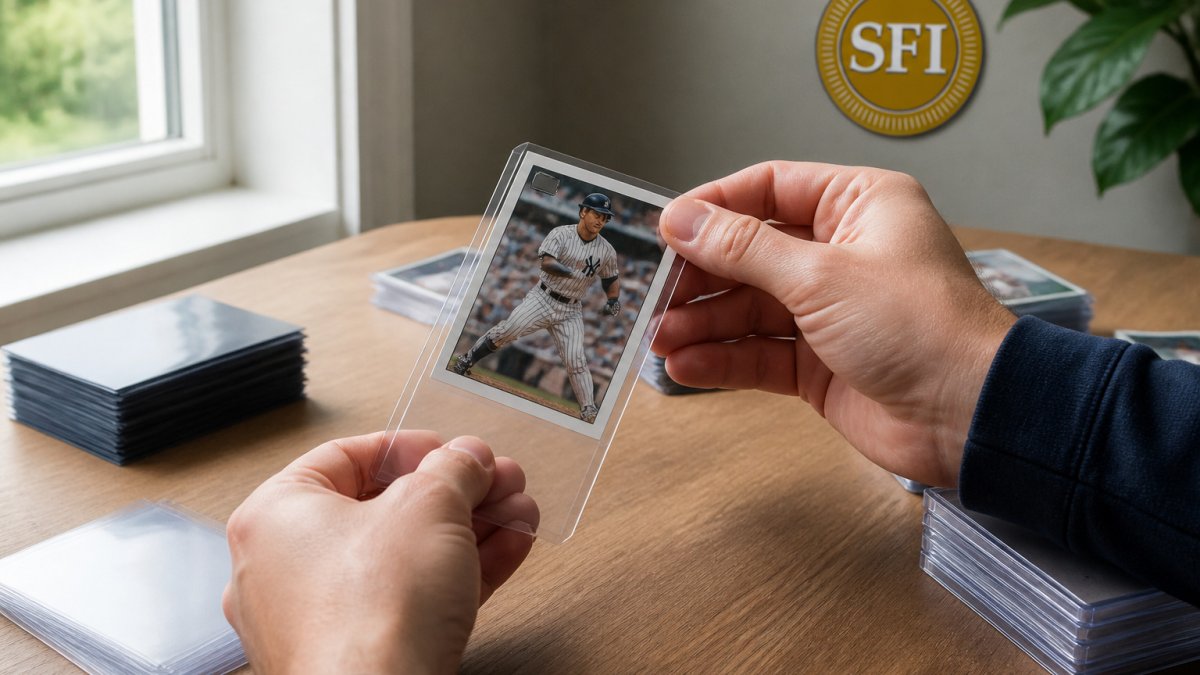
A protective sleeve is the first layer. It keeps the slab clean and guards the face from grit that works its way into packing material. A snug fit matters here: a loose sleeve lets the slab shift and picks up dust at the edges. Our Graded Card Slab Sleeves are cut for exactly this first layer.
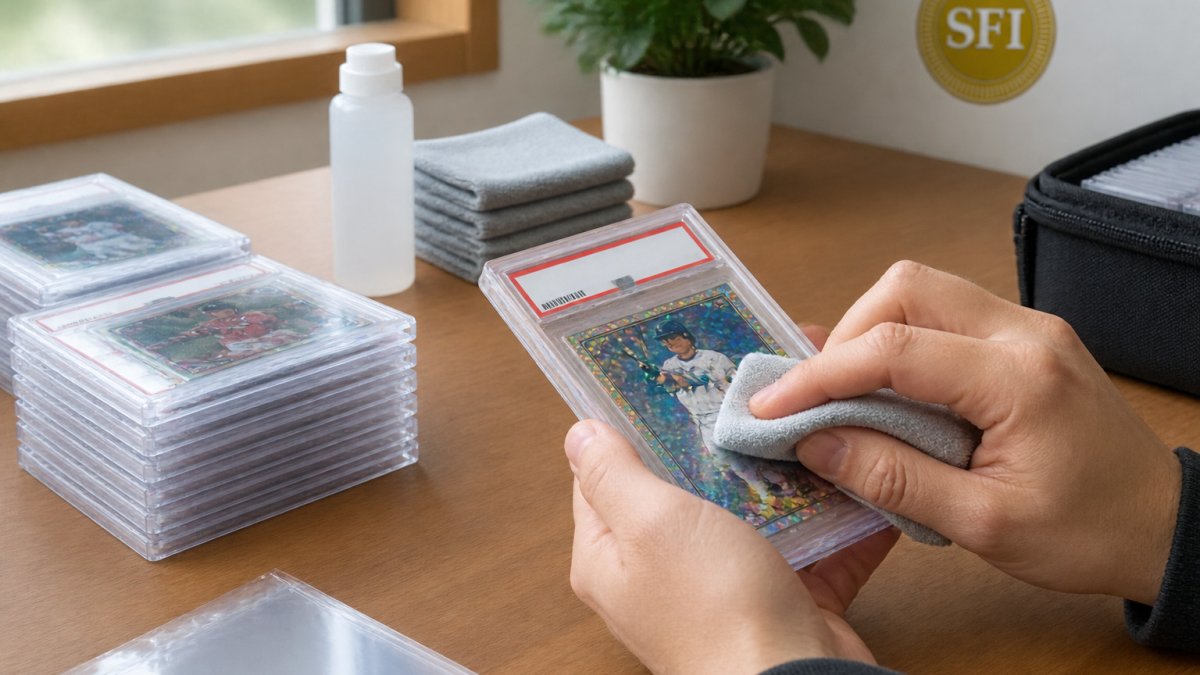
Fit the sleeve before you do anything else. Then set the sleeved slab on a clean, flat surface. Wipe the face with a microfiber cloth so no fingerprints get sealed under the wrap.
If you want the full method for getting a sleeve on without trapping air or creasing the flap, see our guide on how to fit sleeves on slabs. For the wider packing sequence, read preventing slab scuffs during transport.
Step 2: Wrap the Slab in Cushioning and Stop Movement
Cushioning protects the slab from impact, but stopping movement protects it from everything else. A slab that can slide inside its package will scuff its own face against the wrap. Bubble wrap alone does not solve that.
Here is the wrap we use:
- Cut a piece of bubble wrap about three times the width of the slab
- Lay the slab face-up and fold the wrap over it, bubble side in
- Add a second layer so the corners are covered
- Tape the wrap closed so it stays tight to the slab
- Shake it gently. If the slab moves inside the wrap, add another layer
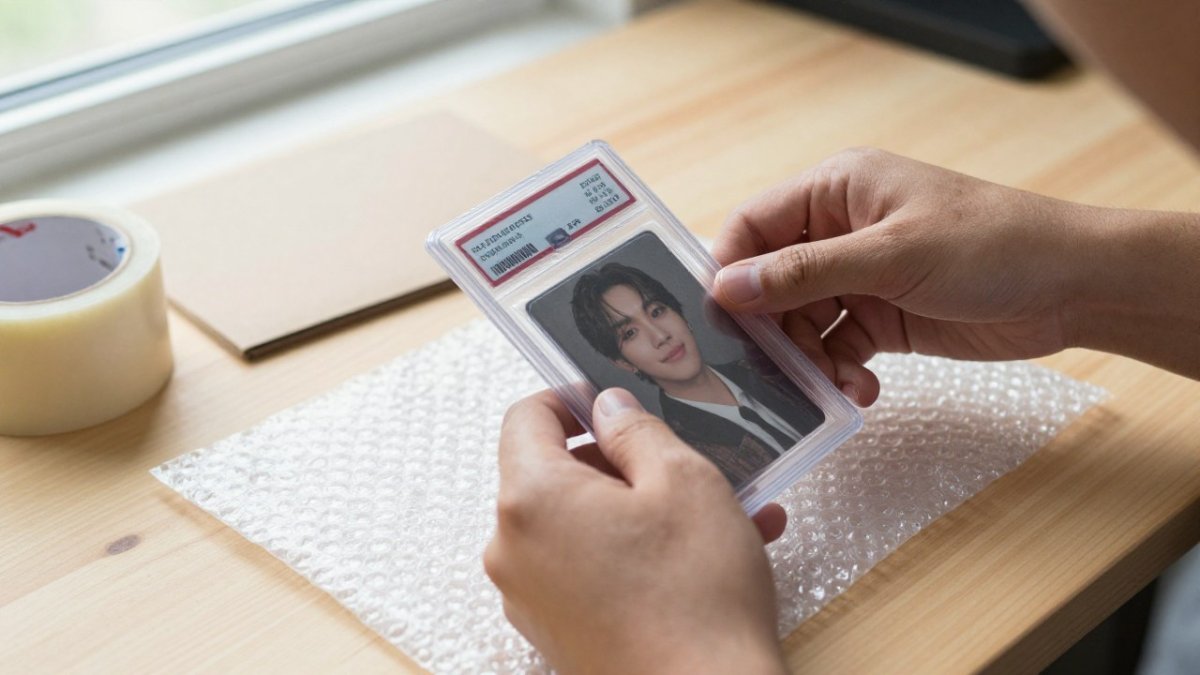
A common mistake is over-wrapping. Too much bubble wrap creates pressure points at the slab's edges when the box is closed. You want firm, even padding, not a tight ball. For a full rundown of protector types and how they layer, our graded card protectors guide covers the options.
Step 3: Choose the Right Graded Card Shipping Box
A graded card shipping box should be rigid, snug, and slightly larger than the wrapped slab. Skip the bubble mailer as the outer package for anything valuable. A mailer bends, and a bent mailer can crack a slab.
Pick a small corrugated box. The wrapped slab should sit inside with a little room on every side, no more. Fill that gap with bubble wrap or crumpled paper so nothing shifts.
Then add rigid reinforcement. Two pieces of stiff cardboard, one on each face of the wrapped slab, spread any impact across the whole surface instead of one corner. Tape the cardboard sandwich together so it stays put.
If you want holders that double as rigid shipping protection, browse our hard cases and top-loaders before you pack.
Step 4: What Size Bubble Mailer for Graded Cards Fits Safely
What size bubble mailer for graded cards works? A mailer only works when the slab is already inside a rigid box or sandwiched between stiff cardboard. The mailer is the outer layer, not the protection.
Never ship a bare slab in a mailer. The plastic face takes the full force of any drop. A mailer with a padded box inside is fine for lower-value cards. For high-value slabs, use a box only.
Step 5: How to Ship Graded Cards on eBay Without a Claim
Shipping graded cards on eBay without a claim comes down to three things: protection, tracking, and proof. Buyers file claims when a slab arrives cracked, when the grade or cert number does not match the listing, or when the package never shows up. Your job is to make each of those outcomes hard to argue.
The claims that actually get filed on graded cards fall into a few predictable buckets, and each one has a different defense:
- Arrived damaged. The buyer says the slab was cracked or scuffed in transit. Your defense is packing photos taken before the box was sealed and a box that shows no crush damage on arrival.
- Not as described. The buyer says the slab is a different grade, a different cert number, or a reholder. Your defense is a clear photo of the label and cert number in the listing and in your pre-ship photos.
- Never arrived. The buyer says the package did not show up. Your defense is tracking that shows delivery, plus signature confirmation on high-value slabs.
- Empty or wrong item. Rare, but it happens. Your defense is a photo of the slab inside the sealed box and the weight on the label.
Follow this checklist before you print a label:
- Slab sleeved, wrapped, and sandwiched in cardboard
- Box sealed on all seams with packing tape
- Label centered and flat, not over a seam
- Tracking number uploaded to the order
- Photos taken of the slab label and cert number before packing
- Photos taken of the packed, sealed box with the label visible
- Declared value and insurance matched to the sale price
- Signature confirmation added for high-value slabs
Those photos are your evidence. If a claim opens, you have a record of the slab's condition, its cert number, and how it was packed. Keep them until the buyer confirms delivery and the return window closes.
Watch out: a photo of the slab alone may not show what went in the box. Take one shot of the wrapped slab sitting inside the open box with the label and packing material visible, then a second shot of the sealed box with the label readable.
eBay's own rules on seller protection and its money-back guarantee are worth reading in full at eBay's seller protection policy, because the specific evidence a seller needs to keep protection depends on the claim type and the listing terms.
Each common eBay claim type has a matching piece of evidence that defends against it.
Claim type | Buyer's complaint | Your defense |
|---|---|---|
Arrived damaged | Slab cracked or scuffed in transit | Pre-seal packing photos and a box with no crush damage |
Not as described | Wrong grade, cert number, or reholder | Clear label and cert number photos in listing and pre-ship |
Never arrived | Package did not show up | Tracking showing delivery plus signature confirmation on high-value slabs |
Empty or wrong item | Rare, but it happens | Photo of slab inside sealed box and the label weight |
Step 6: The Cheapest Way to Ship Graded Cards Without Cutting Corners
The cheapest way to ship graded cards is not the smallest box or the thinnest wrap. It is the method that avoids a replacement. A cracked slab costs far more than any postage savings.
Ways to cut cost without cutting protection:
- Use lightweight corrugated boxes instead of heavy ones
- Keep the box snug so you use less filler
- Compare carrier rates for the same service level before you buy postage
What most guides miss is that a slightly larger box with more filler often costs more to ship and protects less. Snug beats big every time.
Step 7: Insure, Track, and Document Every Valuable Card Shipment
Insurance, tracking, and documentation are what turn a loss into a recoverable one. Declare the full value of the card. Under-insuring to save a little on postage leaves you covering the difference yourself.
Major carriers handle declared value differently, so check each carrier's current terms before you ship:
For each carrier, the same three things decide whether a claim pays:
- Proof of value. A receipt, a sold listing, or a completed sale price. A declared value with nothing behind it is easy to dispute.
- Proof of condition at shipping. Your pre-ship photos of the slab and the sealed box.
- Proof of packaging. Photos of the box, the cushioning, and the rigid reinforcement, plus the carrier's own packaging standards if they apply.
Add signature confirmation for high-value slabs. It creates a delivery record and removes the "it never arrived" argument. Keep the receipt, the tracking number, and your packing photos together until the buyer confirms delivery.
Watch out: carrier coverage limits and exclusions change. Check the current terms with your carrier before you ship, and follow their claims process exactly if something goes wrong.
For international buyers, customs forms and duties add another layer. Declare the value accurately on the customs form; an under-declared value can void insurance and create a customs problem at the same time. Document the declared value carefully and keep a copy of the customs form with your packing photos.
Build Your Packing Station With Slab-Ready Protection
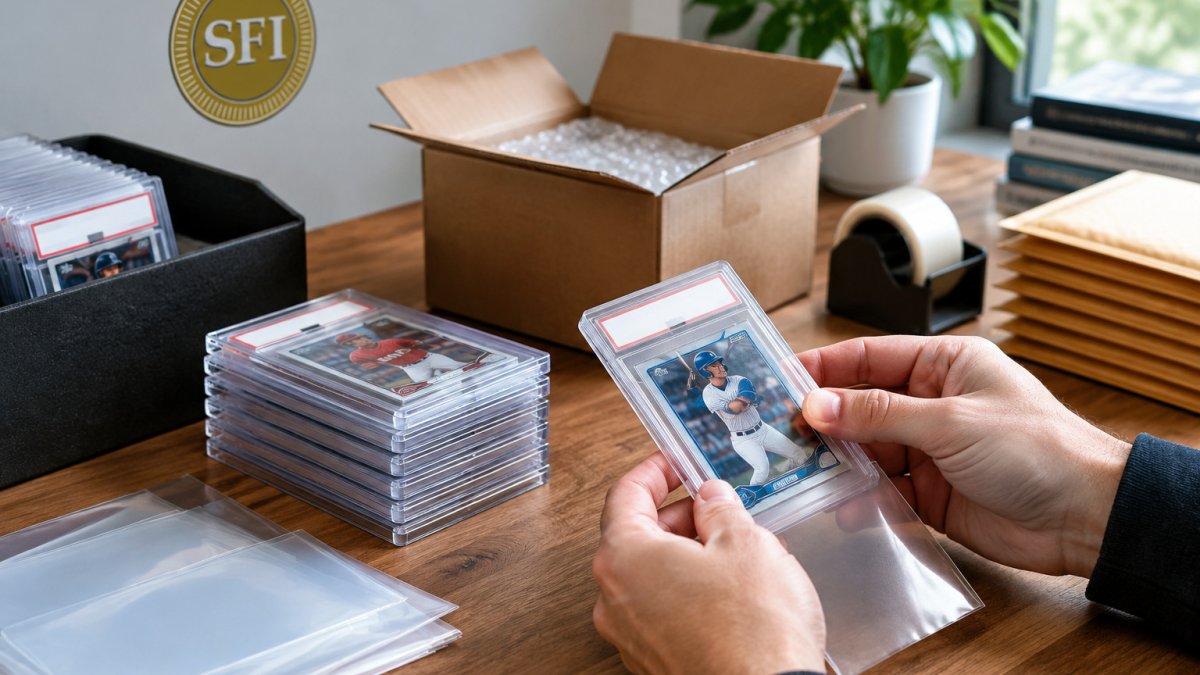
A dedicated packing station makes every shipment faster and more consistent. Set up a clear table with your sleeves, bubble wrap, tape, boxes, and cardboard cut to size. Keep a phone or camera nearby for packing photos.
The layer that touches the slab first matters most. Our archival-grade, acid-free sleeves are cut for a snug fit on PSA, BGS, SGC, and CGC holders, with a tapered resealable flap. If you also ship one-touch magnetic holders, our Magnetic Card Case Sleeves cover that format the same way.
For the full step-by-step method on protecting slabs before and during shipment, read our guide on how to protect graded slabs. Build the station once, and every graded card you ship leaves with the same protection.
Shipping a valuable slab safely takes more than a box and some tape. It takes the right sleeve, firm cushioning, a snug rigid box, and a record of every step. Superior Fit Sleeves gives you the first layer: precision-cut, ultra-clear sleeves with a tapered flap that fit major slab brands and keep the face scratch-free. Get started with Superior Fit Sleeves and ship every graded card with confidence.
Frequently Asked Questions
What is the best way to ship graded cards?
Put the slab in a snug protective sleeve first, then wrap it in bubble wrap so it cannot shift. Place it in a rigid box with cardboard reinforcement on both faces, seal every seam with tape, and ship with tracking. For high-value cards, add insurance and signature confirmation. A snug protective sleeve helps keep the slab from rubbing against the box.
Is a box safer than a bubble mailer for shipping graded cards?
A box is safer for anything valuable or fragile. Bubble mailers work for lower-value slabs when the card is wrapped in bubble wrap and sandwiched between two rigid cardboard sheets, but mailers bend under sorting pressure. A graded card shipping box holds its shape and keeps the slab flat. If the card is worth more than you would comfortably replace, use a box.
What size bubble mailer should you use for a graded card?
A graded slab typically measures about 3.25 by 4.5 inches, so a bubble mailer of at least 6 by 9 inches gives room for bubble wrap and two cardboard sheets without forcing the slab against the seams. Anything smaller compresses the padding. If you ship multiple slabs, move up to a larger mailer or switch to a box so the slabs cannot press against each other.
Should you insure a valuable graded card shipment?
Insure any card you could not easily replace. Declared value coverage through the major carriers protects against loss and transit damage, and signature confirmation adds a delivery record. Keep photos of the packed box, the sealed seams, and the receipt, because claims require proof of condition and value. Check the carrier's coverage limit before you ship, since some services cap declared value well below what a high-end slab is worth.