 how-to
How to Display PSA Slabs Step by Step
Table of Contents
- Assess Your Collection and Choose a Display Location
- Select the Right Graded Card Protectors for Your Slabs
- Implement UV Protection for Graded Cards
- Set Up Your PSA Slab Display Case
- Arrange and Organize Your Display
- Add Professional Lighting and Environmental Controls
- Maintain and Monitor Your Display Over Time
- Frequently Asked Questions
Last Updated: September 20, 2026
Assess Your Collection and Choose a Display Location
Before you display PSA slabs, count your graded cards, note their grades, and identify which pieces deserve prominent placement.
Pick your location carefully. Avoid direct sunlight and moisture-prone areas like kitchens and bathrooms. A climate-controlled bedroom, office, or living room works best.
Display PSA slabs where you can see them comfortably. Wall-mounted displays suit high-traffic areas; shelf arrangements work for personal collections you access frequently.
Select the Right Graded Card Protectors for Your Slabs
Your PSA slabs need outer protection. A protective sleeve guards against dust, fingerprints, and minor impacts.
Graded card protectors come in brand-specific and universal styles. PSA, BGS, and CGC slabs have different dimensions, so sleeves must match your slab brand.
Superior Fit Sleeves provides precision-cut protective solutions. Their Graded Card Slab Sleeves are engineered for a snug fit.
Matching Sleeves to Slab Brands
PSA slabs measure approximately 2.5" x 3.5"; BGS and CGC slabs differ. Matching sleeves to slab brands prevents loose sleeves that slide or tight sleeves that stress corners.
Check your slab's exact measurements before ordering sleeves. If mixing brands, you'll need multiple sleeve types.
Precision-Fit vs. Loose Sleeves
Precision-fit sleeves eliminate movement and create a uniform appearance. Loose sleeves risk damage from shifting.
For display, precision-fit is the clear winner, your collection looks intentional and professional.
Implement UV Protection for Graded Cards
UV radiation causes label fading and card color shift. PSA labels fade under UV-A and UV-B wavelengths; cards inside shift color (reds become orange, blues fade to gray, whites yellow). This permanent damage reduces eye appeal and resale value.
Slab casings degrade under UV exposure, becoming brittle or cloudy. High-grade slabs (9s and 10s) are especially vulnerable; color shift reduces market value by 10-30% or more.
Understanding UV Risk in Your Display Location
Direct sunlight delivers 10,000-50,000 lux with significant UV. Indirect sunlight is safer but still carries UV. LED bulbs vary, warm white (2700K-3000K) emits negligible UV; "daylight" and "cool white" LEDs often emit 5-15% UV-A.
If direct sun hits your display for more than 2-3 hours daily, UV protection is essential. Check bulb specifications for displays under ceiling lights 8+ hours daily.
Three-Tier UV Protection Strategy
Tier 1: Light Source Control (Most Effective) Replace overhead lighting with UV-filtered LED bulbs rated under 0.5% UV output. Install UV-blocking window film (99% UV rejection) on windows receiving direct sunlight. Cost: $20-60 per window.
Tier 2: Display Case Barriers Use UV-filtering acrylic risers or display cases (blocks 99% UV-A and UV-B). UV-filtering acrylic costs 15-25% more than standard acrylic. Alternatively, place UV-filtering sleeves over protective sleeves ($0.50-1.50 per slab).
Tier 3: Rotation and Monitoring Rotate your display every 6-12 months to distribute light exposure evenly. Monitor quarterly by photographing slabs under consistent lighting; compare photos to detect color shift your eye may miss. Move any slab showing yellowing, cloudiness, or color shift to a darker location.
Set Up Your PSA Slab Display Case
How you arrange your display determines whether it looks like a curated collection or a storage shelf. There are two main approaches: wall-mounted systems and shelf-based arrangements.
Wall-Mounted Display Systems
Wall mounting creates a gallery effect. Install level shelves 8-12 inches apart using hardware rated for the combined weight of 20-30 slabs. Mark stud locations and use appropriate anchors.
Shelf and Riser Arrangements
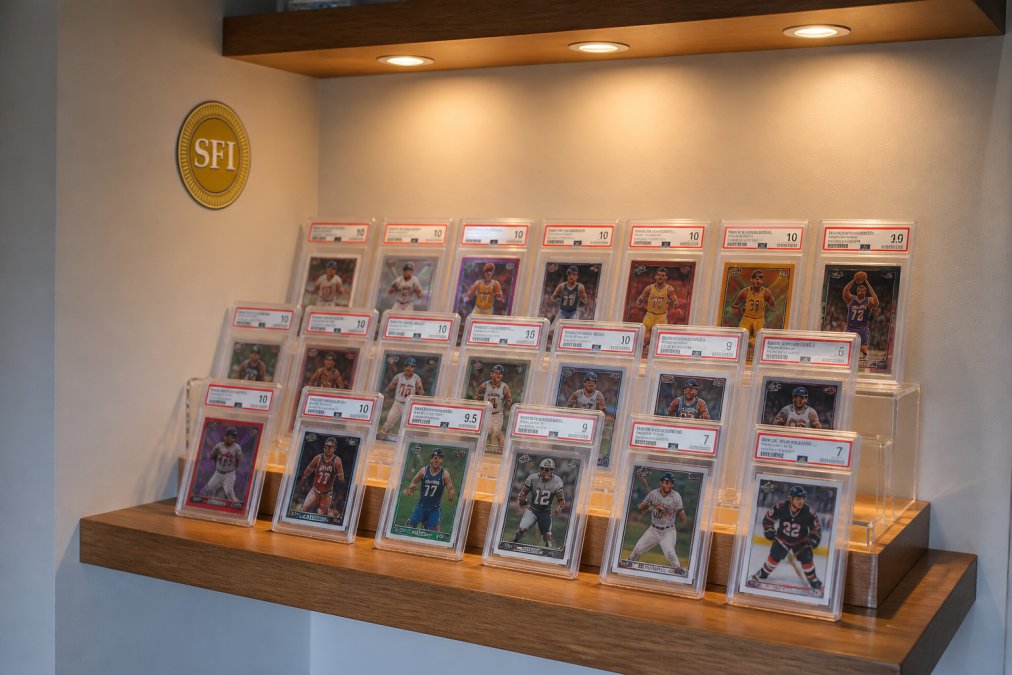
Use clear acrylic risers in tiered patterns to improve sightlines. A standard bookshelf holds 50-100 slabs. Avoid overcrowding. Consider card orientation: horizontal for modern cards, vertical for vintage cards.
Arrange and Organize Your Display
Pick one organization system: by grade (high-grade cards prominent), by set (showing completion progress), or by value (highlighting expensive cards). This creates a coherent display.
Label visibility matters. If your slab labels face forward, ensure the text is readable from your typical viewing distance. Angle risers slightly if needed so labels don't glare under lights.
Add Professional Lighting and Environmental Controls
Lighting transforms your display from functional to impressive. The right lighting reveals card details, reduces glare, and protects your collection.
LED strip lights mounted above or below shelves provide soft, even illumination. Choose warm white LEDs (2700K-3000K color temperature) for a gallery feel. Avoid bright white LEDs, which create harsh glare on acrylic sleeves and risers.
Position lights to minimize reflections on protective sleeves. Angle them slightly downward rather than straight across. This reduces glare while highlighting the cards themselves.
Environmental controls keep your collection stable. A small humidifier or dehumidifier maintains relative humidity between 40-50%. A room thermometer helps you track temperature swings. Stable conditions prevent the expansion and contraction that stresses slab seals.
Avoid placing your display near heating vents, air conditioning units, or radiators. These create temperature fluctuations that damage cards over time.
Maintain and Monitor Your Display Over Time
Your display requires ongoing maintenance across three dimensions: physical preservation, documentation for insurance, and security against theft. Neglecting any one of these can result in permanent loss or uncompensated damage.
Physical Inspection and Cleaning
Check your display monthly for signs of damage, dust accumulation, or shifting slabs. Clean acrylic risers and sleeves gently with a microfiber cloth and distilled water only. Never use harsh chemicals, alcohol-based cleaners, or abrasive materials, these can cloud acrylic, damage protective sleeves, or leave residue that attracts dust.
Inspect protective sleeves for yellowing, fogging, or brittleness. Archival-grade sleeves resist yellowing. If you notice cloudiness developing, replace those sleeves immediately to prevent further damage and to restore visibility of the slab label. Keep spare sleeves on hand so you can replace compromised ones without disrupting your display.
Monitor temperature and humidity with a digital hygrometer. Record readings monthly in a spreadsheet or notebook. If you notice consistent fluctuations (swings of more than 10% relative humidity or 5°F in a single day), adjust your environmental controls. A small humidifier or dehumidifier can stabilize conditions significantly. Avoid placing your display near heating vents, air conditioning units, radiators, or windows, these create localized temperature and humidity fluctuations.
Rotate your display every 6-12 months. Move cards from prominent positions to secondary spots and vice versa. This distributes light exposure evenly across your collection and prevents the one-sided color fading that occurs when display-facing cards receive constant illumination. Rotation also gives you an opportunity to inspect the backs of slabs and risers for dust or moisture.
Documentation and Insurance Protection
Displaying high-value slabs increases your insurance liability. Most homeowners' policies cover collectibles up to a certain limit without a separate rider. If your collection exceeds this threshold, you may need a collectibles insurance policy or an endorsement to your existing homeowners' policy. Securing adequate coverage provides the necessary peace of mind to display classic collectibles in ways that showcase their historical significance while mitigating potential financial loss.
Insurance companies require detailed documentation: photographs, condition grades, purchase prices, and current market values.
Security and Theft Prevention
Displaying graded slabs, especially high-grade or vintage cards, makes your home a target for theft. A PSA 10 vintage card can be worth $5,000-50,000+, and thieves specifically target collectible displays. Implement security measures proportional to your collection's value.
Seasonal and Long-Term Monitoring
Review your collection's value annually. Market prices for graded cards fluctuate based on player performance, set popularity, and overall collector demand. Update your inventory list with current market values and photograph your display for insurance purposes. If your collection grows significantly (adding $5,000+ in value), you may need additional display space or upgraded environmental controls and security measures.
Frequently Asked Questions
What's the best way to protect PSA slabs from UV damage while displaying them?
UV protection for graded cards requires multiple layers: use UV-blocking acrylic display cases or frames, install LED lighting instead of incandescent bulbs (which emit heat and UV), and position your display away from direct sunlight. If your collection sits near windows, apply UV-filtering window film. Archival-grade protective sleeves add an extra barrier against fading and environmental damage. Check your display monthly to ensure no direct sunlight reaches your slabs, especially during afternoon hours.
Will precision-fit sleeves work for PSA, BGS, and CGC slabs without being too loose or tight?
Slab dimensions vary slightly between grading companies. PSA slabs, BGS slabs, and CGC slabs have different thickness tolerances and edge specifications. Precision-fit graded card protectors are engineered to match the exact dimensions of each slab type, ensuring a snug fit without pressure that could damage the case. When selecting sleeves, verify the manufacturer specifies compatibility with your specific slab brand. A proper fit prevents shifting inside the sleeve while maintaining label visibility and card integrity.
How do I know if my sleeves are archival quality and won't yellow over time?
Look for sleeves explicitly labeled as acid-free and archival-grade. These materials resist yellowing, fogging, and brittleness for decades. Avoid cheap sleeves that feel brittle or cloudy out of the box, these often contain plasticizers that degrade and discolor. Premium sleeves protect your collection's value long-term.
Can I use the same sleeves for top-loaders, magnetic cases, and PSA slabs?
No. Each storage method requires different sleeve dimensions. Top-loaders have different interior dimensions than magnetic one-touch cases, and both differ from PSA slab thickness. Using the wrong sleeve size creates gaps that allow shifting or, conversely, applies pressure that damages the case or card. Superior Fit Sleeves offers specialized products for each format, graded card slab sleeves, top-loader sleeves, and magnetic case sleeves, so you can protect your entire collection with the correct fit for each type.