 How-to
Does Humidity Damage Graded Cards?
Last Updated: November 7, 2026
Quick Summary
Humidity damage is the gradual harm moisture causes to a graded card and its holder, including warped card stock, mold growth, label staining, and condensation trapped inside the case. A slab blocks physical contact but is not airtight, so moisture vapor still moves through the seams and around the label window over time.
- Preservation guidance for paper collectibles commonly cites a relative humidity range of roughly 45% to 55%, with 50% as a comfortable target.
- A steady 50% is safer than a room that swings from 30% to 55% every week.
- Buy a digital hygrometer rather than an analog dial and place it at card height.
- Silica gel packets work in small, closed spaces and do almost nothing in an open room.
- In a sealed bin in a humid climate, check desiccant every 4-6 weeks and replace on color change.
Table of Contents
- How Humidity Damages Graded Cards
- The Best Humidity for Trading Cards: Reconciling the Ranges
- PSA Slab Humidity Protection: What the Case Actually Guards
- Monitoring Your Storage Environment With a Hygrometer
- Silica Gel Packets for Card Storage: Where They Help and Where They Don't
- Do You Need a Dehumidifier for Trading Cards?
- Building a Humidity Response Plan for Your Collection
- Choosing Slab Sleeves and Storage Containers That Work Together
- Frequently Asked Questions
How Humidity Damages Graded Cards
Protecting graded cards from humidity damage starts with one uncomfortable fact: a graded slab is a display case, not a sealed vault.
Here is what actually happens. Paper is hygroscopic, meaning it absorbs and releases moisture from the air.
Humidity damage is the gradual harm that moisture causes to a card and its holder: warped card stock, mold growth, label staining, and condensation trapped inside the case. It rarely happens overnight.
What a Slab Does and Does Not Seal Out
A slab blocks physical contact. It stops fingerprints, scratches, and bent corners.
It does not block moisture vapor, and it is not airtight. The plastic seams and the label opening let humid air exchange slowly with the room. So the card inside still tracks the humidity of the space around it, just more slowly.
That gap matters most in three places:
- Paper card stock, which swells and can warp with repeated moisture swings
- The paper label, which can stain or wrinkle when damp
- The inner plastic surface, where condensation can form during temperature drops
Treat the slab as a shield against touch, not against weather.
The Best Humidity for Trading Cards: Reconciling the Ranges
You will see wild disagreement online about the best humidity for trading cards. Some guides say 30%, others say 50%, and a few push higher.
Preservation guidance for paper collectibles commonly cites a relative humidity range of roughly 45% to 55%, with 50% as a comfortable target.
Why the confusion? First, people confuse temperature comfort with humidity comfort. Second, cheap hygrometers drift, so two collectors can read different numbers in the same room.
Stability beats perfection. A steady 50% is safer than a room that swings from 30% to 55% every week.
PSA Slab Humidity Protection: What the Case Actually Guards
PSA slab humidity protection is really about the case's limits, and the limits are more specific than most guides admit. The holder protects against handling damage and keeps the card rigid.
So the case buys you time, not immunity. A slab slows moisture exchange, which softens short humidity spikes. It cannot stop a slow seasonal climb in a damp basement.
What Humidity Can and Cannot Do Inside a Slab
This is where slab-specific guidance beats generic card-storage advice. Ambient humidity and direct water exposure are different problems with different outcomes.
- Card stock: Paper inside the slab can respond to moisture vapor over time, especially with repeated humidity swings.
- The label: The paper label is the most humidity-sensitive part of the assembly. Damp air can wrinkle or stain it, and a fogged or stained label affects presentation and, in some cases, resale confidence.
- The plastic: The slab itself does not absorb water, but condensation can form on the inner surface during temperature drops. That condensation is the mechanism that can wick toward the label.
- Direct water exposure: A spill, a leak, or a damp shelf is a different category from ambient humidity.
Treat the slab as a shield against touch, not against weather. The practical takeaway is that ambient humidity is a slow, manageable variable, while liquid water and condensation are the acute risks worth guarding against first. For deeper guidance, see our archival card storage for graded slabs.
Practical Slab Handling
- Keep slabs upright and off cold floors, where damp air settles.
- Avoid stacking heavy slabs in ways that stress the seams.
- Check the label window for fogging after any temperature swing.
- Keep slabs off exterior walls in humid climates, where condensation on the plastic is most likely.
For a fuller walkthrough of physical protection, see our step-by-step guide to protecting graded slabs.
Watch out: a slab that shows fogging on the inside of the case after a cold snap is telling you the surrounding air is crossing a dew point, so treat it as a signal to check room humidity and airflow rather than wiping the outside and moving on.
Monitoring Your Storage Environment With a Hygrometer
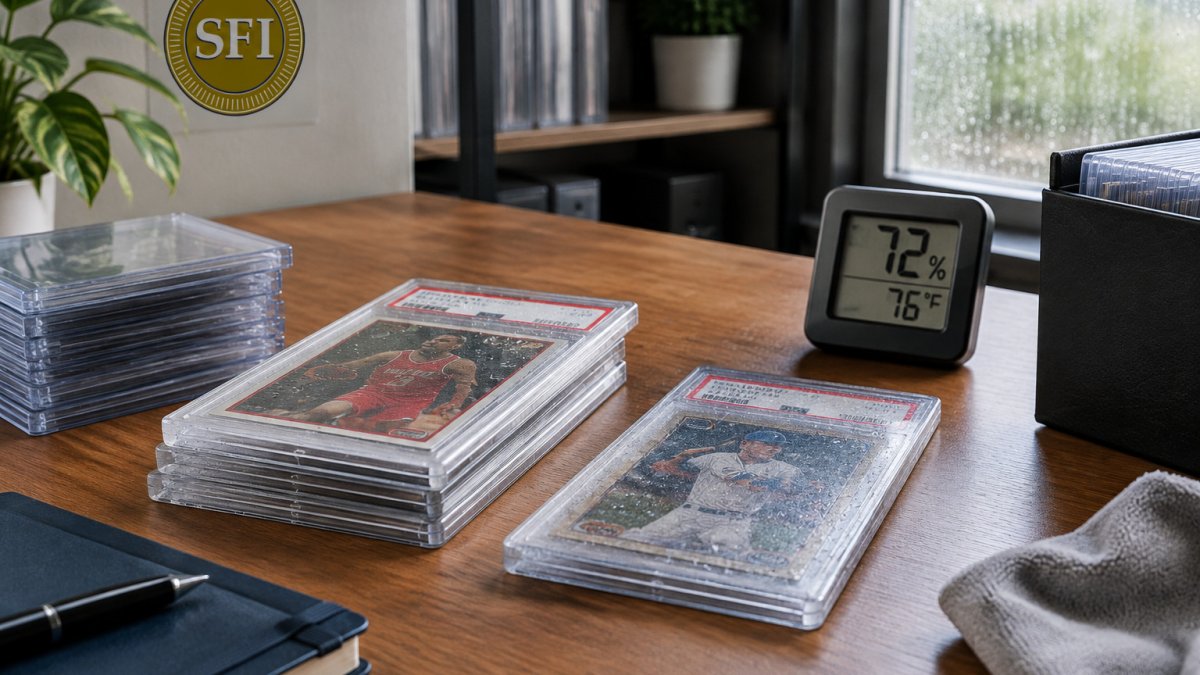
A hygrometer is the single cheapest tool that changes how you store cards. It measures relative humidity in the air around your collection.
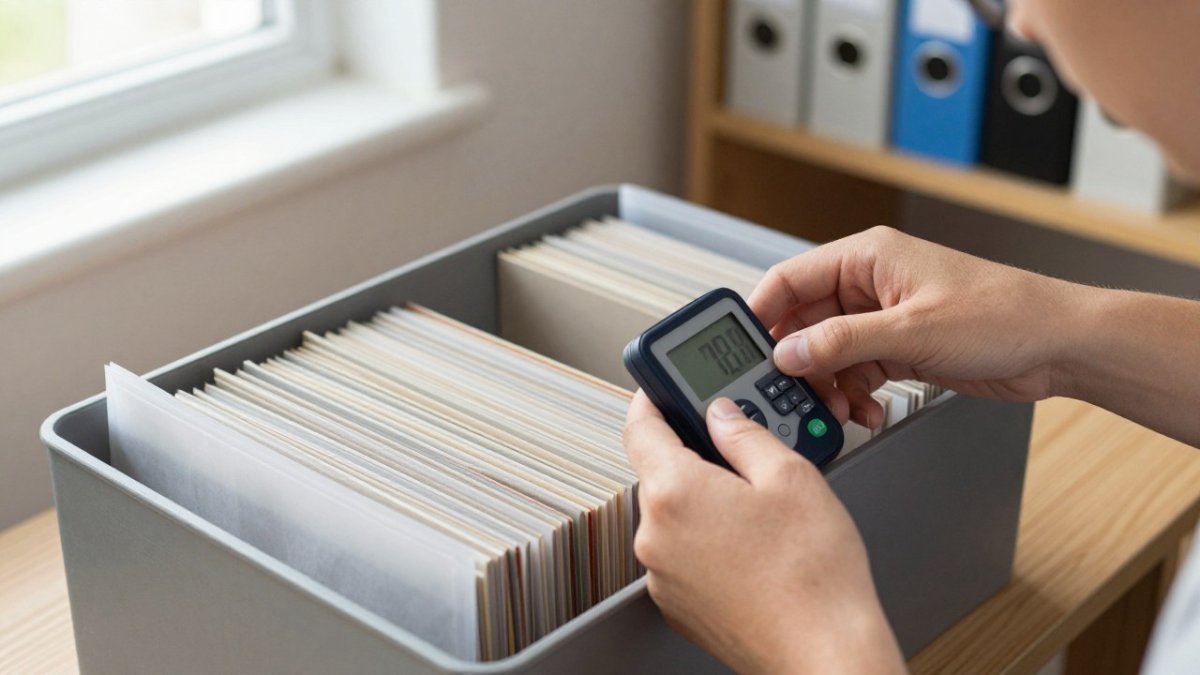
Buy a digital hygrometer, not an analog dial. Digital units read faster and drift less. Place it at card height, inside or beside your storage area, not on the floor.
Then build a simple habit:
- Read it at the same time each week. Morning readings are most stable.
- Log the number. A notebook or phone note works fine.
- Watch the trend, not one reading. Two weeks of rising numbers is your early warning.
- Recalibrate or replace a hygrometer that reads far from a second unit in the same room.
The National Weather Service humidity and dew point guidance explains how relative humidity shifts with temperature, which is why a cold snap can spike indoor moisture.
Silica Gel Packets for Card Storage: Where They Help and Where They Don't
Silica gel packets for card storage work in small, closed spaces. They do almost nothing in an open room, and they can do harm if you overdo them.
Think of desiccant as a sponge for a sealed box. Put packs in a closed storage bin with slabs, and they pull moisture from that trapped air. Leave the lid open, and the pack saturates fast and stops helping.
Sizing Packs to the Space
There is no universal pack count, because silica capacity scales with the volume of air you are drying and the humidity load it sees. A tighter bin generally needs less desiccant than a loose one with gaps around the lid, so adjust the amount based on your own readings.
Placement Rules
- Put packs in the bin, not on the slabs. Direct contact with a slab can create a localized dry spot and, if a pack leaks, a stain risk.
- Keep packs away from the label window and card edges.
- Use a small open container or mesh bag so air reaches the silica.
- Do not bury packs under heavy slabs where airflow is blocked.
Replacement and Reactivation
Indicator silica changes color as it saturates, which makes it easier to know when to replace it. A simple schedule:
| Storage Situation | Check Desiccant | Replace or Recharge |
|---|---|---|
| Sealed bin, stable room | Every 3 months | When indicator changes color |
| Sealed bin, humid climate | Every 4-6 weeks | On color change |
| Open shelf display | Not effective | Use room control instead |
| Safe or cabinet | Every 2-3 months | On color change |
Many silica packs can be reactivated by gentle heat, following the manufacturer's instructions, but only if the pack is the rechargeable type. Reusing a saturated pack without recharging it gives you false confidence: it is holding water, not absorbing more.
Watch out: over-drying a sealed bin can stress card stock just as damp air does, so pair desiccant with a hygrometer inside the bin and back off if readings fall too low.
When Desiccant Is the Wrong Tool
If a whole room runs damp, packs will saturate faster than you can replace them. That is a signal to fix the room with a dehumidifier or relocate the collection, not to buy more silica.
Do You Need a Dehumidifier for Trading Cards?
A dehumidifier for trading cards makes sense when a whole room runs damp. It is overkill for a single shelf in a dry home.
Match the tool to the problem:
- One damp closet: desiccant packs plus a sealed bin may be enough
- A whole basement room: a portable dehumidifier with a drain hose
- A safe or cabinet: small rechargeable desiccant units
- A dry, stable room: a hygrometer and nothing else
The trade-offs matter. Dehumidifiers add noise, use power, and need draining. They can also overshoot and dry a room too far, which can stress card stock. Run one with a target setting and a hygrometer nearby so you can confirm the result.
Building a Humidity Response Plan for Your Collection
A response plan turns worry into steps. Set thresholds and decide your action before the numbers move.
Use this framework:
- Green (45-55%): no action, keep logging weekly
- Yellow (35-45% or 55-60%): add or recharge desiccant, check seals on bins
- Orange (30-35% or 60-65%): move slabs to a more stable room, run a dehumidifier or add humidity as needed
- Red (below 30% or above 65%): relocate the collection, fix the room, recheck daily
Climate changes the plan. In a humid coastal summer, lean on sealed bins and desiccant. In a dry winter with indoor heating, watch for the low end and avoid blasting heat near the collection.
For storage that supports this plan, our guide to the best storage boxes for graded cards covers options built for slab dimensions.
Choosing Slab Sleeves and Storage Containers That Work Together
Sleeves and containers should solve two problems at once: surface protection and a stable microclimate. A good slab sleeve adds a clear barrier against scuffs, dust, and handling, and it pairs with a sealed bin to slow moisture exchange.
Fit matters more than people expect. Our archival-grade, acid-free Graded Card Slab Sleeves are cut for PSA, BGS, SGC, and CGC slabs. If you also keep raw cards in rigid holders, Top-Loader Sleeves offer the same snug, dust-blocking fit for that format.
If you are sizing sleeves for a mixed collection, our CGC vs PSA slab sleeve sizing guide walks through the differences. Ready to protect a batch of slabs? See the Snap Slab sleeves for PSA and CGC graded slabs.
A few buying checks:
- Confirm the sleeve is cut for your specific slab brand
- Look for acid-free, archival-grade material
- Check clarity before bulk buying
- Store sleeves flat and dry before use
Pair sleeves with the right container, keep a hygrometer nearby, and refresh desiccant on schedule. That trio does more for long-term storage than any single product.
Humidity is the quiet threat most collectors underestimate, and it rewards a simple routine: measure, respond, repeat.
Frequently Asked Questions
Do PSA slabs protect cards from humidity?
A PSA slab holds the card inside rigid plastic, which blocks direct contact and slows moisture exchange. It does not make the card immune. Moisture can still migrate slowly through seams and around the label, and the paper insert inside the slab responds to ambient conditions. Treat PSA slab humidity protection as risk reduction, not a guarantee. Keep slabs in a stable room, monitor relative humidity with a hygrometer, and add a snug outer slab sleeve for a second barrier.
What humidity level is best for storing trading cards?
Published collector guidance commonly cites a relative humidity range near the middle of the typical indoor band, with a steady level generally preferred over sharp swings. Avoid sharp swings more than steady numbers. A room that holds between 45% and 55% year-round is easier on graded cards than one that spikes to 70% in summer and drops to 25% in winter. Monitor for at least a week before trusting any single reading.
Can silica gel packets help protect graded cards?
Silica gel packets for card storage work best inside a sealed container, not in an open room. Place a few packets in a closed bin with your slabs and they will absorb moisture trapped in that small air volume. Replace them when the indicator beads change color. In an open shelf setup, packets do almost nothing because they saturate quickly. Pair them with a gasketed storage container and a hygrometer so you can confirm the humidity actually dropped.
Should you use a dehumidifier to protect a card collection?
A dehumidifier can help when a room consistently runs damp. Check results with a separate hygrometer rather than relying only on the unit's display. In drier regions, a dehumidifier is unnecessary and can pull a room too low. The trade-off is noise, energy use, and the need to empty the tank or route a drain. Small collections are usually better served by sealed containers and desiccants.