 How-to
Can Humidity Ruin Your Pokémon Card Collection?
Last Updated: November 9, 2026
Quick Summary
Humidity pokemon cards damage happens when moisture seeps into the layered paper core, causing curling, wavy edges and soft corners, especially on foil cards. Protect your collection by keeping relative humidity steady at roughly 40% to 50%, double sleeving cards, adding correctly sized desiccant or two-way control packs, and running a dehumidifier in damp rooms.
- A hygrometer is the inexpensive tool that shows the humidity level in your storage area.
- Calibrate your hygrometer with the salt test so you can trust its readings.
- Double sleeving with acid-free inner sleeves blocks air and moisture from card edges.
- Match desiccant pack size to the container, since too much can over-dry card stock.
- Dry moisture-damaged cards slowly at room temperature and never use heat.
Table of Contents
- Why Humidity Is the Silent Threat to Your Pokémon Cards
- Recognizing Pokémon Card Humidity Damage Before It Spreads
- The Best Humidity for Pokémon Cards: What Your Hygrometer Should Read
- Step-by-Step: How to Protect Pokémon Cards from Humidity and Moisture
- Choosing a Dehumidifier for Trading Cards: What Actually Works
- Do Humidity Packs for Cards Help or Hurt?
- Long-Term Storage vs. Active Collection: Two Different Humidity Plans
- Fixing Moisture Damage Safely and Preventing a Repeat
- Frequently Asked Questions
Why Humidity Is the Silent Threat to Your Pokémon Cards
Humidity pokemon cards damage is real, and it rarely announces itself.
Here is the part most guides skip: a Pokémon card is layered paper. The paper core absorbs water and swells. The foil layer on top does not swell the same way.
Below, we will show you exactly how to protect pokemon cards from humidity and moisture, from the sleeve you pick to the room you store them in.
A common mistake is storing cards in a damp basement "because it is dark." Darkness does not stop moisture. EPA guide to indoor humidity and mold notes that indoor humidity above ideal levels encourages mold growth on paper materials.
If bending is already a worry, our guide on how to prevent Pokémon cards from bending covers the physical side of the same problem.
Recognizing Pokémon Card Humidity Damage Before It Spreads
Pokémon card humidity damage shows up in a few predictable ways, and catching it early saves the card. Look for these signs:
- Curling or bowing, especially on foil and holographic cards
- Wavy edges that no longer sit flat on a table
- Soft or spongy corners when you press gently
- A faint musty smell when you open the box
- Cloudy or foggy spots under the surface
The tricky part is that a slight curve can flatten out on its own once the air dries. That does not mean the card is fine. Repeated swelling and drying weakens the paper over time.
Graded slabs are not immune either. If you keep slabs in a humid space, read our breakdown on whether humidity damages graded cards before you assume the plastic is enough.
The Best Humidity for Pokémon Cards: What Your Hygrometer Should Read
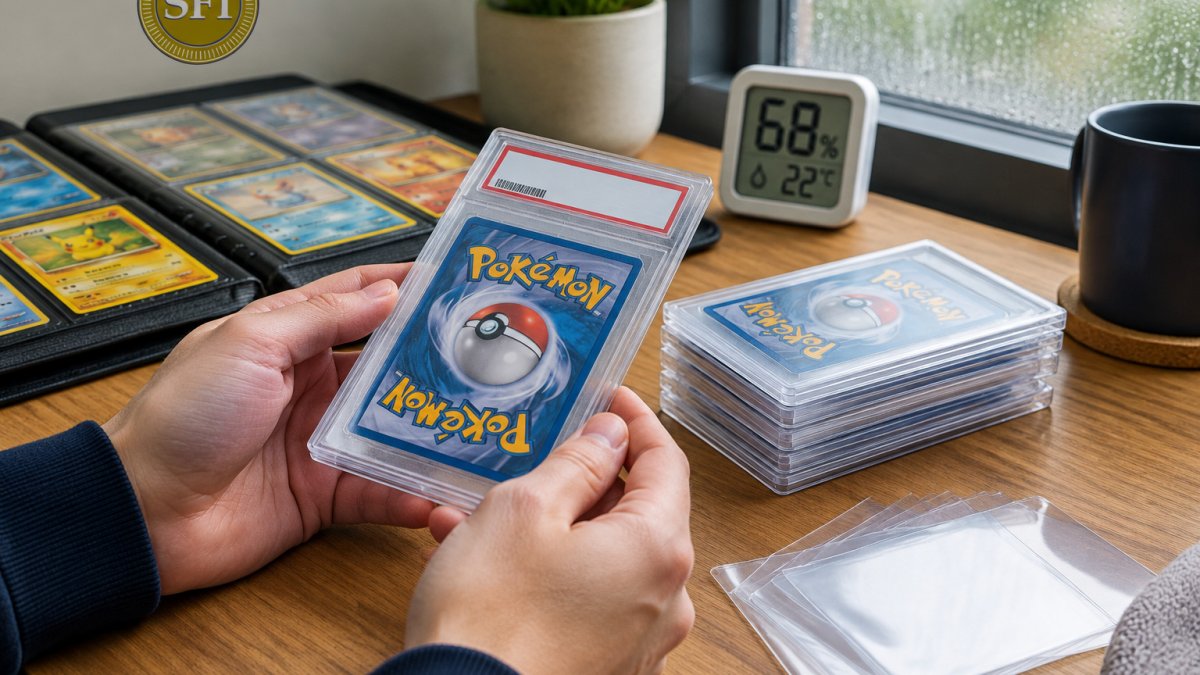
The best humidity for Pokémon cards sits in a stable middle range, roughly 40% to 50% relative humidity, not too dry and not too damp.
Why the middle matters: too much moisture swells the paper core, and air that is too dry pulls moisture out and can make cards brittle and prone to edge cracking. Keeping the reading steady matters more than chasing a single perfect number.
Placing the Hygrometer Correctly
Where you put the meter changes the number it reports. A few habits that help:
- Keep the hygrometer near the cards, not across the room, air at the shelf level is what the cards actually breathe
- Put it inside the storage container if the cards live in a sealed box, since the microclimate inside differs from the room
- Keep it off the floor and away from exterior walls, where moisture gathers and readings run high
- Log the reading once a week so you spot trends instead of reacting to a single bad day
- Watch for swings after weather changes or season shifts, and note them next to the reading
Calibrating Your Hygrometer with the Salt Test
Calibrating your hygrometer is the step almost everyone skips, and it is the difference between trusting your numbers and guessing. Consumer hygrometers can drift from their factory calibration, so an uncalibrated meter may not give an accurate reading.
Reading Trends, Not Just Numbers
A single reading is a snapshot; the trend is the story. A room that reads 48% every morning but spikes to 65% overnight is a room with a moisture problem, even though the daytime number looks fine. Log readings at the same time each day, and compare week to week.
If bending is already a worry, our guide on how to prevent Pokémon cards from bending covers the physical side of the same problem.
Step-by-Step: How to Protect Pokémon Cards from Humidity and Moisture
Protecting pokemon cards from humidity and moisture comes down to four layers: sleeve, desiccant, hard holder, and room control. Each layer handles a different part of the job.
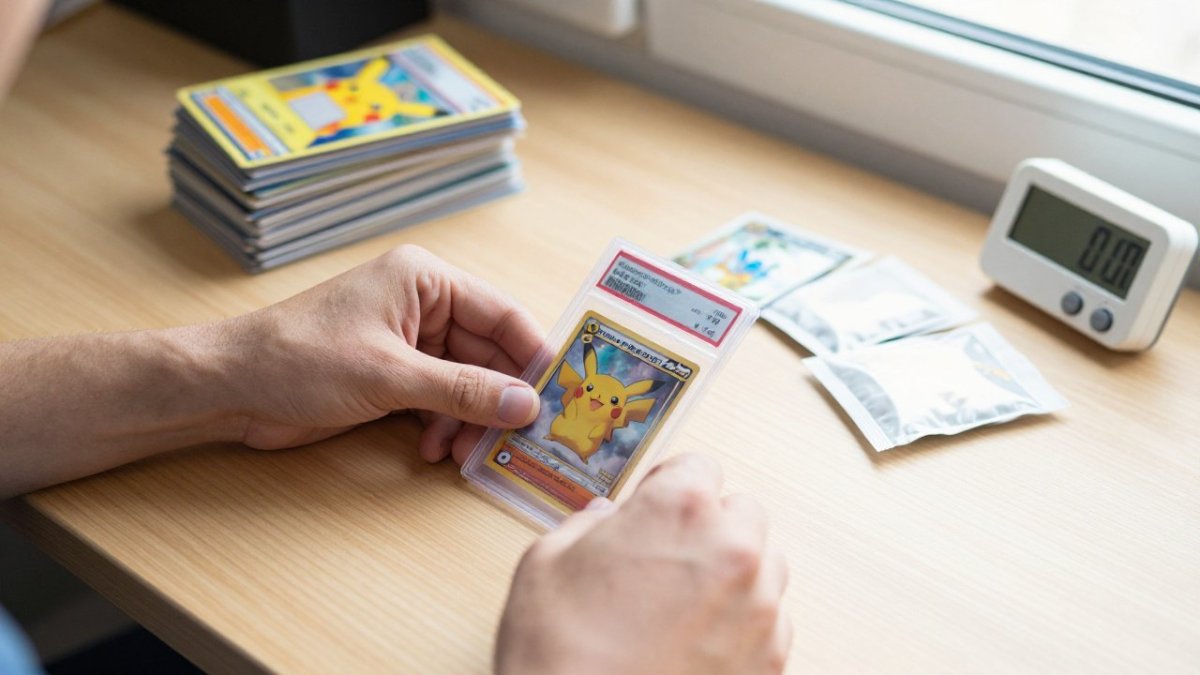
Step 1: Sleeve and Double-Sleeve Every Card
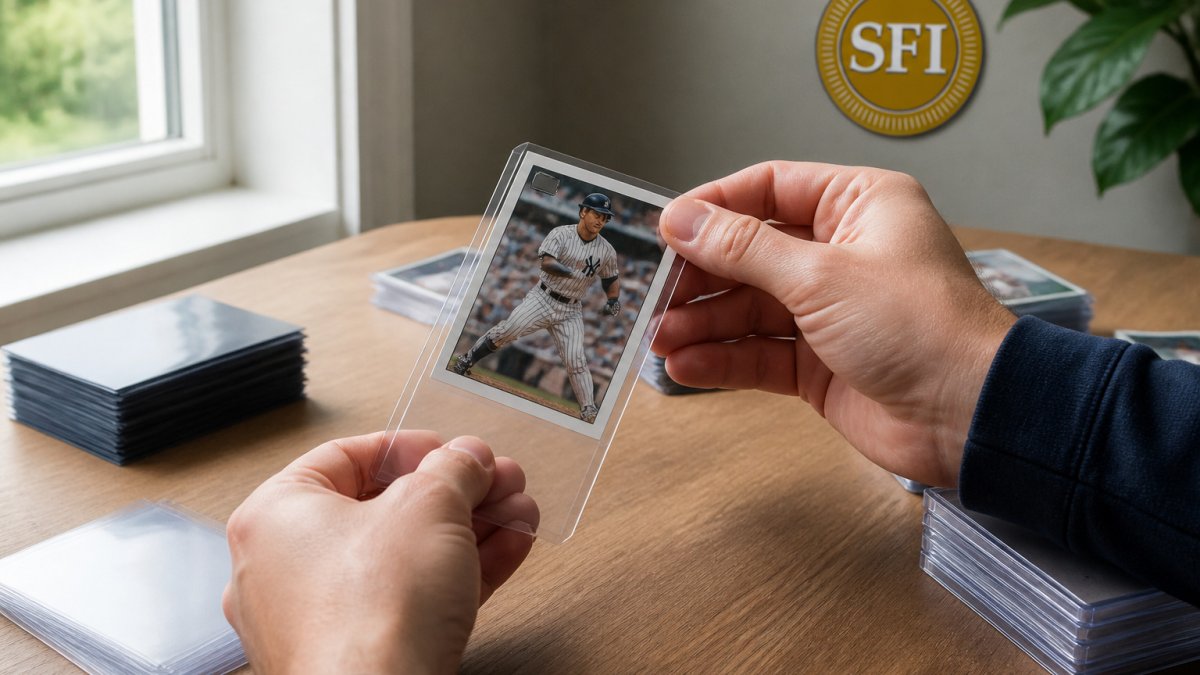
Start with a clean, acid-free inner sleeve, then add a second sleeve facing the opposite way. This double sleeving method blocks air and moisture from reaching the card edges. Use archival-quality, acid-free sleeves so the plastic itself does not break down over the years.
Step 2: Add Desiccant Packets and Silica Gel
Silica gel and desiccant packets absorb moisture inside a closed box or case (Desiccant Films Made of Low-Density Polyethylene with Dispersed Silica Gel, Water Vapor...). Drop a few into your storage container and swap them when they stop working. Rechargeable silica changes color as it saturates, which makes it easy to track.
Watch out: do not let a loose packet rest against a raw card. The packet can rub or leave a mark. Keep packets in a corner of the box, away from the cards.
Step 3: Use Top Loaders, Hard Cases, and Airtight Containers
Rigid protection keeps cards flat while controlling the air around them. Top loaders and hard cases hold the card straight, and airtight containers slow moisture exchange with the room.
Our top-loader sleeves and magnetic case sleeves are cut to fit snugly, so the holder stays sealed without extra bulk. For graded cards, our precision-cut slab sleeves give PSA, Beckett, SGC, and CGC slabs a tight, clean fit.
Step 4: Control the Room with Climate Control
Sleeves and boxes only do so much if the room itself is damp. A dehumidifier and steady climate control handle the air the cards breathe. Keep storage off concrete floors and away from exterior walls, where moisture gathers.
Choosing a Dehumidifier for Trading Cards: What Actually Works
A dehumidifier for trading cards does not need to be large. It needs to be right for the room. Match the unit's capacity to the space, and pick one with a humidistat so it cycles on and off at your target level.
What to look for:
- A built-in humidistat so the unit holds a set level
- A drain hose option for rooms you do not want to empty daily
- Quiet operation if the storage room shares a wall with living space
- A size matched to the room, not the whole house
For a small closet or cabinet, rechargeable silica often does the job without power. For a full storage room, a plug-in unit is the practical choice. Run it before the damp season starts, not after.
Do Humidity Packs for Cards Help or Hurt?
Humidity packs for cards can help or hurt depending on what kind you use and where.
Plain desiccant, silica gel, clay beads, rechargeable silica, only removes moisture. Drop it in a sealed box and it pulls humidity down until it can absorb no more, then it stops.
Two-way control packs are engineered to add or remove moisture to hold a target level. If the sealed case drifts wet, the pack absorbs; if it drifts dry, the pack releases.
Pack Type | What It Does | Best For |
|---|---|---|
Silica gel | Absorbs moisture only | Small boxes, short-term control |
Two-way control pack | Adds or removes moisture to hold a target | Sealed cases, steady long-term storage |
Rechargeable silica | Absorbs, then recharges for repeat use | Display cases, repeat use |
Sizing the Pack to the Container
The most common mistake is stuffing a sealed case with too much desiccant. That pulls the air bone dry and can stress the card stock. Match the pack to the container size, a small display case needs a small pack, not a handful of loose packets, and check the reading with your hygrometer after a day or two to confirm the pack is holding the level you want.
Watch out: do not let a loose packet rest against a raw card. The packet can rub or leave a mark. Keep packets in a corner of the box, away from the cards.
When Each Type Is the Wrong Tool
- Plain silica in a sealed long-term case is the wrong tool, it only dries, and it cannot correct a case that drifts too dry
- Two-way packs in a leaky box are wasted, if the container is not sealed, the pack fights the room and loses
- Rechargeable silica in a case you never open is fine for short-term control, but it saturates and stops working, so it needs a swap schedule
A common pattern is to start with rechargeable silica for a display case, then move to a two-way pack once the collection is sealed for the long haul. Either way, the hygrometer is what tells you whether the pack is doing its job.
Long-Term Storage vs. Active Collection: Two Different Humidity Plans
Long-term storage and an active collection need different plans. Cards you handle weekly face constant air exchange. Cards sealed away for years face slow, steady conditions.
For long-term storage:
- Seal cards in airtight containers with a two-way control pack
- Store in a stable room, away from floors and outer walls
- Check the hygrometer and packs a few times a year
For an active collection:
- Keep a working binder or box in the living space, not the garage
- Re-sleeve cards that see regular handling
- Keep a hygrometer on the shelf so you catch swings early
If you are building a long-term plan, our guide on the best way to store Pokémon cards long term walks through containers and placement in more detail.
Fixing Moisture Damage Safely and Preventing a Repeat
Fixing moisture damage starts with drying slowly, never with heat. Move the card to a dry, room-temperature space and let it settle.
Flattening a curled card works best after it has fully dried.
Preventative maintenance beats any repair:
- Keep the hygrometer reading steady
- Swap desiccant and control packs on a schedule
- Store cards off the floor and away from outer walls
Once a card has water stains or delamination, the damage is permanent. That is why the sleeve and holder you choose matter so much.
Moisture is patient, and it wins when you leave cards exposed. Take the four steps above, keep a hygrometer nearby, and your collection stays flat and clean.
Frequently Asked Questions
Does humidity ruin Pokémon cards?
Yes. High humidity softens the card stock and swells the paper layers, which causes warping, curling, and a wavy surface. Foil and holographic cards are especially vulnerable because the metal layer expands at a different rate than the paper. Moisture also feeds mold and can stain edges. Keeping relative humidity stable and storing cards in acid-free sleeves and hard cases is the most reliable way to prevent this damage.
What is the best humidity for Pokémon cards?
Keeping relative humidity steady, roughly in the 40-50% range, helps protect cards. A hygrometer is a practical way to see what your room is doing.
How do I get humidity out of Pokémon cards?
If cards have absorbed moisture and started to curl, move them to a dry room at 40-50% RH and let them acclimate slowly, ideally inside a sealed container with fresh silica gel. Do not use heat, a hair dryer, or direct sunlight, which can warp foils permanently. For cards that are already wavy, place them between clean, acid-free boards under light weight for a few days. Severe damage may not reverse.
Do humidity packs for cards help protect Pokémon cards?
Two-way humidity packs can help inside a sealed container by holding a target RH, but they are not a substitute for room-level climate control. Use them only in airtight boxes where you can monitor with a hygrometer. Silica gel is better for absorbing excess moisture in small spaces. For graded slabs and top loaders, pair humidity control with archival-grade sleeves to protect surfaces from scuffs and moisture.