 ultimate-guide
Best Way to Store Pokemon Cards Long Term
Table of Contents
- Why Long-Term Storage Decisions Matter More Than You Think
- How to Store Pokemon Cards Long Term: A Tiered Protection Strategy
- Archival Grade Card Sleeves: Materials That Protect for Decades
- Graded Card Slab Protection: Keeping PSA, BGS, and CGC Cases Pristine
- How to Prevent Pokemon Card Warping: Environmental Controls That Work
- Organizing, Cataloging, and Disaster-Proofing Your Collection
- Frequently Asked Questions
Last Updated: September 23, 2026
Why Long-Term Storage Decisions Matter More Than You Think
The best way to store Pokemon cards long term is to control three things: the materials touching the card, the environment around it, and how the card is positioned. Get those right and a collection can stay mint for decades.
How to Store Pokemon Cards Long Term: A Tiered Protection Strategy
Match protection level to card value. Not every card needs a slab case; treating a bulk common like a first-edition holo wastes money and space.
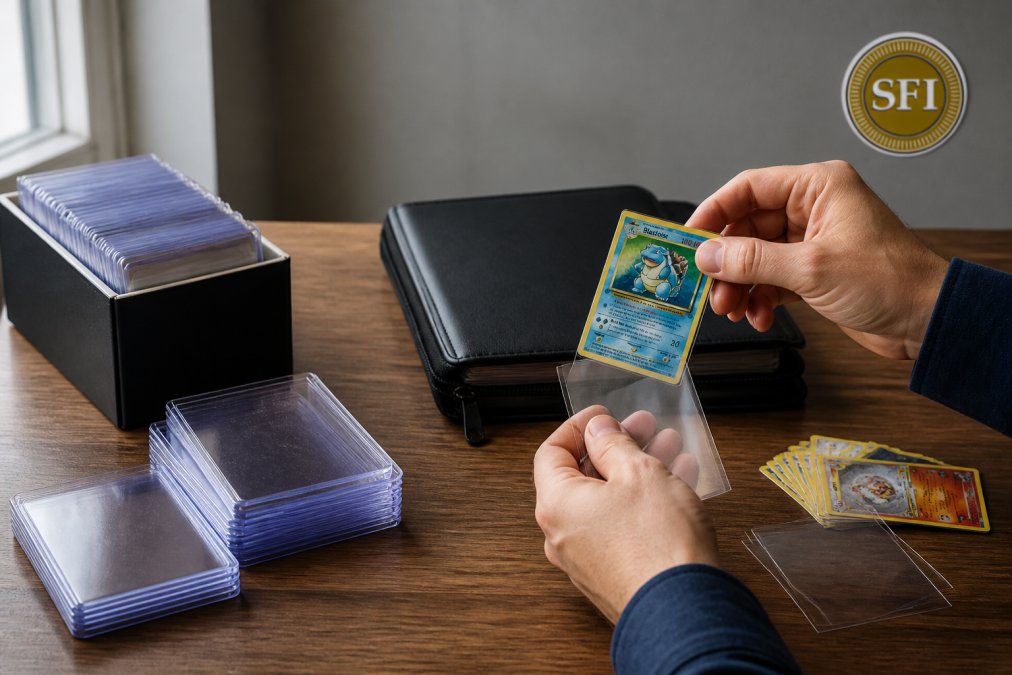
A workable three-tier approach:
- Tier 1 (bulk and low-value): penny sleeves inside binder pages. Cheap, viewable, fine for cards you're not insuring.
- Tier 2 (mid-value): an archival inner sleeve plus a rigid top-loader, stored upright in a box.
- Tier 3 (high-value and graded): graded slab protection, magnetic holders for raw stars, and a controlled storage environment.
Layered Protection: Sleeves, Toploaders, and Binders
The layer touching the card matters most. Start with an acid-free, PVC-free inner sleeve, then move outward.
Choosing the Right Storage Containers
Containers decide how much the environment reaches your cards: airtight beats open, rigid beats flexible.
Tier | Inner Layer | Outer Layer | Container |
|---|---|---|---|
Bulk | Penny sleeve | Binder page | Zippered binder |
Mid-value | Archival inner sleeve | Top-loader | Rigid storage box |
High-value | Archival inner sleeve | Magnetic holder or slab sleeve | Airtight hard case |
Archival Grade Card Sleeves: Materials That Protect for Decades
Archival grade card sleeves are made from chemically stable plastics that won't break down, off-gas, or bond to the card surface. Look for polypropylene and polyester.
Acid-Free and Non-PVC: What the Labels Really Mean
Acid-free means no acidic content migrates into paper card stock to cause yellowing or brittleness. Non-PVC means no polyvinyl chloride, so the plastic won't degrade into the card.
Graded Card Slab Protection: Keeping PSA, BGS, and CGC Cases Pristine
Graded card slab protection is about the case, not the card. Once encapsulated, your job is to keep the slab free of scratches, dust, and edge chips, and to store it so the case and card inside aren't stressed.
How Slab Storage Differs From Raw Card Storage
Raw cards fail from moisture, bending, and surface contact. Slabs fail from three things:
- Surface scratching. The clear plastic face is softer than glass and picks up micro-scratches from sliding against other slabs or rough surfaces, dragging down presentation value even when the card inside is a gem mint 10.
- Edge chipping and corner cracks. Slabs are rigid but not indestructible. A drop on a hard floor can chip a corner or crack the seal near the card, requiring a trip back to the grading company for reholdering.
- Internal card shift. Stored flat and stacked under weight for years, the card can shift within its well, and the case itself can bow. Upright storage avoids this.
Fit Matters More Than People Expect
PSA, BGS, and CGC slabs vary in size, so a sleeve cut for one brand may fit others loosely or not at all. A loose sleeve lets dust settle against the surface; one that's too tight stresses the slab edges.
Stacking, Storing, and Handling Slabs
- Store slabs upright, on edge, in a rigid box. This prevents the bowing and internal shift that flat stacking causes over years.
- Never stack slabs more than a few high without a rigid divider. Weight transfers down the stack, and the bottom slab bears the load.
- Keep slabs out of direct light. The clear plastic can yellow, and the card’s ink can fade- the same UV threat as raw cards.
- Handle by the edges. Oils trap dust and grit that scratch the surface during cleaning.
- Clean with a microfiber cloth and plastic-safe cleaner. Avoid paper towels and abrasives, which micro-scratch the face.
- Insure high-value slabs separately. A graded card's value is documented by the grade, making it easier to insure, but only if you keep the certification number and a photo on file.
When to Reholder
A slab that's cracked, badly scratched, or has a compromised seal should go back to the grading company for reholding, which preserves the grade while replacing the case. It's slow and not cheap, but it's the only way to restore presentation value without risking the grade. Reholder only when the slab's condition would visibly drag down a sale or display; otherwise, a slab sleeve and careful storage are enough.
How to Prevent Pokemon Card Warping: Environmental Controls That Work
Warping is a moisture problem, not a handling problem. Card stock is a paper core between printed layers and, on holos, a metallic foil layer. Paper fibers absorb and release water vapor as humidity changes, and the two faces don't absorb at the same rate; when one side swells more, the card curls toward the drier side. That's why a card can sit untouched in a box for two years and still bow.
What Actually Moves Humidity in a Home
Before buying anything, know the drivers that cause the biggest swings:
- Attics and garages. Unconditioned spaces can swing 30+ percentage points between morning and afternoon. Never long-term storage.
- Basements. Cooler and more stable than an attic, but prone to seasonal damp and, in flood-prone areas, total loss risk.
- Exterior walls and windows. Condensation forms on the cold side of a wall in winter; a binder pressed against it absorbs that moisture.
- HVAC vents and space heaters. Direct airflow creates hot/dry pockets that dry one face of a card faster than the other.
- Kitchens and bathrooms. Steam spikes local humidity for hours. Keep collections out of both.
Practical Controls That Work
- Pick an interior closet or room away from exterior walls, windows, and vents. Interior walls buffer temperature better than perimeter walls.
- Seal the container, then buffer it. Airtight hard cases and gasketed boxes slow moisture exchange. Add a silica gel desiccant packet and swap it on schedule, most changes color when saturated, and a typical packet needs replacement every one to three months depending on climate.
- Monitor, don't guess. A $10-$20 digital hygrometer inside the container prevents a $500 mistake.
- Store upright, not flat under weight. Flat stacking puts continuous pressure on bottom cards and encourages bowing; upright storage in a rigid box lets cards rest on their edges without load.
- Keep the container closed. Every opening exchanges internal air with the room. Minimize open time during humid months.
Light Exposure: The Slow Killer
UV radiation breaks the chemical bonds in inks and paper lignin, which is why faded cards look washed out and yellowed rather than simply lighter. Holographic foil is especially vulnerable: the foil reflects light, but the printed ink over it still fades, leaving a dull, mismatched surface.
Practical rules:
- Never store in direct sunlight. Even an hour a day of window light fades ink over months.
- Keep binders and boxes closed and opaque. Clear plastic lets light in from every angle.
- Avoid fluorescent and unfiltered LED display lighting. If you display cards, use UV-filtering acrylic cases and rotate pieces out of the light.
- Assume UV damage is cumulative and irreversible. Faded ink can't be restored; prevention is the only option.
The Material Degradation Timeline
Most guides stop at 'keep it cool and dry,' but the longer view matters for a 10+ year horizon. Here's what happens to the materials around your cards:
- PVC sleeves (avoid): plasticizers migrate out within a few years, leaving a greasy film that can bond to card surfaces- the waxy residue found in old binders.
- Polypropylene sleeves (acceptable): chemically stable for decades, but can become brittle and yellow slightly with prolonged UV exposure. Keep them out of light.
- Polyester (Mylar-type) sleeves (best): the most inert common plastic, with excellent clarity and very slow degradation. Higher cost, but the archival standard.
- Cardboard boxes (avoid for long-term): lignin and residual acids in cheap cardboard off-gas and migrate into card stock over years, contributing to yellowing.
Organizing, Cataloging, and Disaster-Proofing Your Collection
A collection you can't find is one you can't protect. Cataloging is preservation.
Frequently Asked Questions
Is it better to store cards in a binder or a box?
It depends on how often you handle them. Binders work well for browsing and keeping cards upright, but pages can bend over time. For long-term storage of valuable cards, use a box with penny sleeves, toploaders, or graded slab sleeves. Many collectors do both: binders for display and boxes for the rest.
What are the best archival-grade materials for Pokemon card storage?
Look for acid-free, PVC-free plastics such as polypropylene or polyethylene. These materials won't break down and damage your cards. Products like archival grade card sleeves from Superior Fit Sleeves are designed to fit graded slabs without off-gassing. Avoid cheap vinyl pages that can stick to cards over time.
How do humidity and temperature affect long-term card storage?
High humidity causes card stock to absorb moisture, leading to warping and mold. Low humidity makes cards brittle. Aim for 40-50% relative humidity and a stable temperature around 65-70°F. Use desiccant packets in sealed containers and keep cards away from basements, attics, and exterior walls where swings are common.
Should I use perfect-fit sleeves for my graded Pokemon cards?
Yes, but only if they are made for slabs. Perfect-fit sleeves for graded card slab protection, like those from Superior Fit Sleeves, add a snug layer that keeps dust and scratches off the case. They also prevent scuffing when you stack slabs. Do not force a raw card into a slab sleeve; use the correct size for each.
archival-grade