 comparison
Do Cheap Card Sleeves Yellow? What You Need to Know
Table of Contents
- Do Cheap Card Sleeves Yellow Over Time?
- Why Do Card Sleeves Get Dirty and Discolored?
- Archival Safe Card Sleeves: What Makes Them Different
- How to Store Trading Cards to Prevent Sleeve Discoloration
- Cheap Yellow Sleeves vs. Premium Options: What You're Actually Paying For
- Common Mistakes Collectors Make With Budget Sleeves
- Frequently Asked Questions
Last Updated: October 10, 2026
Do Cheap Card Sleeves Yellow Over Time?
Budget card sleeves are tempting, but whether they yellow deserves a serious answer: yes, most will yellow, fade, or cloud over time, especially in poor storage conditions. The difference between budget and archival-grade protection is stark.
A yellowed sleeve obscures the card, reduces visual appeal, and signals poor storage to buyers. The real cost of cheap sleeves isn't upfront savings; it's long-term damage to your investment.
Why Budget Sleeves Deteriorate
Budget sleeves yellow because they're made from lower-grade polypropylene lacking UV inhibitors and stabilizers. Over months or years, the plastic becomes brittle, discolored, and opaque.
Cheaper sleeves have minimal quality control, inconsistent composition, and thinner walls, so they degrade faster. Residual manufacturing chemicals continue to off-gas and degrade the plastic.
The Timeline of Yellowing
Most budget sleeves yellow within 6-18 months depending on conditions. Warm, humid storage accelerates yellowing; direct sunlight causes visible yellowing within weeks.
Yellowing starts at edges and spreads inward. By year two or three, many budget sleeves become so cloudy they obscure the card inside.
Why Do Card Sleeves Get Dirty and Discolored?
Sleeve discoloration happens through two main mechanisms: material degradation from within and environmental contamination from without. Understanding both helps you make smarter storage choices and recognize yellowing before it damages your collection's appearance.
Material Quality and Oxidation
Lower-quality plastics oxidize under oxygen, light, and heat, breaking down polymer chains and causing yellowing and brittleness. Cheap sleeves lack UV stabilizers and antioxidants, making them fragile and prone to cracking.
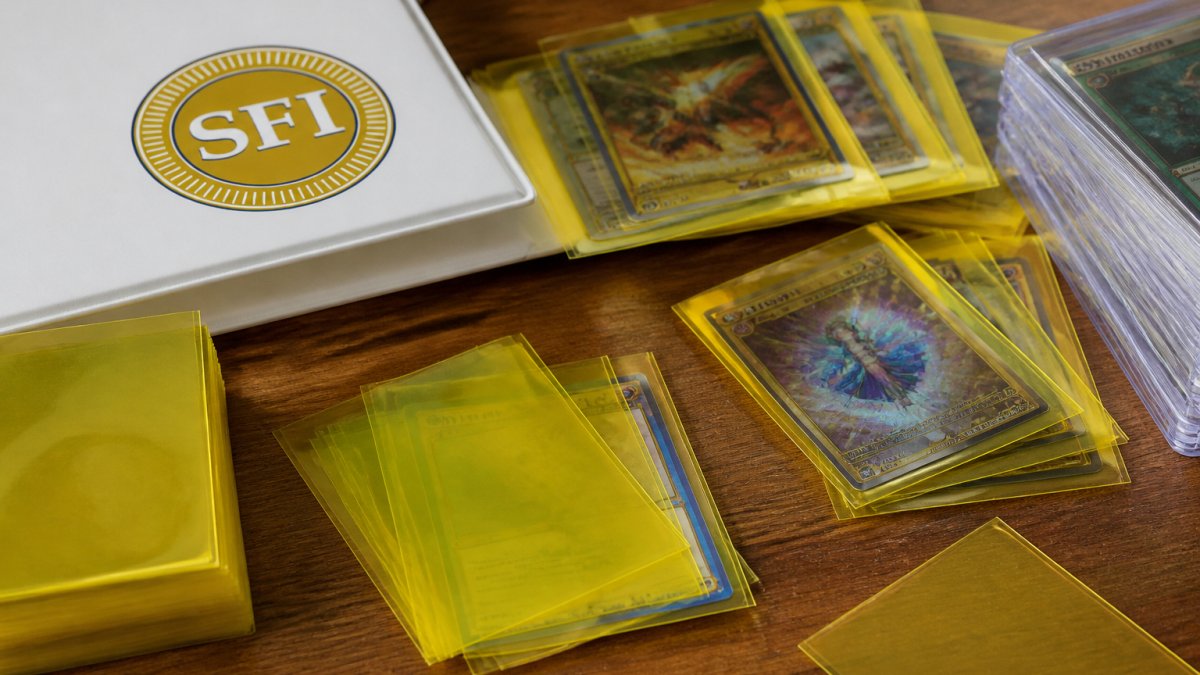
Early yellowing appears as a faint amber tint at sleeve edges. By 12-18 months, many budget sleeves develop a visible yellow or brownish cast that obscures the card. The contrast with fresh sleeves is striking.
Sleeves that don’t meet acid-free standards can damage cards through direct contact. Acids migrate into cardstock, causing foxing and permanent discoloration that may not appear until months later.
Environmental Factors and Accelerated Yellowing
Heat accelerates oxidation exponentially. Sleeves stored at 75°F yellow faster than those at 65°F. Attic storage can cause visible yellowing within 6-12 months.
High humidity (above 50%) combined with warmth accelerates degradation and promotes mold. Moisture-prone basements cause faster yellowing and potential card damage.
Direct sunlight is the worst culprit. UV rays break down polymers quickly, causing sleeves near windows to yellow within weeks and look washed out and faded.
Air quality matters too. Sleeves near off-gassing sources (furniture, paint, adhesives) absorb volatile compounds that accelerate yellowing. Smoke and dust create dull discoloration.
Why Cheap Sleeves Yellow Faster: A Comparison
Budget sleeves yellow faster because they lack UV stabilizers and antioxidants, which begin oxidation during manufacture. Premium sleeves resist degradation dramatically; a budget sleeve shows visible yellowing 6-12 months before a premium sleeve shows any discoloration.
Thickness matters too. Thinner budget sleeves let UV and oxygen penetrate easily, while thicker premium sleeves significantly slow yellowing.
Archival Safe Card Sleeves: What Makes Them Different
Archival-grade sleeves use premium polypropylene with UV stabilizers and antioxidants that dramatically slow oxidation. The thicker material maintains clarity for decades.
Acid-Free and PVC-Free Standards
The key difference is the absence of harmful chemicals. Archival sleeves are manufactured without PVC, which degrades and releases chlorine gas over time. They're also acid-free, meaning they won't chemically damage the cards inside. According to archival standards from the Library of Congress, materials in direct contact with valuable items should meet strict acid-free and lignin-free specifications to prevent long-term damage.
Archival sleeves stay crystal-clear for 20 years, protecting card condition far longer than budget options that cloud in two years.
Protection for Graded Slabs
Graded slabs need sleeves that fit perfectly. Loose sleeves risk edge and corner damage; oversized sleeves look unprofessional. Graded Card Slab Sleeves are precision-cut for major slab dimensions, providing snug coverage without bulk.
Clarity matters for display. Yellowed sleeves make pristine cards look dull and aged.
How to Store Trading Cards to Prevent Sleeve Discoloration
Storage practices matter as much as sleeve quality. Poor conditions accelerate degradation; budget sleeves yellow eventually regardless.
Storage Environment Best Practices
Keep your collection in a cool, dry space away from direct sunlight. Ideal storage temperatures range from 60 to 70 degrees Fahrenheit, with humidity between 30 and 40 percent. Avoid basements prone to moisture and attics subject to temperature swings. A climate-controlled closet or cabinet is far better than either.
Store slabs upright or flat, never stacked at angles, which puts pressure on corners. Keep them away from heat sources, windows, and areas with fluctuating humidity. Air circulation helps prevent moisture buildup, so avoid sealing cards in airtight containers without proper desiccant packs.
Dual Sleeve Strategy for Maximum Protection
Many serious collectors use a dual-sleeve approach: an inner sleeve that directly protects the card, and an outer sleeve that protects the slab or card from external dust and handling. This layered approach is especially effective for high-value cards. The outer sleeve takes the brunt of environmental exposure, while the inner sleeve keeps the card isolated from potential contamination.
Using archival-grade sleeves for both layers ensures maximum protection. A cheap outer sleeve can yellow and off-gas chemicals that migrate inward, defeating the inner sleeve's protection. For cards stored in Top-Loader Sleeves or Magnetic Card Case Sleeves, archival-grade outer protection ensures the entire storage system remains clear and functional for decades.
Cheap Yellow Sleeves vs. Premium Options: What You're Actually Paying For
The price difference between budget and premium sleeves often seems significant upfront, but the math changes when you factor in replacement frequency, pack size, and true cost per sleeve. Most collectors focus only on the sticker price and miss the hidden costs of frequent replacement.
Cost-Per-Sleeve Breakdown: Where Budget Options Fall Short
Budget sleeves typically sell in packs of 100 to 500 sleeves for $0.01 to $0.03 per sleeve when bought in bulk. A 500-count pack of basic polypropylene sleeves might cost $3-$5, translating to roughly $0.01 per sleeve. That sounds cheap until you factor in replacement cycles.
If budget sleeves yellow and cloud within 12 to 18 months, a serious collector who maintains 1,000 sleeved cards replaces 1,000 sleeves annually. Over a decade, that's 10,000 replacement sleeves at $0.01-$0.03 each, totaling $100-$300 just in sleeve costs, plus the labor of re-sleeving thousands of cards multiple times.
Archival-grade sleeves cost more upfront but remain clear and functional for 10 to 20 years. The math is stark: cheap sleeves cost more over a collector's lifetime.
Pack Size and Bulk Discounts: The Hidden Trap
Budget sleeve manufacturers often use pack-size psychology to inflate per-sleeve costs. A 100-count pack might cost $1.50 ($0.015 per sleeve), but a 500-count pack costs $4.00 ($0.008 per sleeve). Collectors buying smaller packs to "save money" actually pay 50-100% more per sleeve. Serious collectors need to buy in bulk to get true per-sleeve pricing, but bulk purchases of low-quality sleeves mean committing to thousands of sleeves that will yellow and need replacing.
Premium sleeves often have less aggressive bulk discounts because the per-sleeve cost is already optimized for long-term value. Buying 1,000 premium sleeves once costs less than buying 10,000 budget sleeves over a decade.
Shipping and Availability Costs
Budget sleeves are widely available through marketplace retailers, but shipping costs vary dramatically. Ordering in bulk to reduce per-shipment costs requires upfront capital and storage space.
Archival-grade sleeves from specialized retailers often ship faster and at more predictable costs because fewer vendors stock them. While the per-pack price is higher, the per-sleeve cost after shipping is often comparable to or lower than budget options when you account for realistic order sizes.
Material Thickness and Durability
Premium sleeves use thicker, more durable plastic that resists cracking and splitting. Budget sleeves often feel flimsy because they are thinner; thinner material breaks down faster under handling stress. When you insert and remove cards repeatedly, thicker sleeves hold up better and maintain their structural integrity.
Thickness also affects clarity. Thicker archival plastic maintains optical clarity longer because it has more material to degrade before yellowing becomes visible. Budget sleeves start out thinner, so any degradation shows immediately.
Fit and Clarity for Graded Cards
Graded slabs come in specific dimensions. A universal, cheap "one-size-fits-most" sleeve will be either too loose or too tight. Loose sleeves allow the slab to shift, risking corner and edge damage. Tight sleeves can stress the slab corners or make insertion difficult.
Precision-engineered sleeves from Superior Fit Innovations Ltd. are tailored to the slab dimensions of PSA, BGS, CGC, and other major grading companies. The result is a snug, professional fit that protects the slab while keeping it visible and displayable. Budget sleeves simply cannot deliver that precision fit.
Clarity matters for the same reason. A yellowed sleeve obscures the graded card inside, making even a high-grade card look dull. Premium sleeves stay crystal-clear, letting the card and its grade shine through.
Common Mistakes Collectors Make With Budget Sleeves
Many collectors buy cheap sleeves thinking they're making a smart financial choice, then discover the hard way that the savings disappear quickly.
The biggest mistake is assuming all sleeves are created equal. A sleeve is a sleeve, right? Wrong. The material, manufacturing process, and chemical composition vary wildly between budget and premium options. Buying based on price alone ignores the protection your cards actually get.
Another common mistake is storing sleeved cards in conditions that speed up degradation. Even if you buy decent sleeves, storing them in a warm attic or humid basement will yellow them faster than ideal conditions would.
Collectors also often underestimate how much a yellowed sleeve hurts their collection's visual appeal. When you show cards to other collectors or potential buyers, yellowed sleeves signal poor care and storage. They make high-grade cards look mediocre.
Finally, many collectors don't realize that cheap sleeves can actually damage the cards inside through chemical off-gassing and acid migration. By the time visible damage appears, it's too late.
The choice between cheap and premium card sleeves ultimately comes down to what you're protecting and how long you want to protect it. Budget sleeves will yellow, cloud, and degrade. That's not a possibility; it's a certainty.
Superior Fit Sleeves feature precision cuts, acid-free materials, and UV stabilizers that keep your cards protected and crystal-clear for decades.clear when you compare old, cheap sleeves with
Frequently Asked Questions
Do cheap card sleeves turn yellow over time?
Yes, budget card sleeves frequently yellow due to low-quality polypropylene and inadequate UV protection. Yellowing typically begins within 6-12 months of exposure to light and air. Archival-safe card sleeves resist discoloration because they use acid-free, stabilized materials designed to maintain clarity for decades. The difference becomes visible when comparing old cheap sleeves to premium options side by side.
What causes card sleeves to get dirty and discolored?
Discoloration occurs through oxidation, UV exposure, and chemical degradation of low-grade polypropylene. Cheap sleeves lack UV inhibitors and acid-free formulations, making them vulnerable to environmental damage. Dust, moisture, and handling also contribute. Storing cards in warm, humid, or bright conditions accelerates this process. Archival-safe sleeves with acid-free construction resist these factors significantly longer.
Are archival safe card sleeves worth the extra cost?
For valuable or graded cards, archival sleeves are essential. They prevent yellowing, maintain crystal clarity, and protect against acid migration that damages cards over time. Budget sleeves may save money initially but risk permanent discoloration and card deterioration. If your collection includes PSA, BGS, or CGC slabs, premium protection preserves both the card's condition and resale value far better than cheap alternatives.
How should you store trading cards to prevent sleeve discoloration?
Keep cards in a cool, dry environment away from direct sunlight and UV light. Store them upright or flat in acid-free boxes, never in damp basements or hot attics. Use dual sleeves for maximum protection: an inner sleeve plus an outer protective sleeve. Maintain temperatures between 60-70°F and humidity below 50%. These practices work best when combined with archival-safe sleeves designed to resist yellowing and degradation.
archival-safeoften yellow because of