 blog
Best Safeguards for Valued Tapered Card Sleeves
Last Updated: November 4, 2026
Quick Summary
The best safeguards for valued tapered card sleeves combine a snug, exact fit, crystal-clear archival-grade material, and a resealable tapered flap. A sleeve sized to the holder stops shifting and scuffing, while acid-free plastic avoids residue damage. Pair the sleeve with careful handling and stable, upright storage.
- Choose a sleeve whose listed dimensions match your holder closely, without forcing it in.
- Pick archival-grade, acid-free plastic so the sleeve does not degrade or transfer residue.
- Tapered flaps guide the holder in and seat it, reducing edge wear from shifting.
- Lift slabs by their edges and ease them out along the taper rather than yanking.
- Store slabs upright in rigid containers, away from direct sunlight and humidity swings.
Table of Contents
- How a Tapered Flap Design Protects Graded Slabs
- Comparing Tapered Flaps With Other Sleeve Designs
- Archival-Safe Card Sleeves: Materials That Matter
- Graded Card Slab Sleeves: Choosing the Right Fit
- How to Protect Graded Cards During Handling and Storage
- Trading Card Storage Best Practices for Your Collection
- Frequently Asked Questions
Valuable cards deserve more than a basic inner sleeve. At Superior Fit Sleeves, we build tapered card sleeves for graded slabs, top-loaders and magnetic cases, and the protection you choose matters most when a card is worth real money. The right sleeve shields the surface, the edges and the case itself from the scuffs and pressure that quietly reduce value over time.
A thin, loose inner sleeve covers the card but does little for the slab around it. Slabs and top-loaders can rub against each other in a binder, and a sleeve that sits loosely lets the holder shift and scratch. A snug, purpose-built fit keeps the holder still and reduces the friction that causes wear on the edges.
Here is what matters when you protect a valued card:
- Fit: the sleeve should match the holder's dimensions closely, without forcing it in.
- Clarity: crystal-clear material keeps the card visible without haze or distortion.
- Material: choose archival-grade, acid-free plastic so the sleeve does not degrade or transfer residue.
- Access: a resealable flap lets you remove and return the holder without stressing the seal.
How a Tapered Flap Design Protects Graded Slabs
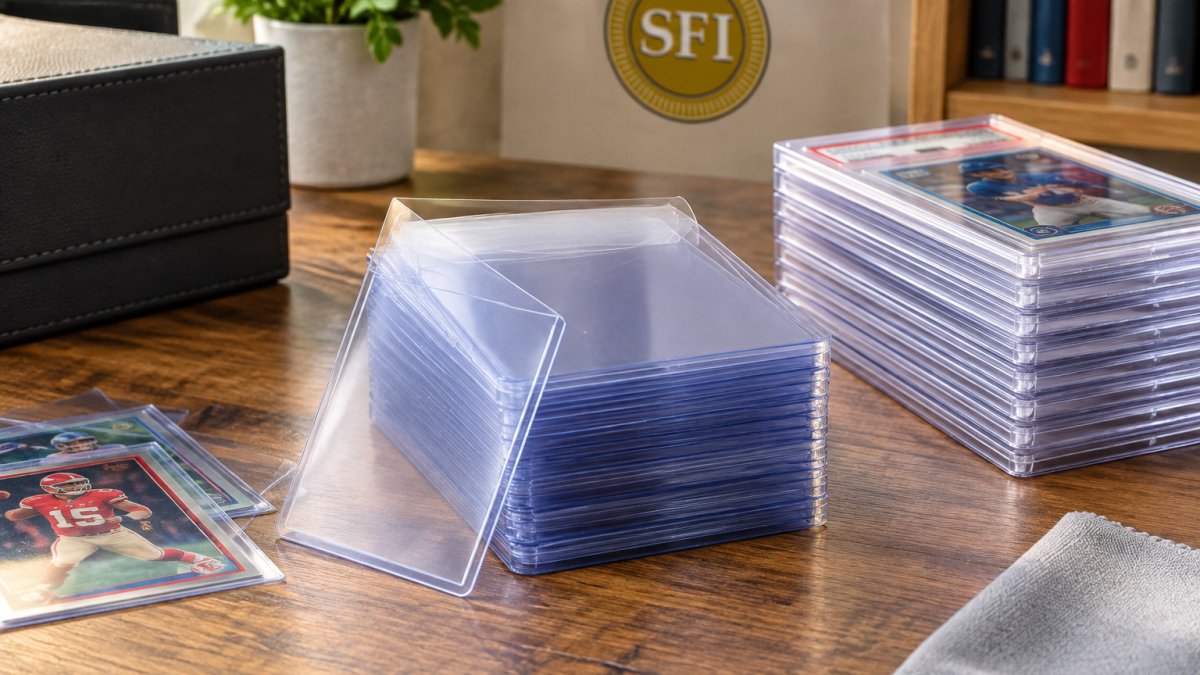
A tapered flap is the narrow, angled opening at the top of the sleeve that guides the slab in and seats it securely. The taper is designed to guide the holder in and out of the sleeve.
The flap closes over the top of the sleeve once the holder is inside. Our guide to choosing protective sleeves for graded cards covers how grading holders are sized, which helps explain why an exact fit matters.
For collectors who want to see how the design works in practice, our Best Tapered Flap Sleeves for Card Slabs: 2026 Guide walks through the options. If you protect slabs that need extra support, our Superior Fit Mag and Slab Inner Card Protection Sheets (100) 300-Z add a second layer of protection inside the case.
Comparing Tapered Flaps With Other Sleeve Designs
Most sleeve designs on the market fall into three families, and the differences show up in how the holder enters the sleeve, how it stays seated, and how much of the holder's edge stays exposed to friction.
Straight-edge, open-top sleeves. These are the most common and the least expensive. The opening is a straight cut across the top, so the slab or top-loader slides in and out with nothing guiding it. The sleeve is usually cut with a little slack, which means the holder can shift side to side and up and down.
Flat-opening resealable sleeves. These add a flap, but the flap folds flat across a straight opening. The seal is usually a pressure-sensitive adhesive strip or a tuck. The weakness is at the fold line: repeated opening and closing stresses the same crease, and a flap that no longer lies flat lets dust in and lets the holder ride up.
Tapered-flap sleeves. The opening narrows toward the top, so the sleeve acts like a funnel. The angled edges guide the holder in, and the narrowed throat helps position it once inside. The resealable flap then closes over the top. A tapered sleeve has to be sized to the holder, so choose the size that matches each slab.
Design | How the holder is guided | How the holder stays seated | Main wear risk | Best use |
|---|---|---|---|---|
Straight-edge, open-top | Not guided; slides freely | Loosely; depends on slack | Edge scuffs from shifting; dust ingress | Bulk storage of lower-value cards |
Flat-opening resealable | Straight opening; corner can catch | Flap holds top, but fold line weakens | Flap crease failure; bulk at top | Cards handled occasionally |
Tapered flap | Angled throat funnels the holder in | Narrowed throat plus resealable flap | Misfit if sized wrong | High-value slabs and top-loaders handled often |
A common pattern among collectors is to sort by value first, then match the design to how often the card is handled. A card that stays in a box for years does not need a tapered throat. A card that comes out for shows, trades, or grading submissions does, because every removal and reinsertion is a chance to catch a corner.
Watch out: a tapered sleeve sized for one slab brand can be too tight for another, and forcing a holder into a tight throat is one of the few ways a sleeve can crack a case. Measure the holder's actual width and thickness before you commit a high-value slab to a new sleeve design. Once the holder fits without pressure, keep the slab out of direct light, Protecting high-value memorabilia.
For a closer look at how the taper and flap behave on real holders, see our Best Tapered Flap Sleeves for Card Slabs: 2026 Guide. If you want to compare the cost-per-sleeve trade-off against your collection's value, Are Perfect Fit Toploader Sleeves Worth the Investment? This guide walks through when the added precision earns its keep.
Archival-Safe Card Sleeves: Materials That Matter
Archival-safe means the materials are chemically stable and free of compounds that can damage cards over time. Look for acid-free, lignin-free plastic, usually polypropylene or a similar inert polymer.
Clarity matters for the same reason. Clear, distortion-free material lets you inspect the card without handling it. Cloudy or wavy plastic can hide scratches and make it harder to judge condition.
Graded Card Slab Sleeves: Choosing the Right Fit
Grading companies use slightly different holder sizes, so a sleeve made for one slab may not fit another. Check the sleeve's listed dimensions against your holder before buying. For a 5 x 7 PSA slab, choose a sleeve built for that size, such as Superior Fit Sleeves for 5 x 7 PSA Graded Card Slabs (50) 405B. For Beckett holders, our Superior Fit PREMIUM Sleeves for Beckett Graded Card Holders (50) 501 are made for that slab type.
Measure before you buy.
How to Protect Graded Cards During Handling and Storage
Damage to a valued card rarely comes from one dramatic event. It accumulates through small, repeated stresses: a corner catching on a sleeve edge, a slab sliding against another slab, a humid room warping a holder, a flap that stops sealing.
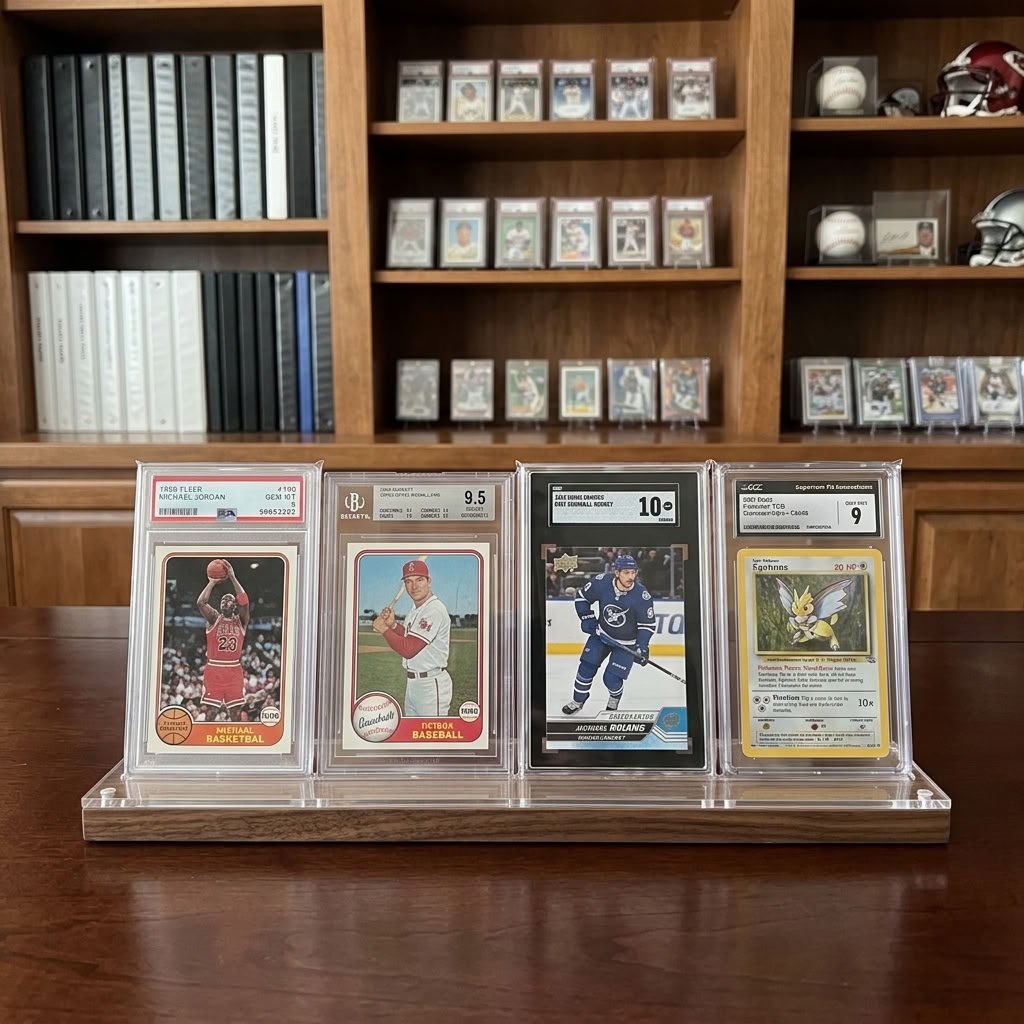
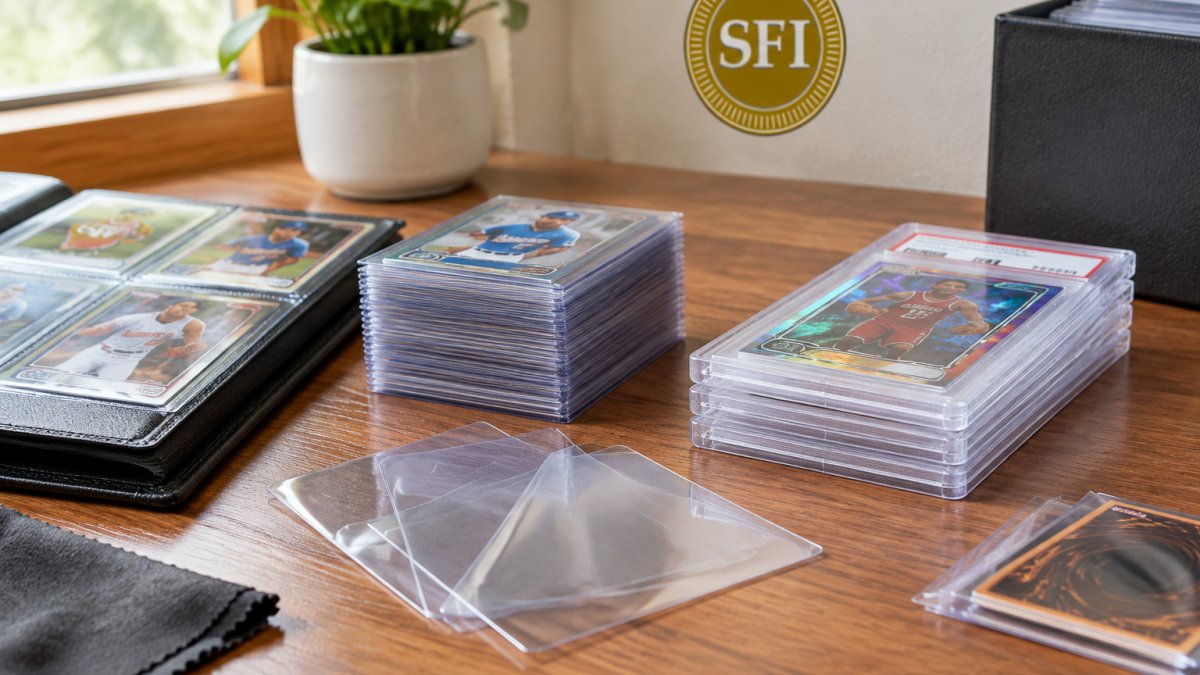
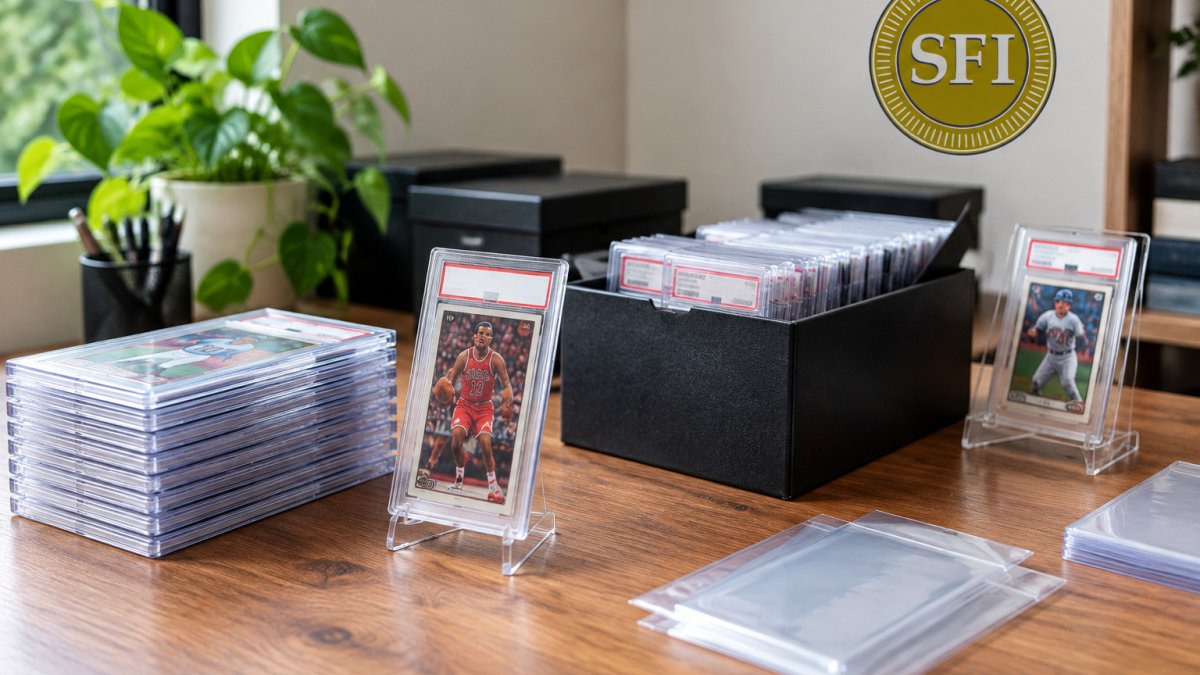
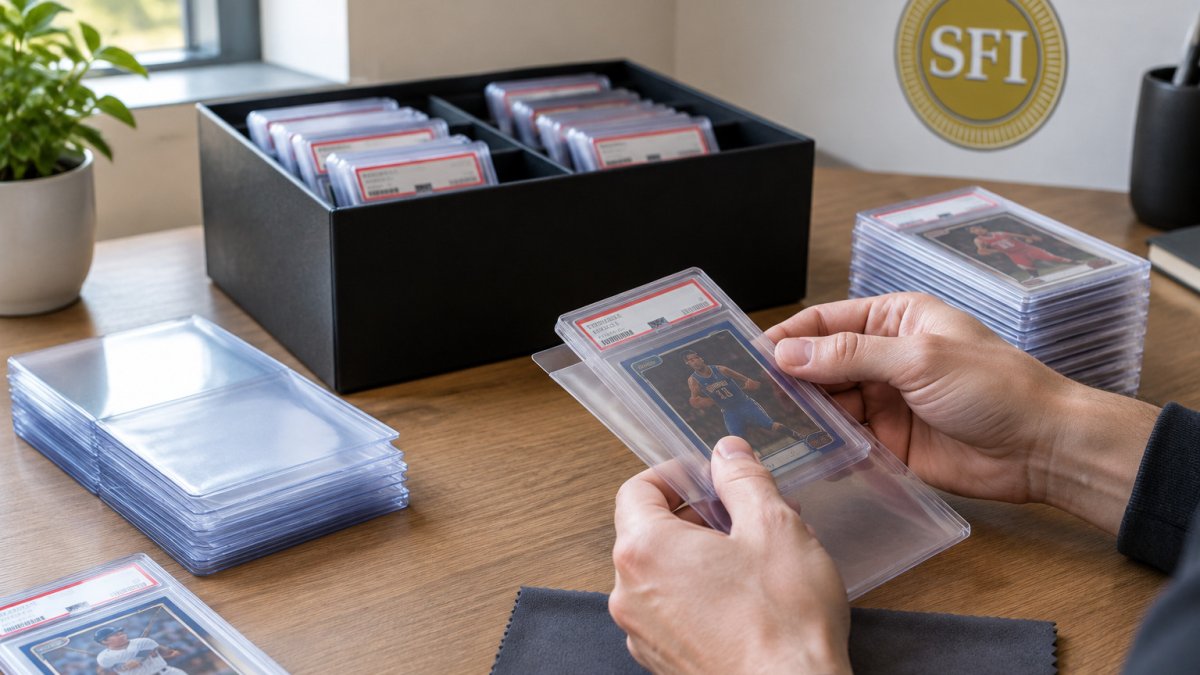
Graded card slabs in tapered card sleeves on a clean wooden desk
Before handling: set up the environment.
- Work over a soft, clean surface, a felt mat or a folded towel, so a dropped slab lands on something forgiving rather than a hard table edge.
- Wash and dry your hands, or wear clean nitrile gloves. Oils and grit transfer to the sleeve and then to the holder.
- Clear the work area of loose holders, scissors, and anything else a slab could knock against.
- Have the destination sleeve or box open and ready before you pick up the card, so you are never holding a slab in one hand while fumbling for a container with the other.
During handling: control the two main damage modes.
The first mode is edge and corner impact. Always lift a slab by its edges, never by the face, and never slide a stack of slabs across a surface. When removing a holder from a tapered sleeve, ease it out along the taper rather than yanking, because the angled throat is designed to release the holder cleanly only when it is pulled straight.
The second mode is surface friction. A loosely fitting sleeve lets the holder shift, and every shift creates a small abrasion against the sleeve wall. A snug, correctly sized sleeve is itself a safeguard, which is why fit is the first thing to verify. If a holder rattles when you tilt the sleeve, the sleeve is too large.
Watch out: forcing a slab into a sleeve that is too tight can crack the holder at the seam, and a cracked holder exposes the card to air and handling. If a sleeve resists, stop and check the listed dimensions against the holder rather than pushing harder.
After handling: storage that removes the slow risks.
- Store slabs upright in a rigid container sized so they do not lean or slide. Sideways stacks put sustained pressure on the bottom holders.
- Keep the container out of direct sunlight. Ultraviolet light fades inks and yellows plastic over years, not days.
- Control humidity. A basic hygrometer in the storage room is enough to spot swings; a stable, climate-controlled room is the simplest safeguard against warping and residue.
- Keep the container off the floor and away from exterior walls, where temperature and moisture fluctuate most.
A recurring inspection routine.
Every few months, check each high-value sleeve for cloudiness, cracks along the flap crease, or residue inside. A flap that no longer seals is a failed safeguard even if the plastic looks fine, because dust and handling debris can now reach the holder. Replace compromised sleeves promptly and log the date, so you can see how long a given sleeve design lasts under your handling habits.
Prioritize by value.
Not every card needs the full checklist. A sensible pattern is to tier your collection: the highest-value slabs get fitted tapered sleeves, rigid upright storage, humidity tracking, and quarterly inspection; mid-value cards get fitted sleeves and stable storage; bulk cards get basic dust protection. That way, the safeguards that cost the most time and money go where the loss would hurt most.
For holders that need extra support inside the case, our Superior Fit Mag and Slab Inner Card Protection Sheets (100) 300-Z add a second layer, and our Graded Card Slab Sleeves collection lets you match the sleeve to each holder's exact dimensions.
Trading Card Storage Best Practices for Your Collection
Good storage is a system, not a single product. Sort your collection by value so the most important cards get the best protection. Keep graded slabs in fitted sleeves, store them in rigid containers, and use a consistent labeling system so you can find any card quickly without pulling it out.
Keep a written or digital inventory with photos, grades, and purchase dates. Review your inventory once a year and upgrade any sleeves that have degraded or no longer fit.
Protecting valued cards comes down to fit, clarity, archival materials, and careful handling. Start with the cards that matter most, and choose sleeves that match your holders exactly. Browse our Graded Card Slab Sleeves collection to find the right fit for your slabs. The grading company's case, since holders from PSA, BGS, SGC, or CGC can vary slightly
Frequently Asked Questions
How do tapered-flap sleeves protect graded card slabs?
A tapered flap sits at the opening of the sleeve and narrows toward the edge, so the slab slides in with minimal friction and the flap closes snugly without catching on the slab's edges. Collectors should still check that the sleeve matches their slab size before purchase.
What sleeve material is considered archival-safe for trading cards?
Archival-safe sleeves are generally made from clear, acid-free plastic that does not off-gas chemicals that can yellow or cloud a card over time. When evaluating a product, look for explicit acid-free and archival-grade labeling from the manufacturer rather than vague marketing terms. Clarity matters too, since distortion-free plastic keeps the card image easy to view. Storing sleeved cards in a stable, dry, dark environment further supports long-term preservation.
How do you choose the right sleeve for a graded card slab?
Start by measuring your slab, including its grading company's case, since slightly different holders from PSA, BGS, or CGC can vary in dimensions. A sleeve that is too loose lets the slab shift, while one that is too tight can strain the holder. Check whether the product is specifically designed for your slab type and whether it offers a resealable flap. Compare the fit against your collection's size and value before committing to a bulk order.
Can a sleeve help prevent scratches on a top-loader?
A sleeve over a top-loader can be used as an additional layer around the holder. It does not replace careful handling. Choose a sleeve that fits the top-loader without forcing it, and avoid stacking heavy items on top of the assembly. Regularly inspect sleeves for wear and replace any that have become cloudy or cracked.
serve as an extra, not