 ultimate-guide
How to Organize Pokémon Card Binders by Set
Table of Contents
- Step 1: Gather Your Supplies Before You Sort
- Step 2: How to Sort Pokémon Cards by Set Number
- Step 3: Build a Pokémon Master Set Binder Layout
- Step 4: Choosing the Best Card Sleeves for Binder Storage
- Step 5: Sort by Rarity, Variants, and Promo Cards
- Step 6: Digital Inventory and Long-Term Preservation
- Common Mistakes When You Organize Pokémon Binders
- Conclusion
- Frequently Asked Questions
Last Updated: September 19, 2026
Step 1: Gather Your Supplies Before You Sort
The biggest reason projects to organize Pokemon binders stall is starting without the right materials. You pull everything out, realize you don't have enough pages, and your collection lives in stacks on the floor for weeks.
Gather everything first. Here's the minimum kit:
- D-ring binders (2-inch or 3-inch) with a rigid spine
- Side-loading binder pages that are PVC-free and acid-free
- Penny sleeves for every card before it goes into a page
- Card dividers or tabs for set boundaries
- A sorting tray or clean, flat surface with good lighting
- Sticky notes for temporary labels while you work
Step 2: How to Sort Pokémon Cards by Set Number
Sorting by set number is the backbone of any organized collection. Every modern Pokémon card carries a collector number at the bottom, usually formatted like 025/165, which tells you exactly where the card belongs within its set.
Here's the workflow that actually works:
- Separate cards into piles by set symbol first, not by number
- Within each set pile, arrange cards in ascending collector number order
- Flip through once to catch misprints or cards facing the wrong way
- Stack in order and rubber-band nothing (use a card box if you need to move them)
Reading the Collector Number and Set Symbol
The collector number sits bottom-left or bottom-right depending on the era. Older cards from the original Wizards of the Coast print runs used different numbering conventions than modern Scarlet & Violet era cards. The official Pokémon Trading Card Game card database lets you verify any card's set, number, and rarity if you're unsure.
Step 3: Build a Pokémon Master Set Binder Layout
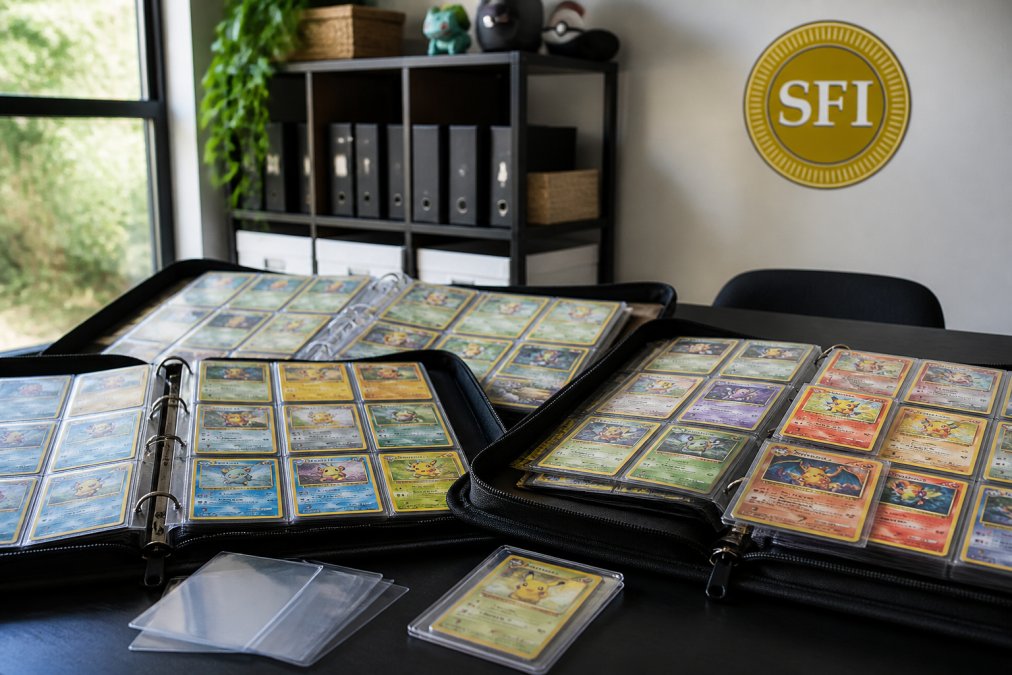
A Pokémon master set binder layout is an organizational system where every card in a set, including all variants, reverse holos, and secret rares, has a designated slot in the binder.
Doing the Page Math Before You Buy
Most 9-pocket pages hold 18 cards front and back, so divide total slots by 18 and round up. A 165-card base set needs 10 pages; add 20 secret rares and you're at 11. Add reverse holo variants behind each card and the same set balloons past 20 pages. Run this math before you buy pages, or you'll end up with half-filled binders and orphaned stacks.
Scaling From One Binder to a Multi-Binder System
A single binder works until it doesn't, and the transition is where collections fall apart.
A common pattern that holds up over time:
- One binder per era or block (for example, all Scarlet & Violet sets together, all Sword & Shield sets together) once you pass three or four completed sets
- A dedicated binder for high-value cards, anything worth grading or insuring lives separately from bulk
- A promo binder that stays separate from set binders permanently
- A trade binder with duplicates and extras, kept deliberately messy so you don't raid your master sets
Handling Empty Slots and Collection Gaps
Empty pockets are not a problem. They're a checklist.
Leave the slot open, drop in a sticky note with the card name and number, and move on. When you acquire the card later, you know exactly where it goes without re-sorting. This is the most effective way to manage gaps without rebuilding your binder every time you buy cards.
Step 4: Choosing the Best Card Sleeves for Binder Storage
Sleeving Cards Before Binding
Never put a raw card straight into a binder page. The page plastic is stiffer than a sleeve, and the card can catch on the edge, scuffing the surface or bending a corner.
Step 5: Sort by Rarity, Variants, and Promo Cards
Not every card in a set belongs in the same section. Rarity tiers, reverse holos, and alternate arts each deserve their own treatment.
A workable structure inside each set section:
- Common and uncommon: standard number order
- Rare and holo rare: keep in number order but consider a separate tab
- Reverse holo variants: slot directly behind or beside the standard version
- Full art and secret rares: group at the end of the set
- Promo cards: separate binder or a dedicated promo section entirely
Step 6: Digital Inventory and Long-Term Preservation
Physical organization only solves half the problem. The other half is knowing what you actually own.
Syncing Physical Binders With a Digital Tracker
Most guides stop at "use a spreadsheet," but a spreadsheet and a binder drift apart the moment you add a card and forget to log it. Make the binder the source of truth and the digital record a mirror of it.
A workflow that holds up:
- Number your binders and pages. Write a small code on the inside cover (for example,
SV-B1-P04) so every card has a physical address. - Log cards as you sleeve them, not after. One card in, one row added. Batching the logging for later is how gaps appear.
- Use a tracker that supports set and number fields. Spreadsheets work. Dedicated collection apps work better because they already know every set's card list, so you can pull up a set and see exactly which slots are empty without typing card names by hand.
- Reconcile once a quarter. Pull the binder, flip through it against the digital list, and fix discrepancies. Twenty minutes per binder, four times a year, keeps the two in sync.
Material Science: What Actually Protects Cards
"Acid-free" is the floor, not the ceiling; the plastic itself matters most.
- Polypropylene (PP) pages and sleeves are the standard for card storage. They're chemically stable, won't off-gas, and are safe for decades of contact.
- Polyvinyl chloride (PVC) pages are the ones to avoid. PVC breaks down over time and releases plasticizers that migrate onto card surfaces, leaving a greasy film that fogs holos and can't be fully removed. If a page smells like a new shower curtain, it's PVC.
- Polyethylene (PE) is used in penny sleeves and works well for short- and long-term use, though it's softer and less rigid than PP.
Preventing Ring Dents and Page Pressure
Ring dents are the most common and most preventable form of binder damage. They happen when pages sit against the metal rings under load, and the card closest to the ring takes a permanent indentation.
Three habits prevent them:
- Use D-rings, not O-rings. D-rings keep pages flat against the spine instead of curving them into the metal.
- Don't overfill. Leave the last inch of ring capacity empty. A binder that's stuffed to the rings puts constant pressure on every page.
- Store upright, spine out, on a shelf. Flat stacking compresses pages; leaning stacks warp them. Upright and snug is the goal.
Humidity, Temperature, and Light
Cards are paper with a plastic coating, and paper responds to its environment. Practical targets:
- Relative humidity around 30 to 50 percent. Below that, cards can dry and curl. Above it, mold and mildew become a risk.
- Temperature stability matters more than the exact number. A steady 65 to 70 degrees Fahrenheit is fine. A garage that swings from 40 to 100 degrees is not.
- Keep binders out of direct sunlight. UV fades ink and yellows sleeves. A closed shelf or cabinet is enough.
- Avoid basements and attics unless you're actively controlling humidity. Both are the two worst rooms in a typical house for paper storage.
Common Mistakes When You Organize Pokémon Binders
The same handful of errors show up again and again, each costing money or card condition.
- Using O-ring binders: pages bow and press against cards. Switch to D-rings.
- Skipping sleeves: raw cards scuff on binder page edges.
- Mixing sets in one binder without dividers: you lose the ability to find anything quickly.
- Storing binders flat: weight compresses pages and can mark cards.
- Ignoring variants: reverse holos and alternate arts get lost in the shuffle.
- No digital backup: you can't prove what you own or track gaps.
Conclusion
The hardest part of learning to organize Pokémon binders by set isn't the sorting; it's committing to a system long enough for the payoff to show up.
Frequently Asked Questions
Should I organize my Pokémon binder by set number or by Pokémon type?
Set number wins for serious collectors. Sorting by set number keeps cards in the order the manufacturer intended, which makes set completion and gap tracking simple. Type sorting works for deck building, but it scatters cards across dozens of sets and makes it hard to spot what you're missing. If you want a master set, stick with set number and use dividers for type-based reference lists instead.
How do I handle empty slots in a master set binder?
Leave the slot open and place a placeholder card or a labeled index card in its spot. This keeps every card aligned with its collector number, so you never have to reshuffle when a missing card arrives. Some collectors use a checklist printout behind the empty slot. Either way, resist the urge to shift cards forward, because that breaks the numbering system you built.
What supplies do I need to protect my cards while organizing?
You need acid-free, PVC-free card sleeves, side-loading binder pages, and a ring binder or portfolio with a D-ring mechanism. Sleeve every card before it goes into a page, including bulk and promo cards. For graded slabs, top-loaders, or magnetic one-touch cases, use precision-fit sleeves sized to the holder. Superior Fit Sleeves provides archival-grade, acid-free protective solutions for graded slabs (including PSA, BGS, and CGC), top-loaders, and magnetic cases.
How do I identify which set a Pokémon card belongs to?
Look at three things: the set symbol printed near the bottom right of the card, the collector number (like 025/165), and the copyright date. The set symbol is the fastest identifier, and the collector number tells you the exact position within that set. Cross-reference both against a set list online if you're unsure, especially for older cards with similar symbols.
Building a binder that holds up for years comes down to the materials you choose. Superior Fit Sleeves makes archival-grade, acid-free sleeves with precision-cut edges and ultra-clear, distortion-free display quality, engineered specifically for collectors who care about long-term protection. Start with the right sleeves, and every other step in the process gets easier. Explore the full range at Superior Fit Sleeves and give your collection the protection it deserves.