 blog
blog
What Card Protector Does PSA Recommend?
Table of Contents
- What Card Protector Does PSA Recommend?
- Why Semi-Rigid Holders Are Preferred Over Top Loaders
- Card Saver 1 vs Card Saver 2: Which Should You Choose?
- Best Sleeves for PSA Slabs: Archival Safety and Clarity
- How to Properly Insert Cards for Submission
- Common Submission Mistakes to Avoid
- Protecting Your Graded Cards After PSA Returns Them
- Frequently Asked Questions
Last Updated: September 19, 2026
What Card Protector Does PSA Recommend?
What card protector does PSA recommend? While PSA doesn't publicly endorse specific brands, its submission guidelines specify semi-rigid holders that fit snugly, with no excess space, to protect cards during grading while keeping them visible for authentication.
Semi-rigid holders are the standard for serious collectors. A penny sleeve inside a semi-rigid holder creates a two-layer defense against dust, fingerprints, and damage.
The right card protector protects your investment, displays your card clearly, and fits properly. Too loose and your card shifts during shipping; too tight and you risk edge damage.
Why Semi-Rigid Holders Are Preferred Over Top Loaders
Semi-rigid holders grip your card securely without crushing it, while top loaders use a snap closure that pressurizes all four corners. For PSA submissions or valuable slabs, semi-rigid holders reduce movement during shipping and prevent corner wear.
Here's what separates them:
Feature | Semi-Rigid Holder | Top Loader |
|---|---|---|
Grip strength | Snug, no shifting | Tight pressure on corners |
Visibility | Crystal clear on all sides | Top view only |
Shipping safety | Minimal card movement | More flex and bounce |
Archival grade | Acid-free options available | Often PVC-based |
Best for | Graded slabs, display | Basic storage only |
Semi-rigid holders come in standard thickness for most cards and oversized for jumbo or vintage cards. Thickness determines grip snugness without applying pressure, the industry standard.
Card Saver 1 vs Card Saver 2: Which Should You Choose?
Card Saver 1 (thinner) protects raw cards before grading; Card Saver 2 (thicker) protects graded slabs after return. Most collectors use both: submit in Card Saver 1, then place the returned slab in Card Saver 2 for long-term protection.
Best Sleeves for PSA Slabs: Archival Safety and Clarity
The best sleeves for PSA slabs are archival-safe, acid-free, and crystal clear. Cheap sleeves yellow and off-gas, creating haze. Polypropylene sleeves offer the best clarity and won't react chemically with the slab over decades.
Look for acid-free, polypropylene sleeves with proper fit and archival certification. A clear archival sleeve showcases your graded card professionally while protecting it. Options like Graded Card Slab Sleeves are designed specifically to fit snugly around PSA slabs without excess space.
How to Properly Insert Cards for Submission
Inserting a card correctly takes 30 seconds and prevents submission damage. A single mistake can result in edge creasing or surface scratches that graders will penalize.
Step 1: Prepare your workspace
Gather a penny sleeve, your card, and a semi-rigid holder on a clean surface. Wash and dry your hands thoroughly to prevent oils and moisture from transferring to the card. Inspect your semi-rigid holder for cracks, warping, or defects before use.
Step 2: Insert the card into the penny sleeve
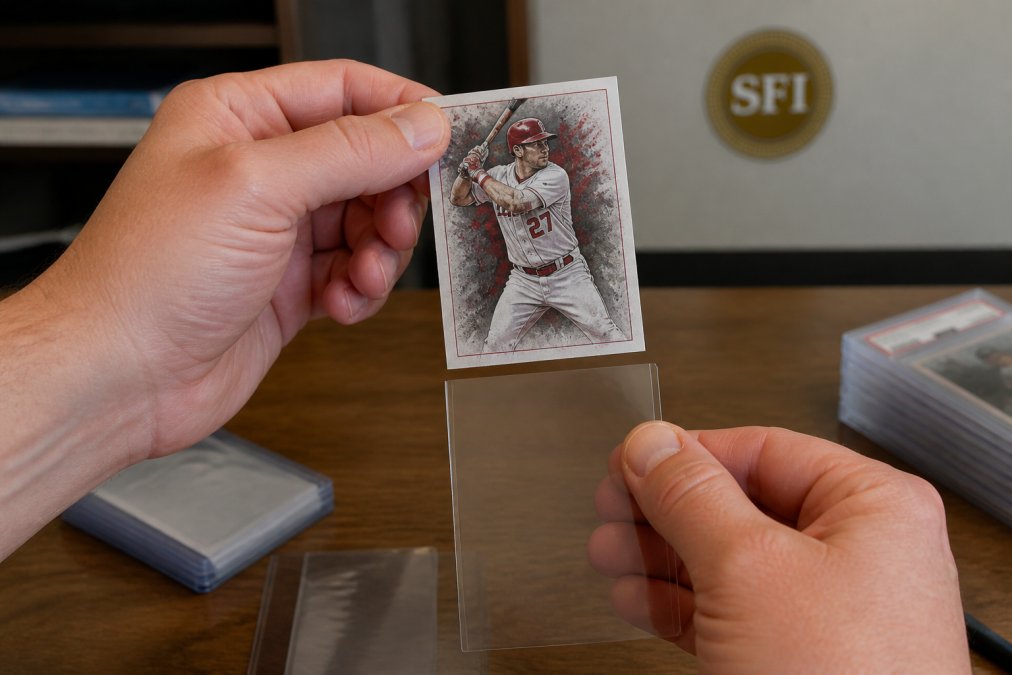
Hold the penny sleeve with the opening facing you. Position your card vertically, front face forward. Gently slide the card into the sleeve using a smooth, straight motion. The card should enter without resistance. If you feel friction or have to force it, stop immediately; the sleeve may be too small, or the card may be slightly warped.
Common insertion error: tilting the card as it enters the sleeve. This causes the top corner to catch on the sleeve edge, creating a small crease. Keep the card perfectly vertical and aligned with the sleeve opening throughout insertion.
Once inserted, the card should sit flat inside the penny sleeve with no visible gaps at the sides. The penny sleeve protects the card's surface from direct contact with the semi-rigid holder.
Step 3: Insert the sleeved card into the semi-rigid holder
Hold the semi-rigid holder with the open side facing upward. Position the penny-sleeved card above the holder opening, angled at about 15 degrees. Lower the card slowly and straighten it as it enters. This angled approach prevents the top corner of the penny sleeve from catching on the holder's edge.
Slide the card all the way to the back of the holder. It should rest flat against the back wall with no tilting or gaps. The penny sleeve should be visible but not bunched or folded inside the holder.
If the card doesn't slide smoothly, do not force it. Stop, remove the card, and check for these issues:
- The penny sleeve is too thick for the holder (rare, but possible with oversized sleeves)
- The semi-rigid holder is warped or has manufacturing defects
- The card itself is slightly bent or warped and catching on the holder edge
Forcing a card into a too-tight holder is one of the most common causes of edge damage during submission.
Step 4: Check the fit from all angles
Hold the holder up to a light source and look through it from the front. The card should be centered horizontally and vertically. No visible gaps should appear between the card and the back wall of the holder.
Gently tilt the holder from side to side. The card should not shift or rattle. If it moves, the fit is too loose, and your card will shift during shipping, causing corner wear.
Step 5: Label the holder (optional)
Troubleshooting common insertion problems
Common Submission Mistakes to Avoid
Common submission mistakes:
Skipping the penny sleeve: Your card should never touch the holder directly. The penny sleeve prevents surface scratches.
Damaged holders: Inspect for cracks or defects before submission.
Protecting Your Graded Cards After PSA Returns Them
Inspecting your slab upon arrival
When your graded card arrives, inspect it immediately for seal integrity, visible damage, card position, and label clarity. Check for gaps, cracks, or separation around edges. If you notice a cracked or bent slab, photograph it and contact PSA immediately. Do not attempt to open or repair the slab yourself.
Choosing the right protective holder for graded slabs
Storage environment and conditions
Organizing and storing multiple graded cards
Handling and display best practices
Protective sleeves for slabs
- Archival-safe: Acid-free material that won't yellow or off-gas over time
- Crystal clear: Polypropylene sleeves offer the best clarity and don't distort the view of the grade or card
- Properly sized: The sleeve should fit snugly around the slab without excess space that allows shifting
- Distortion-free: Avoid sleeves with texture or patterns that obscure the view
Monitoring slab condition over time
- Check the seal: Look for any new cracks, gaps, or separation. If you notice seal failure, the card is at risk and should be resubmitted for regrading.
- Look for label fading: The grade label should remain legible. Significant fading indicates light or humidity exposure.
- Inspect for warping: The slab should be flat and rigid. Warping indicates temperature or humidity fluctuations.
- Check for discoloration: The slab material should remain clear. Yellowing or cloudiness indicates age or environmental stress.
Insurance and documentation
For valuable graded cards, maintain detailed records:
- Photograph each slab: Take clear photos of the front and back, showing the grade label and card image
- Record details: Player name, card number, grade, and estimated value
- Store documentation separately: Keep photos and records in cloud storage or a safe deposit box, separate from the physical cards
- Update insurance: If you have homeowner's or renter's insurance, add a rider for your graded card collection. Provide documentation of card values to your insurance agent
Frequently Asked Questions
Does PSA want Card Saver 1 or Card Saver 2?
PSA accepts both Card Saver 1 and Card Saver 2 semi-rigid holders for submissions. Card Saver 1 is the standard thickness option, while Card Saver 2 is thicker and offers additional durability. The choice depends on your card's condition and your preference for holder thickness. Both are archival-safe and meet PSA's submission guidelines. Check PSA's current submission requirements before sending cards, as specifications may change.
Why does PSA require semi-rigid holders for submissions?
PSA requires semi-rigid holders because they provide superior edge damage protection and surface protection compared to top loaders. Semi-rigid holders maintain a snug, secure fit around the card, preventing movement during shipping and handling. They also offer better clarity and archival safety with acid-free polypropylene construction. This professional-grade protection ensures your trading card arrives in the same condition it was submitted, which is critical for accurate grading and maintaining the card's value.
What's the difference between a semi-rigid holder and a top loader?
Semi-rigid holders are precision-fit sleeves that wrap snugly around a card, offering superior edge protection and minimal movement. Top loaders are rigid plastic cases with an open top, designed for temporary storage or display. Semi-rigid holders provide better archival safety, clarity, and professional presentation, making them PSA's recommended choice for submissions. Top loaders are adequate for casual storage but lack the precision fit and long-term durability that serious collectors and grading services require.
Are Superior Fit Sleeves safe for PSA slabs?
Yes, Superior Fit Sleeves are specifically engineered for graded card slabs, including PSA slabs. They feature archival-grade, acid-free polypropylene construction that ensures your graded cards remain protected without yellowing or fogging over time. The precision-cut design delivers a snug fit that prevents card movement while maintaining crystal-clear clarity. Superior Fit Sleeves are the original inventor of perfect-fit tapered sleeves since 2014 and are trusted by collectors who demand professional-grade protection for their valued investments.