 listicle
Premium Sleeves for Graded Comic Slabs: 2026 Buyer's Guide
Table of Contents
- Why Graded Comic Slabs Need Premium Protection
- Quick Comparison: Top Sleeves for Graded Comic Slabs
- Material Types: Mylar vs. Polypropylene vs. Polyethylene
- How to Protect Graded Comic Slabs from Scratches
- Archival-Grade Comic Slab Sleeves: What to Look For
- Sizing, Fit Tolerance, and Slab Thickness Variations
- Resealable vs. Non-Resealable Flaps: Which Is Better?
- Frequently Asked Questions
Last Updated: September 16, 2026
Why Graded Comic Slabs Need Premium Protection
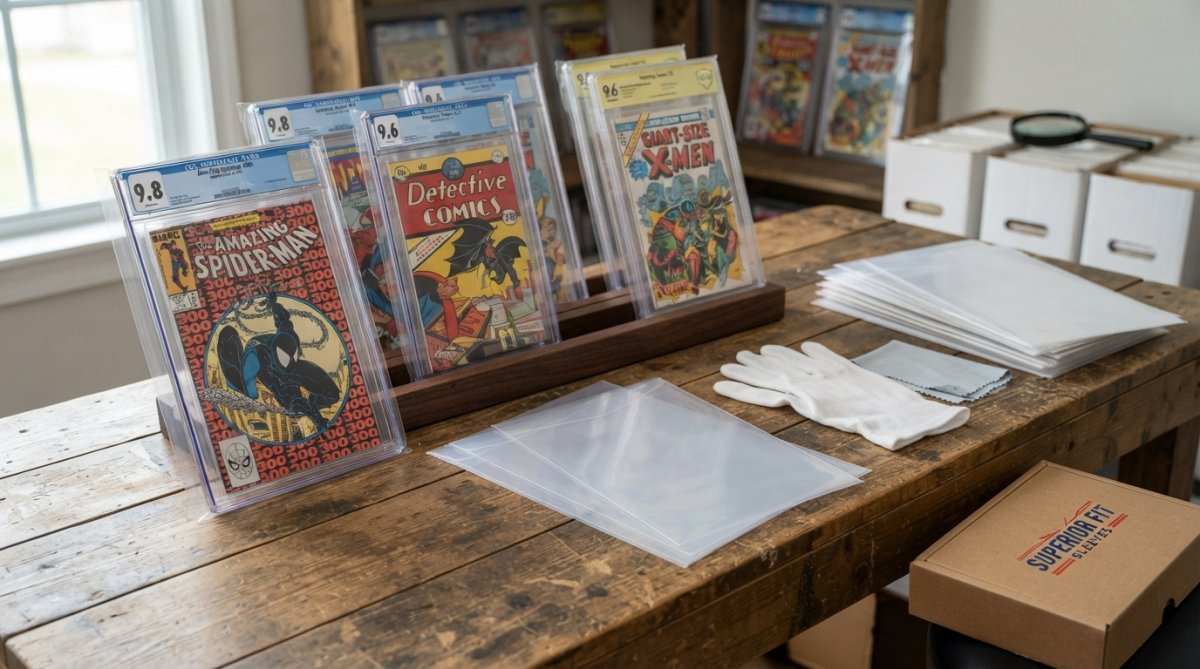
A graded comic slab is a sealed, tamper-evident holder encapsulating a comic book with its certified grade, label, and serial number. That holder is the only thing standing between a valuable book and the scratches, moisture, dust, and UV exposure that degrade it. At Superior Fit Sleeves, we understand the importance of protecting valuable graded comics. Collectors often invest significantly in high-grade slabs, and without proper protection, cases can quickly accumulate scuffs and fingerprints.
Quick Comparison: Top Sleeves for Graded Comic Slabs
The table below compares material, fit style, and best use for various sleeve options.
Sleeve | Material | Fit Style | Best For |
|---|---|---|---|
Superior Fit Sleeves | Archival-grade, acid-free film | Tapered, snug-fit | CGC, CBCS, PSA, BGS slabs |
Bags Unlimited Graded Slab Sleeves | Polyethylene | Standard, loose | Bulk storage |
E.Gerber Mylites 2 | Mylar (polyester) | Standard | High-end preservation |
Miraclekoo Resealable Bags | Polypropylene | Standard, resealable | Dust-resistant storage |
Generic bulk poly bags | Polyethylene | Loose | Short-term handling |
Material Types: Mylar vs. Polypropylene vs. Polyethylene
Mylar is a polyester film prized for archival stability and clarity; polypropylene is a clearer, stiffer plastic that resists moisture well; polyethylene is a softer, cheaper film offering basic protection at the lowest cost. The material you pick determines how the sleeve ages, how clear it stays, and whether it can off-gas compounds that harm what's inside.
- Mylar (polyester): Archival-safe, tear-resistant, and the industry standard for high-end preservation. It stays clear for decades but costs more and is harder to source.
- Polypropylene: Acid-free, clear, and dust-proof. A solid middle ground and the material behind most resealable slab bags.
- Polyethylene: The budget workhorse. Fine as a barrier, but it scuffs, clouds over time, and won't hold a snug-fit tolerance.
UV Protection: What Each Material Actually Blocks
Most sleeve listings say "UV protection" and stop there. That word means little without a number, and the numbers vary sharply by material and formulation.
- Uncoated polyethylene: Blocks almost no UV. It is a physical barrier against dust and handling, not light. A slab in a clear polyethylene bag near a window will still fade.
- Standard polypropylene: Blocks a modest share of UV, but the figure depends on additives. Clear polypropylene with no UV stabilizer performs closer to polyethylene than to Mylar.
- Mylar (polyester) with UV inhibitors: The strongest option here. Archival polyester is naturally more UV-resistant than the polyolefins, and UV-inhibited grades push blocking higher still.
Visual Clarity: How Each Film Affects the Label and Cover
Clarity is the other spec nobody quantifies, and it matters because the slab label is where the grade, serial number, and certification live. A hazy sleeve makes the label hard to read and dulls the cover art.
- Mylar (polyester): The clarity benchmark. Polyester stays optically clear and does not develop the micro-haze softer films do. Cover colors read true through it.
- Polypropylene: Very clear when new. Holds clarity in dry, stable storage but can develop slight surface haze if it scuffs.
- Polyethylene: The weakest of the three. It starts softer-looking and clouds over time as plasticizers migrate. On a dark cover, that cloudiness is obvious.
Matching Material to Use Case
- Display shelf, rotated often: Mylar or clear polypropylene. Maximum clarity and enough UV resistance to survive indirect light.
- Long-term box storage: Mylar with UV inhibitors. Archival stability and off-gas resistance matter more than handling speed.
- Bulk short-term handling: Polyethylene is acceptable if slabs are not stored near light and not held for years.
- Mixed collection with high-value keys: Standardize on Mylar above a value threshold and use polypropylene for the rest.
The material decision is really about time horizon and light exposure. Match the film to both, and the sleeve will outlast the slab's display life.
How to Protect Graded Comic Slabs from Scratches
Scratch prevention comes down to three things: the sleeve, the handling, and the storage. A premium sleeve handles the first; you handle the other two. Here's the process we recommend.
- Match the sleeve to the slab brand. CGC, CBCS, PSA, and BGS cases differ in slab dimensions. Measure your case, then buy a sleeve rated for it.
- Check the mil thickness. Thicker film resists scuffing and puncture better. Thin film tears at the corners during insertion.
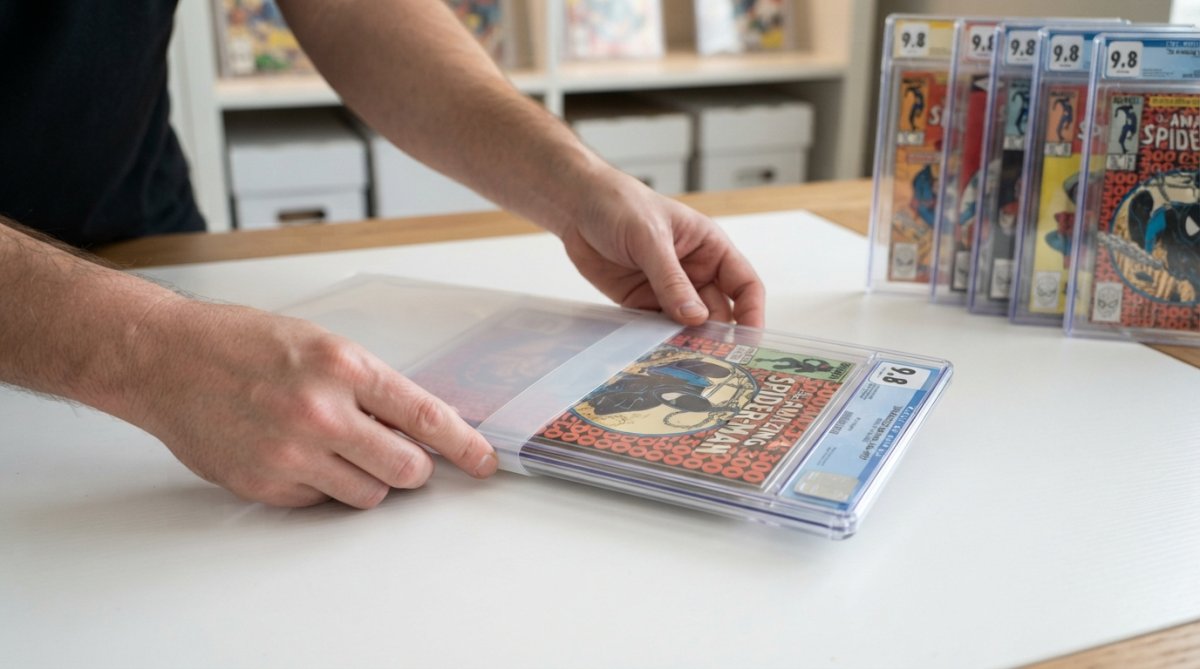
- Insert label-first, slowly. Pushing a slab in corner-first catches the film and creates a crease that never comes out.
- Seal the flap if resealable. This keeps dust and moisture out during long-term storage.
- Store slabs upright, not stacked flat. Stacking puts weight on the case faces and invites surface scratches.
- Keep them out of direct sunlight. UV exposure fades labels and degrades the film itself.
Archival-Grade Comic Slab Sleeves: What to Look For
An archival-grade comic slab sleeve is made from acid-free, chemically stable film that won't yellow, fog, or off-gas over long-term storage. Everything else is fit and finish.
Check these before you buy:
- Material claim: Look for "acid-free" and "archival-safe" stated explicitly, not implied.
- Clarity: Crystal-clear, distortion-free film lets you read the label and view the cover without removing the slab.
- Fit tolerance: A snug-fit sleeve with tight tolerances looks professional and keeps dust out. A loose bag looks sloppy and lets debris in.
- UV resistance: UV-resistant film slows label and cover fade, the most underrated feature in the category.
- Slab housing compatibility: Confirm the sleeve is rated for your grading service's case, whether CGC-compatible or CBCS-compatible dimensions.
Sizing, Fit Tolerance, and Slab Thickness Variations
Sizing is where most buyers get burned. Slab dimensions vary by grading service and case generation, and thickness is a variable to consider. A sleeve that fits one CGC case perfectly can be too loose on another.
Why Slab Thickness Varies by Generation
Grading holders are not a fixed spec. Manufacturers have revised case molds over the years, and each revision changes outer dimensions slightly. Two slabs from the same service, produced years apart, can differ noticeably in thickness even when height and width match.
The main drivers of thickness variation:
- Case mold revisions. When a service updates its holder design, the new mold often changes wall thickness or internal well depth. Older and newer cases can sit differently in the same sleeve.
- Label and insert thickness. Thicker inner labels or different insert materials push outer case dimensions out slightly.
- Sealing method. Ultrasonic welds and other techniques add material at the edges, affecting how a snug sleeve grips.
- Book thickness itself. A thicker comic can bow the case faces outward, increasing effective thickness at the center.
A Practical Fit Guide by Case Type
Exact numbers change as manufacturers revise molds, so treat published measurements as a starting point and verify with your own slab.
- Standard comic slabs (CGC, CBCS): The most common size. Most sleeves sold as "comic slab sleeves" are cut for this footprint, so a single per-service size usually covers it.
- Oversized or magazine slabs: Taller and wider than standard. A standard comic sleeve will not fit; you need one explicitly rated for the oversized footprint.
- Trading card and non-comic slabs (PSA, BGS): Different height, width, and thickness profile entirely. Not interchangeable with comic slab sleeves even though both are "graded slabs."
- Thick or jumbo holders: Some services offer thicker holders for high-page-count books. These need extra depth or the case will not seat fully.
How to Measure Your Slab Correctly
- Use a ruler or caliper, not a tape measure. Tape measures flex and round off; a rigid ruler or digital caliper gives a number you can trust.
- Measure at the thickest point. Usually the center where the book sits, not the sealed edge.
- Measure height and width at the outer edges of the case, not the inner well.
- Write the three numbers down and compare them to the sleeve's stated fit range before ordering.
- Order one sample first for a mixed collection. Test the fit on your oldest and newest slabs from the same service before committing to a bulk pack.
Fit Tolerance: What It Actually Means
If your collection spans multiple grading services, buy per-service sizing rather than forcing one bag to do everything. If it spans multiple case generations within one service, test-fit before committing to a bulk order. Fit tolerance is the feature you're paying for.
Resealable vs. Non-Resealable Flaps: Which Is Better?
Resealable flaps offer benefits for long-term storage and dust protection. Non-resealable sleeves are often preferred for display and quick access. This represents a common tradeoff.
Frequently Asked Questions
Are resealable sleeves better for graded comic slabs?
Resealable sleeves offer a dust-proof seal that keeps out moisture and airborne particles, which is useful for long-term storage. However, the adhesive flap can wear out over time and may not provide the snug, distortion-free fit of a tapered sleeve. For display purposes, non-resealable tapered sleeves often look cleaner and more professional. Many collectors use resealable sleeves for storage and switch to tapered sleeves for display.
Do graded comic slabs need extra protection?
Yes. While the grading case itself is rigid, the surface can still be scratched, scuffed, or exposed to dust and UV light. A premium sleeve for graded comic slabs adds a protective barrier that prevents scratches, reduces fingerprint smudges, and blocks some UV exposure. It also keeps the label and hologram clean and visible, which matters when you resell or display your collection.
What are the best archival-grade sleeves for CGC slabs?
The best archival-grade comic slab sleeves are made from acid-free, archival-safe materials like Mylar or high-quality polypropylene. Look for sleeves specifically sized for CGC slab dimensions, with a snug fit and crystal-clear clarity. Superior Fit Sleeves offers tapered sleeves engineered for CGC slabs, providing a precise fit that prevents slipping and protects against scuffs. Always check that the material is labelled archival-safe.
How do I prevent scratches on my graded comic slabs?
Preventing scratches starts with handling. Always hold slabs by the edges, never slide them across rough surfaces, and store them in a protective sleeve. A snug-fit sleeve acts as a sacrificial layer that absorbs minor abrasions. Avoid stacking slabs directly on top of each other without sleeves, and keep them away from keys, coins, or other hard objects. For extra protection, use a sleeve with a soft, non-abrasive interior and replace it if it becomes dirty or cloudy.
Are premium sleeves worth the extra cost for comic slabs?
Premium sleeves cost more than bulk bags, but they offer a tighter fit, better clarity, and archival-grade materials that help preserve your slab's condition and value. If you own high-value graded comics, the extra protection and display quality often justify the price. For large collections, you might use premium sleeves for your top-tier slabs and standard sleeves for lower-value ones. For current options, check the brand's website.