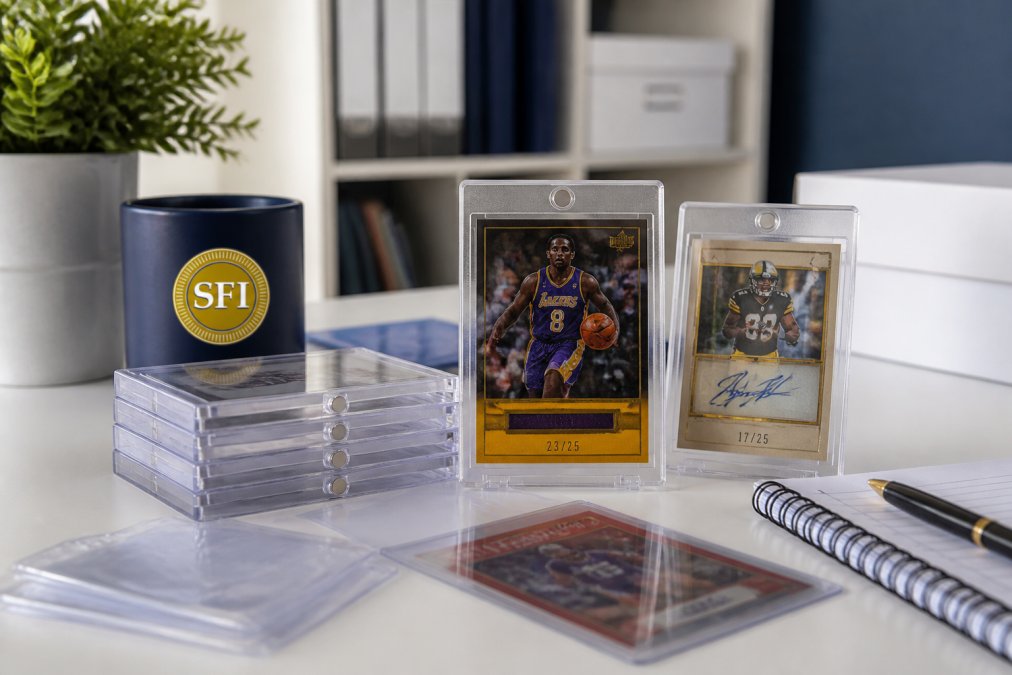
 comparison
Is Magnetic Card Holder Display Worth It? 2026 Guide
Table of Contents
- Magnetic Card Holders vs. Toploaders: What's the Real Difference?
- The Real Risks: Card Damage and Movement in Magnetic Holders
- Magnetic Card Case Sleeve Protection: Why an Inner Sleeve Matters
- How to Prevent Card Damage in Magnetic Holders
- VaultX Alternative for Magnetic Case Protection: What to Look For
- Cost Analysis: Are Magnetic Displays Worth the Investment?
- Conclusion: When Magnetic Holders Make Sense
- Frequently Asked Questions
Last Updated: September 12, 2026
Magnetic Card Holders vs. Toploaders: What's the Real Difference?
The short answer: a magnetic card holder is a rigid display case with two acrylic panels that snap together using embedded magnets, while a toploader is a single open-ended rigid plastic sleeve. That structural difference decides everything that follows, from surface contact to dust exposure.
Magnetic holders win on presentation: two clear panels clamp the card flat and look desk-worthy. Toploaders win on cost and volume, cheap in bulk, stackable, and the default shipping standard.
Here's where the comparison gets less flattering for magnetic cases. A toploader holds the card loosely, so it can shift and rub against rigid plastic. A magnetic holder clamps the card in place, eliminating movement but introducing surface pressure, edge contact if the card isn't seated correctly, and the fact that most ship without an inner sleeve.
Library of Congress guidance on archival storage enclosures makes the general principle clear: enclosures that are chemically stable and free of acidic components are the baseline for long-term paper and card stock preservation. Neither a toploader nor a magnetic case meets that bar on its own. The sleeve you put inside it does.
The Real Risks: Card Damage and Movement in Magnetic Holders
Magnetic holders reduce one risk and create two others. Card movement drops to nearly zero once the panels close, valuable for chrome and holographic surfaces, but pressure and edge friction return if the card isn't seated properly.
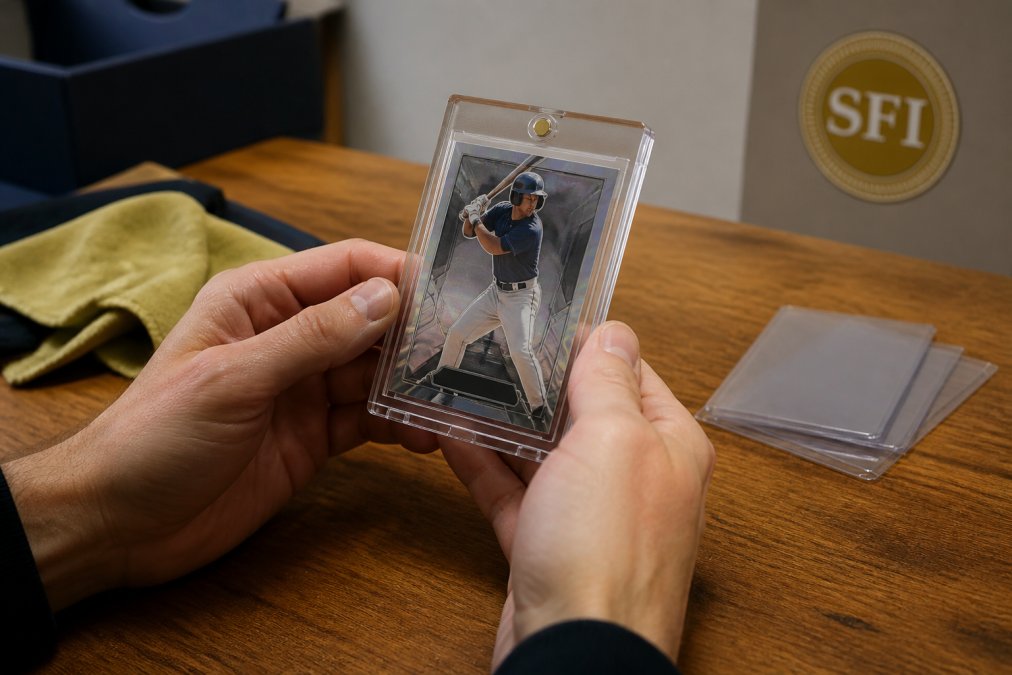
The Pressure Mechanism, Explained
The pressure problem is manageable once you understand it. Acrylic panels flex slightly when the magnets pull together, and the recessed well in most one-touch cases is cut a hair deeper than a standard card so the panels close without crushing it. But a card that sits proud of the well, or one thicker than the case was cut for, takes uneven pressure. Over months in a warm room, that produces faint surface impressions on soft-stock vintage cards: a compression set, not a scratch, and it doesn't buff out.
The edge problem is more common and more preventable. Drop a raw card into a magnetic case without a sleeve, and it can catch on the inner lip of the recess; do that a few times, and you'll see whitening on the corners, exposed paper fiber where the printed layer has been abraded away, permanent and visible under any light angle.
Humidity, Temperature, and What the Case Actually Seals
A magnetic one-touch case is not airtight. The closure holds the panels in contact, but there's no gasket, no sonic weld, and no mechanical seal. That matters in two directions:
- Humidity swings. In seasonal humidity, moisture can migrate into the case and reach the card. A sleeved card is better protected than a bare card, but neither is sealed; graded slabs are sonically welded and effectively sealed. In humid summers, a silica packet in the storage box does more than any case upgrade.
- Temperature. Acrylic expands and contracts with temperature more than paper does. A case in a hot car or sun-facing window can flex enough to change the pressure on the card inside; the risk is the case moving against a card that can't move with it.
- Dust and airborne particles. An unsleeved card in a magnetic case is exposed to whatever gets through the panel gap; a sleeved card is not. This is the strongest argument for the inner sleeve.
A common pattern among collectors who've run both formats for years: magnetic cases for display rotation, graded slabs or sealed boxes for long-term storage. The magnetic case is a presentation tool, not a preservation vault.
Raw Cards vs. Graded Slabs: Don't Confuse the Two Products
Search results blur this constantly. A magnetic card holder is built for raw cards, cards not encapsulated by a grading company. The recess and panels are cut to card dimensions, and the point is to display the card itself.
A graded slab is already encapsulated and doesn't go inside a magnetic holder. What you buy for a graded slab is a slab sleeve or slab bumper, a soft or semi-rigid outer sleeve sized to the slab, not the card. Putting a graded slab in a magnetic card holder is not a thing.
The confusion matters because collectors searching for "magnetic card holder" sometimes actually need slab protection, and vice versa. If your card is in a PSA, BGS, or CGC slab, you're shopping for slab sleeves. If it's raw and you want it visible, you're shopping for a magnetic holder plus an inner sleeve.
The Risk That Isn't Real
One concern that circulates in forums- that the magnets themselves damage cards- doesn't hold up. The magnets are embedded in the acrylic panels and separated from the card by the panel thickness and, if you're doing it right, by the sleeve. No magnetic field at the card surface is strong enough to affect card stock. The real risks are mechanical: pressure, edge contact, and environmental exposure.
Magnetic Card Case Sleeve Protection: Why an Inner Sleeve Matters
Magnetic card case sleeve protection turns a display case into an archival enclosure. A precision-cut inner sleeve sits between the card surface and the acrylic, absorbing contact, blocking dust, and adding a chemically stable barrier bare acrylic doesn't provide.
This is where Superior Fit Sleeves built its reputation. Superior Fit Sleeves, the original inventor of perfect-fit tapered sleeves since 2014, provides premium, archival-grade protective solutions specifically engineered for trading card collectors and hobbyists. A straight-cut sleeve bunches at the corners when the panels close; a tapered sleeve follows the card's outline, so the fit stays flat, and the case seals cleanly.
Material matters as much as cut. Archival-grade, acid-free construction is the baseline for anything touching a card long-term; a cheap sleeve can yellow or fog a display while a properly made one stays clear (nara.gov).
Sizing and Thickness: Matching Sleeves to 35pt and 55pt Cases
Magnetic cases are sold by card thickness, and the two numbers you'll see most are 35pt and 55pt. Standard trading cards sit around 20pt, so a 35pt case gives a little room and a 55pt case accommodates thicker stock, patch cards, and memorabilia.
Match the sleeve to the case, not just the card:
Case Size | Typical Card Type | Sleeve Consideration |
|---|---|---|
35pt | Standard raw cards, base set | |
55pt | Patch cards, thick stock, memorabilia | Deeper sleeve, verify recess depth |
100pt+ | Relic and booklet cards | Specialty sizing, check clearance |
Get this wrong and the card either rattles or the panels won't close flush. Both outcomes defeat the purpose of buying a magnetic holder.
How to Prevent Card Damage in Magnetic Holders
Preventing card damage in magnetic holders comes down to three habits: sleeve first, seat fully, close gently. Skip any one and you're posting damage photos in forums.
Step-by-Step: Inserting Cards Without Surface Scratches
- Clean your workspace. Wipe the surface and wash your hands. Grit on a fingertip becomes a scratch under acrylic.
- Sleeve the card first. Slide the card into a perfect-fit sleeve before it goes anywhere near the case.
- Open the case fully. Separate both panels and lay them flat so you're not fighting the magnets.
- Seat the card in the recess. Confirm all four corners sit inside the well with no overhang.
- Lower the top panel straight down. Don't slide it into place. Vertical placement avoids dragging the panel across the card face.
- Let the magnets close it. Don't press. If the panels resist, the card isn't seated.
VaultX Alternative for Magnetic Case Protection: What to Look For
If you're searching for a VaultX alternative for magnetic case protection, the criteria that matter are fit precision, material stability, and clarity. Brand loyalty matters less than whether the sleeve matches your case dimensions.
Here's the evaluation framework I'd use:
- Does the sleeve taper to follow the card outline, or is it straight-cut?
- Is the material documented as archival-grade and acid-free?
- Does the sleeve come in sizes matched to 35pt and 55pt cases specifically?
- Is the clarity high enough that you're not looking through a fogged layer?
- Does the sleeve stay flat when the panels close, or does it bunch at the corners?
Superior Fit Sleeves offers precision-cut, ultra-clear, and distortion-free sleeves for graded slabs (including PSA, BGS, and CGC), top-loaders, and magnetic cases, ensuring your most valued investments are safeguarded from damage while maintaining a professional, snug-fitting display. Our commitment to archival-grade, acid-free protection and crystal-clear clarity sets us apart, enhancing the presentation of your collection with a clean, smooth, and professional finish.
American Institute for Conservation guidance on enclosures and mounting reinforces the point that enclosure materials should be selected for chemical stability first and appearance second. Clarity is a bonus. Stability is the requirement.
Cost Analysis: Are Magnetic Displays Worth the Investment?
Magnetic holders cost more per card than toploaders, and that gap is the entire question. The answer depends on what's inside the case, not how many cases you own.
The Real Per-Card Math
A toploader is a few cents. A magnetic one-touch case runs several dollars, and a precision-cut inner sleeve adds a bit more. So the honest comparison isn't "magnetic case vs. toploader", it's "magnetic case plus sleeve vs. toploader plus penny sleeve," because a bare card in either format is a bad setup.
That changes the decision. If you're protecting a card worth meaningful money, the per-card cost of a magnetic display plus sleeve is a rounding error against its value. If the card is worth a few dollars, the same setup costs more than the card. The format isn't the variable, the card is.
A useful rule of thumb: if the display setup costs more than roughly a tenth of the card's value, a toploader is the better tool. If it costs less, the magnetic case earns its place.
The Decision Table, With the Sleeve Baked In
Your Situation | Better Choice | Why |
|---|---|---|
High-value raw card, on display | Magnetic holder + inner sleeve | Presentation and reduced handling |
Graded slab | Slab sleeve or slab bumper | Case already rigid and sealed; a magnetic holder doesn't fit a slab |
Bulk commons, storage | Toploader + penny sleeve + box | Cost per card dominates |
Cards you swap often | Magnetic holder + inner sleeve | Fast access without surface contact |
Cards headed to grading | Toploader + penny sleeve, or a card saver | You'll be shipping them; don't pay for display you won't use |
Where the Money Actually Goes
The case is the visible cost. The sleeve is the hidden one, and it determines whether the case does its job. A magnetic case with a cheap, straight-cut sleeve bunches at the corners, keeps the panels from closing flush, and can fog or yellow over time. That's not a saving, it's a case that fails at the one thing you bought it for.
Budget for both from the start. Collectors who buy the case first and "get around to" the sleeves usually end up buying the sleeves anyway, plus a replacement card.
What a Magnetic Case Does Not Buy You
One thing worth flagging: magnetic cases are not a substitute for grading. A holder protects and displays; it doesn't authenticate, assign a grade, or lock in a condition assessment a buyer will trust. Collectors who treat a magnetic case as a grading alternative end up disappointed, and out the cost of the case plus the grading fee they eventually pay anyway.
If the card's value depends on provenance or condition verification, grading is the path. If the card's value is in how it looks on your shelf, a magnetic case is the right spend.
Conclusion: When Magnetic Holders Make Sense
Magnetic holders make sense when a card's presentation value justifies the per-unit cost and you pair the case with a proper inner sleeve. They make less sense for bulk storage, cards headed to grading, or anyone unwilling to add the sleeve step.
The risk that turns collectors off magnetic cases, surface damage and edge wear, is a seating and sleeving problem, not a flaw in the format. Solve it with a precision-cut, archival-grade sleeve and the format does exactly what it promises.
Superior Fit Sleeves makes magnetic card case sleeves engineered for this exact use, with tapered perfect-fit construction, ultra-clear distortion-free material, and acid-free archival protection that keeps a display looking sharp for years. If you're protecting cards worth displaying, start with the sleeve that fits the case. SEARCH magnetic card case sleeves at Superior Fit Sleeves and give your best cards the enclosure they've earned.
Frequently Asked Questions
Are magnetic card holders safe for long-term card storage?
Magnetic card holders are safe for long-term storage if you use archival-grade materials and an inner sleeve. Look for acid-free, UV-protected acrylic and avoid cases with sharp edges that can scratch the card surface. Always place the raw card inside a perfect-fit sleeve before inserting it into the magnetic holder to prevent movement and surface damage. Without an inner sleeve, cards can shift and develop scratches over time.
Do I need a sleeve inside a magnetic card holder?
Yes, a sleeve inside a magnetic card holder is strongly recommended. A perfect-fit or inner sleeve creates a barrier between the card surface and the rigid acrylic, preventing scratches and reducing movement. It also adds a layer of protection against dust and moisture. For magnetic card case sleeve protection, choose sleeves sized to your holder's thickness, such as 35pt or 55pt, to ensure a snug fit without bending the card.
How do you prevent cards from moving inside a magnetic case?
To prevent card movement, use a correctly sized inner sleeve and ensure the magnetic closure is fully engaged. Cards can shift if the holder is too thick for the card or if the sleeve is loose. Measure your card thickness and match it to the holder's point rating (e.g., 35pt for standard cards). If the card still slides, add a thin backing card or switch to a tighter sleeve. Avoid over-tightening, which can warp the card.
Are magnetic card holders better than toploaders for display?
Magnetic card holders offer superior display quality because of their crystal-clear acrylic and frameless design, making them ideal for showcasing valuable raw cards. Toploaders are more cost-effective for bulk storage and shipping but are less aesthetically pleasing. For high-value cards you want to display, magnetic holders with UV protection and an inner sleeve provide better presentation and protection. For everyday storage, toploaders remain a practical choice.