 Comparison
Anti-Glare vs Clear Card Sleeves: Which Is Better?
Last Updated: October 31, 2026
Quick Summary
Anti-glare card sleeves use a matte or textured front that scatters light, cutting reflections from lamps and windows. Clear sleeves have a smooth, glossy front that shows fine detail sharply but can reflect bright light straight into your eyes or a camera. The better choice depends on how bright your table is and how you handle your cards.
- Clear sleeves have a smooth, glossy front that reflects light in a predictable direction.
- Anti-glare sleeves use a matte or textured coating that scatters incoming light.
- Test sleeves under the lighting where you actually play before buying in bulk.
- Matte sleeves can polish smooth in high-contact spots, increasing glare over time.
- Finish affects how a sleeve ages, not how well it protects the card.
Table of Contents
- How Anti-Glare and Clear Card Sleeves Differ in Finish
- Glare Reduction and Visibility Under Bright Light
- Matte vs Glossy Card Sleeves: Finish Trade-Offs
- Best Card Sleeves for Visibility Across the Table and on Camera
- Inner vs Outer Card Sleeves and Standard vs Japanese Sizes
- Durability, Protection and Long-Term Wear
- Choosing the Right Sleeve for Your Collection and Next Step
- Frequently Asked Questions
How Anti-Glare and Clear Card Sleeves Differ in Finish
Anti-glare card sleeves and clear card sleeves differ mainly in their front surface finish, and that finish changes how light behaves at the surface. Clear sleeves have a smooth, glossy front. Light hitting that smooth surface bounces off at a predictable angle, so a lamp, window, or ring light can reflect straight back into your eyes or into a camera lens, which is why many players choose anti-glare card sleeves for bright tables. Anti-glare sleeves use a matte or textured coating that scatters incoming light in many directions instead of one, which spreads the reflection out and softens it. For a side-by-side look at how fitted and penny sleeves differ in protection, see Fitted Sleeves vs Penny Sleeves: Which Protects Cards Better.
That single mechanism explains most of the practical differences you will notice at the table.
What sellers actually mean by clear, matte, non-glare, and anti-glare
Terminology in this category is loose, and the labels describe a finish, not a measured optical rating. A useful way to read product listings:
- Clear / glossy, smooth, transparent front with a mirror-like surface. Maximum transmission, maximum specular reflection.
- Matte, a textured front that diffuses light. Reduces reflection but can add a faint haze.
- Non-glare / anti-glare, usually a matte or lightly textured finish marketed for reflection control. The terms are often used interchangeably with matte, even though the texture level varies by brand.
- Anti-fingerprint / anti-static, surface treatments that may or may not affect glare; do not assume they do.
None of these labels come with a standard test method, so two sleeves both sold as "matte" can diffuse light very differently. Treat the label as a starting point and judge the actual surface.
The optical trade-off, in plain terms
A smooth clear front transmits the most detail, so fine print, holo patterns, and foil edges look sharpest through it. A textured anti-glare front trades a small amount of that sharpness for reflection control. In practice, most players find the loss of crispness minor in normal play and noticeable when inspecting a card closely for condition or centering.
The choice is not about one finish being better overall. It depends on how and where you handle your cards, and on whether you are reading a card at arm's length or inspecting it under a loupe.
Glare Reduction and Visibility Under Bright Light
Glare is the main reason players reach for anti-glare sleeves. A glossy sleeve can reflect an overhead lamp or window light directly into your eyes, making it harder to read a card's values, text or artwork from your seat.
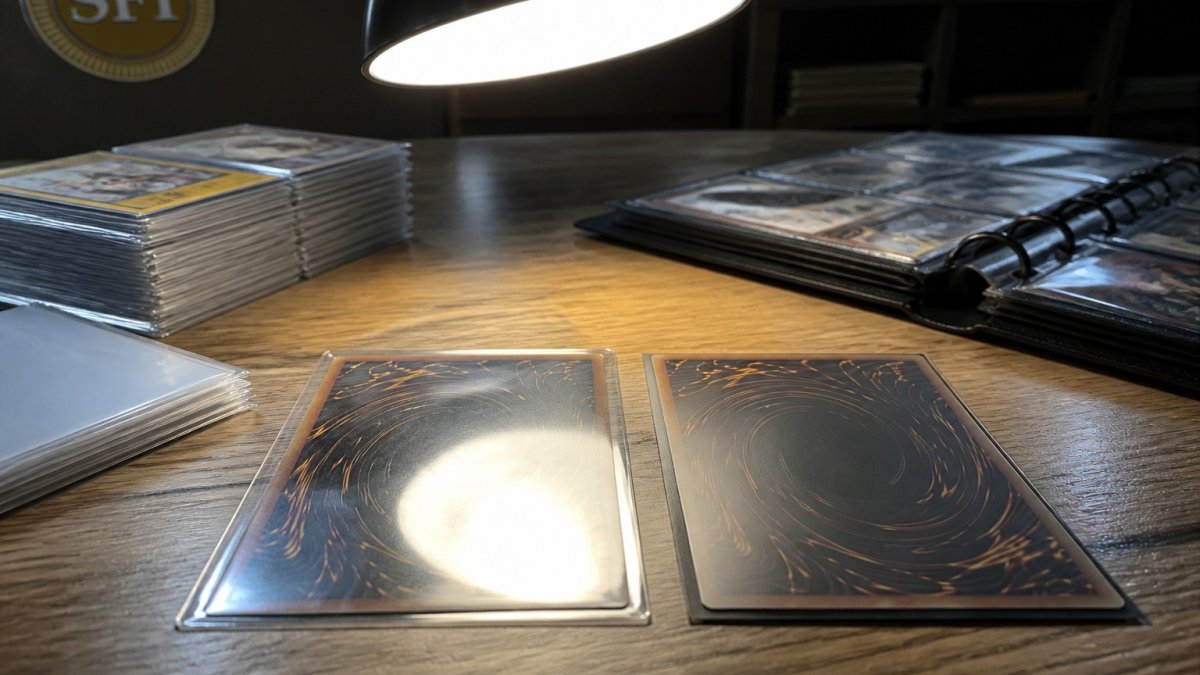
Anti-glare sleeves reduce this effect by diffusing light across the surface. The trade-off is that the diffusion can slightly soften fine detail, so the card may look a little less crisp than it does through a clear sleeve in dim conditions.
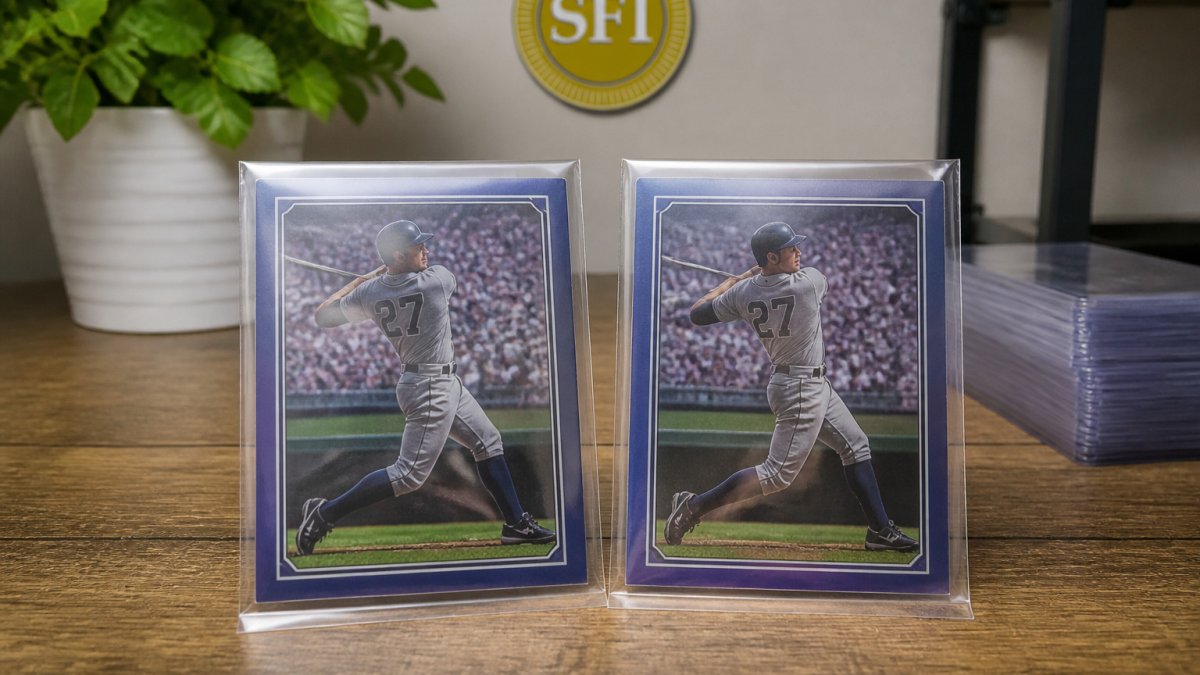
Clear sleeves perform well in average room lighting, but they can produce noticeable reflections under bright, direct light. If your table sits under strong lamps or near a window, test a few sleeves in the spot where you actually play before committing to a bulk order.
!Close-up of a trading card in a clear sleeve on a collector's table under a bright overhead lamp, with visible glare on the surface beside a matte-sleeved card
Matte vs Glossy Card Sleeves: Finish Trade-Offs
Matte sleeves have a textured, non-reflective surface. Glossy sleeves are smooth and shiny. The difference affects more than glare.
Matte finishes tend to reduce reflections and fingerprints. Many collectors also find them easier to grip and shuffle. The downside is that some matte sleeves can look slightly cloudy, which can dull the color of foil cards and bright artwork.
Glossy finishes show color and foil shine more vividly. They are a good fit for collectors who display cards in clear cases or want the most natural look. They also tend to reflect more light, which can be frustrating during play.
Neither finish is universally better. Choose matte if glare and handling matter most. Choose glossy if color clarity and foil appearance matter most.
The two finishes differ in how they handle reflection, grip and color, as summarised below.
| Finish | Main strength | Main trade-off |
|---|---|---|
| Matte | Reduces reflections and fingerprints | Can look slightly cloudy |
| Matte | Easier to grip and shuffle | Dulls foil and bright artwork |
| Glossy | Shows color and foil shine vividly | Reflects more light during play |
| Glossy | Suits clear cases and displays | Less suited to frequent handling |
Best Card Sleeves for Visibility Across the Table and on Camera
Visibility changes depending on who is looking. A card that reads clearly to the player holding it may be hard to see from across the table. Cameras add another layer, since reflections that a person ignores can wash out a streamed or filmed shot.
For across-the-table visibility, clear sleeves with a low-gloss finish usually work well. They keep card art sharp while limiting the reflections that make values hard to read from a distance.
For on-camera play, anti-glare sleeves tend to produce cleaner footage because they reduce the bright spots that cameras pick up. If you stream or film your games, test a sleeve under your actual lighting setup before buying in bulk. Beyond the immediate benefits for video clarity, these matte finishes also provide a necessary layer of defense when protecting sports memorabilia from the long-term degradation caused by harsh ultraviolet exposure.
Inner vs Outer Card Sleeves and Standard vs Japanese Sizes
Inner sleeves sit directly against the card. Outer sleeves go over the inner sleeve to add a second layer of protection. Some collectors double-sleeve cards for extra protection, while others use a single sleeve for convenience.
Size matters as much as finish. Using the wrong size can cause sleeves to bulge or fit loosely.
If you collect both, check card dimensions before ordering. Our graded card slab sleeves and magnetic card case sleeves are available for collectors who need a precise fit.
Standard vs Japanese Card Sleeves
Matching the sleeve to the card keeps the card centered and reduces movement inside the sleeve.
Durability, Protection and Long-Term Wear
Protection is not only about the finish. Sleeve thickness, material quality and how tightly a sleeve fits all affect how well a card holds up over time. A sleeve that fits snugly limits movement and reduces the chance of edge wear. But the finish you choose also changes how a sleeve ages, and that is where most buying guides stop short.
How each finish wears over time
Clear glossy sleeves show wear clearly. Fine scuffs, shuffle marks, and fingerprints catch the light and become visible as a dull haze across the front. The same smooth surface that shows artwork best also shows its own scratches best. Over months of play, a well-used glossy sleeve can develop a visible wear pattern in the center where cards slide against each other.
Matte and anti-glare sleeves hide fine scuffs better because the texture already scatters light. The trade-off is that the coating itself can wear. Repeated shuffling and thumb pressure can polish a matte surface smooth in high-contact spots, creating small shiny patches that glare more than the surrounding texture. If you shuffle hard, inspect matte sleeves periodically for those polished zones.
The wear mechanisms that matter
- Surface scuffing, cards and sleeves rubbing during shuffling. Worse on glossy fronts, less visible on matte.
- Coating polish, matte texture smoothing out in high-contact areas, reducing glare control over time.
- Edge splitting, seams failing after repeated flexing, more common in thin sleeves regardless of finish.
- Clouding, gradual loss of clarity from micro-scratches and plasticizer migration, most noticeable on clear fronts.
- Fingerprint and oil buildup, shows more on glossy surfaces; matte hides it but can trap residue in the texture.
Does finish change protection?
Finish does not meaningfully change the barrier a sleeve provides against dust, moisture, and handling. What changes is how quickly the sleeve looks worn and how often you will want to replace it. A player who shuffles daily may replace glossy sleeves sooner because scuffs become distracting, while a collector who stores cards and rarely handles them may keep either finish for years.
For long-term storage, look for sleeves made from archival-quality materials and keep them away from heat and direct sunlight.
!Collector inspecting a sleeved trading card on a table for surface scuffs, under soft natural light
Choosing the Right Sleeve for Your Collection and Next Step
Start with how you use your cards. If glare is your main problem, choose an anti-glare sleeve. If you want the clearest display, choose a clear sleeve. If you shuffle and handle cards often, consider a matte finish for grip.
For sports cards stored in top-loaders, our top-loader sleeves are designed for a precision, snug fit.
Test a small batch under your own lighting, then buy in larger quantities once you know which finish works best for your setup.
Frequently Asked Questions
What is the difference between standard and Japanese card sleeves?
Using the wrong size can cause cards to slide or fit loosely, so check the card dimensions before buying.
Do anti-glare card sleeves make cards look less clear?
Anti-glare sleeves use a matte surface that scatters light, which reduces reflections but can make artwork look slightly softer or cloudier than a clear sleeve. The trade-off is visibility under bright light versus maximum sharpness of the print. Players who prioritize readability under overhead lighting often accept that softness, while collectors who display cards in dim settings may prefer clear.
Are matte card sleeves the same as anti-glare sleeves?
Not always. Matte sleeves describe a surface texture, while anti-glare describes the function of reducing reflections. Many matte sleeves are anti-glare, but finishes vary by manufacturer, so compare product descriptions rather than assuming the terms are interchangeable.
Are clear card sleeves better for displaying trading cards?
Clear sleeves generally show card artwork and foil detail more sharply, which suits display and photography. They can reflect light more strongly, so placement matters. For cards kept in a binder or viewed under bright lamps, an anti-glare finish may be more practical.