 ultimate-guide
How to Preserve Trading Cards Long Term: 2026 Guide
Table of Contents
- The Layered Protection Method for Long-Term Card Storage
- Why Card Condition Decides Your Collection's Value
- Step 1: Sleeve Every Card Before It Touches Storage
- Step 2: Rigid Protection with Toploaders and Magnetic Holders
- Step 3: Control Climate to Prevent Card Warping
- Step 4: Block UV Light and Moisture Damage
- Step 5: Choose Archival-Grade Storage Supplies
- Organizing Bulk Cards with Boxes for Pokemon Cards
- Frequently Asked Questions
Last Updated: September 5, 2026
The Layered Protection Method for Long-Term Card Storage
Long-term preservation is not about a single miracle product. It is about building a layered defence that protects your cards from physical damage, environmental degradation, and handling errors simultaneously. This guide from Superior Fit Sleeves breaks down the exact system serious collectors use to preserve trading cards for decades, not just months.
The core principle is simple: every layer serves a distinct purpose. A penny sleeve prevents micro-scratches. A rigid holder stops bending and crushing. Climate control halts warping and moisture damage. Together, these layers create a barrier that keeps card stock flat, clean, and colorless.
Most collectors lose value not from one catastrophic event but from slow, cumulative damage. Corner wear, edge whitening, and surface haze creep in over years of improper storage. The system below eliminates those risks before they start.
Why Card Condition Decides Your Collection's Value
The single most important factor in trading card valuation is condition. A card graded as mint state can be worth multiples of the same card in near-mint condition, and that gap widens every year as high-grade populations stay static.
Environmental degradation is the silent killer. Humidity above 50% causes card stock to absorb moisture and warp (loc.gov). Heat accelerates the breakdown of the card's coating. UV light bleaches ink and yellows the surface. These forces work continuously, even inside closed boxes.
Understanding this changes how you approach storage. You are not just organizing cardboard. You are managing a delicate, layered material that responds to its environment. Treat preservation as a science, and your collection retains its value.
Step 1: Sleeve Every Card Before It Touches Storage
Every card, regardless of value, needs a soft inner sleeve before it enters any rigid holder. The sleeve is your first line of defense against micro-scratches and surface abrasion.
Penny sleeves are the standard for bulk storage, but they fit loosely. A loose sleeve allows the card to shift and can cause edge friction during handling. For high-value cards, a precision-fit sleeve eliminates that movement entirely.
This is where the distinction between standard and archival-grade matters. Look for sleeves made from polypropylene that are PVC-free and acid-free. These materials will not off-gas or degrade over time, protecting the card surface without chemical interaction.
Step 2: Rigid Protection with Toploaders and Magnetic Holders
Once sleeved, the card needs structural support. A rigid holder prevents bending, crushing, and the kind of edge damage that happens when boxes shift or get stacked improperly.
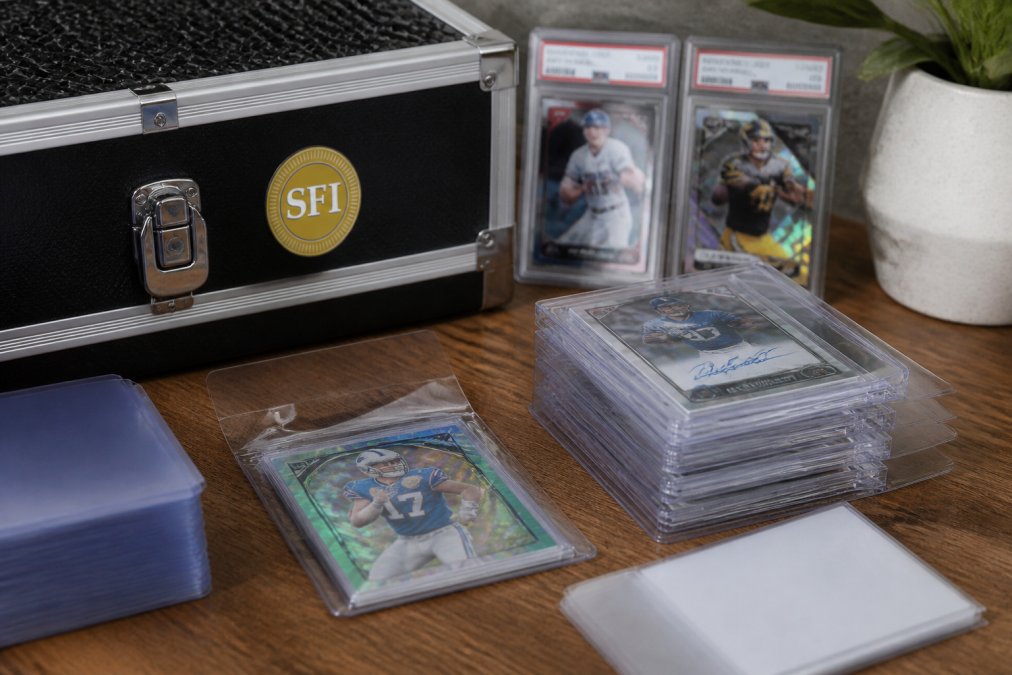
Toploaders are the workhorse of card protection. They are inexpensive, stackable, and provide excellent rigidity. For cards in rotation or bulk storage, a toploader is often sufficient. The trade-off is that toploaders do not seal, so they offer minimal protection against moisture or dust over long periods. Adding Top-Loader Sleeves can help keep dust and debris from settling on the card inside.
Magnetic holders, often called one-touch cases, provide a tighter seal and a more premium presentation. They are ideal for display or for cards you want to access regularly. The downside is cost and bulk; magnetic holders take up significantly more space than toploaders.
Toploaders vs. Magnetic Holders: Which One Fits Your Needs?
Holder Type | Best For | Protection Level | Space Efficiency |
|---|---|---|---|
Toploader | Bulk storage, low-cost protection | Good against bending | High |
Magnetic Holder | Display, high-value singles | Excellent, seals against dust | Low |
The right choice depends on your collection. If you have thousands of cards, toploaders are the practical answer. If you have a smaller number of high-value cards, magnetic holders are worth the investment.
Step 3: Control Climate to Prevent Card Warping
Card warping is one of the most common and most preventable forms of damage. Warping happens when card stock absorbs or loses moisture unevenly, causing the cellulose fibres to expand or contract at different rates. The result is a card that is no longer perfectly flat, which can be a significant factor in grading and long-term value.
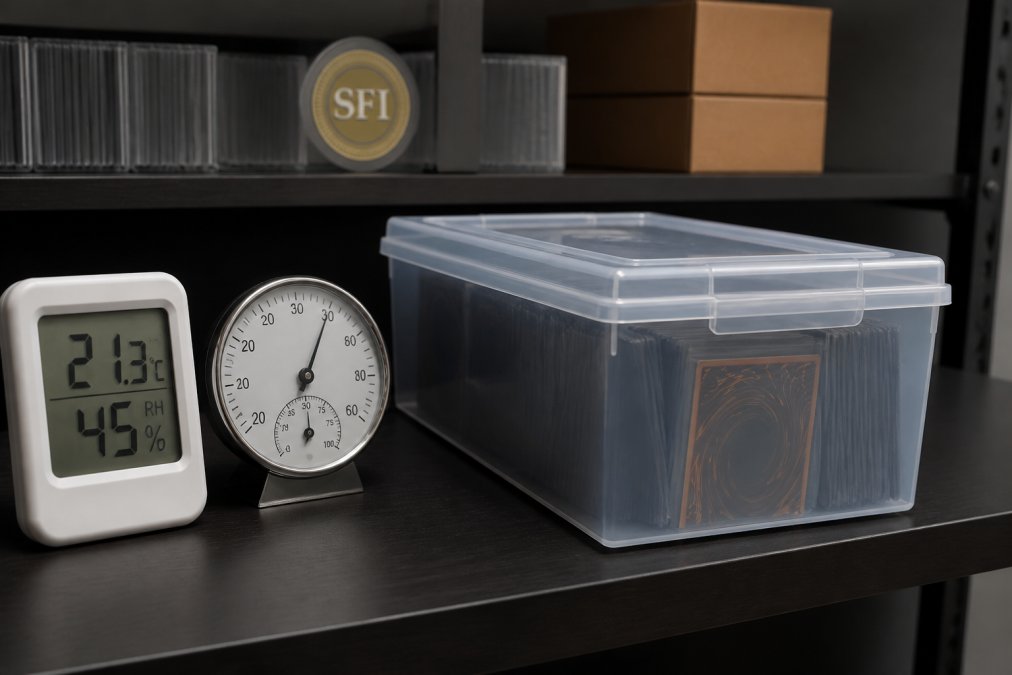
Process diagram showing steps for hygrometer and thermometer and sitting concepts for preserving trading cards
The ideal storage environment is cool and dry. Aim for a temperature between 60 and 70 degrees Fahrenheit and a relative humidity between 40 and 50 percent (archives.gov). Consistency matters more than perfection; wild swings in humidity cause more damage than a steady, slightly imperfect level. A card that cycles between 30% and 60% relative humidity on a weekly basis is under constant stress, which can lead to micro-cracking and accelerated wear at the edges.
To manage this, you need to think about your entire home environment, not just the box on your shelf. The first step is to purchase a digital hygrometer, an inexpensive tool that measures humidity. Place one in the room where you store your collection and check it periodically. If you see readings consistently above 55%, you need to take action.
A dehumidifier is the most effective solution for a room that runs humid, especially during the summer months. Look for a model with a built-in humidistat so it can maintain a set level automatically. For localized protection inside storage boxes, silica gel packets are a useful secondary defence. These packets absorb moisture from the air inside a sealed container. However, they are not a substitute for room-level control; they are a supplement. You will need to recharge or replace them periodically, as they become saturated over time.
Beyond humidity, consider the source of heat. Avoid storing cards near radiators, heating vents, or appliances that generate heat, such as a refrigerator or a computer. Heat accelerates the chemical breakdown of the card's coating and can cause plastic holders to warp over time. A stable, cool environment is the single most important factor in preventing warping and preserving the structural integrity of your cards for the long term.
Step 4: Block UV Light and Moisture Damage
Two environmental threats cause the most irreversible damage: UV light and moisture. Both work slowly, but their effects are permanent.
Sunlight exposure bleaches ink and yellows card stock over time. Even indirect light through a window can cause noticeable fading in a few years. Store cards in opaque boxes or in a room without direct sunlight. If you display cards, rotate them periodically and use UV-protective glass in frames.
Moisture damage is equally destructive. Water causes card stock to swell, ink to run, and surfaces to stick together. Never store cards in a room prone to dampness, and keep them off the floor where spills or flooding could reach them.
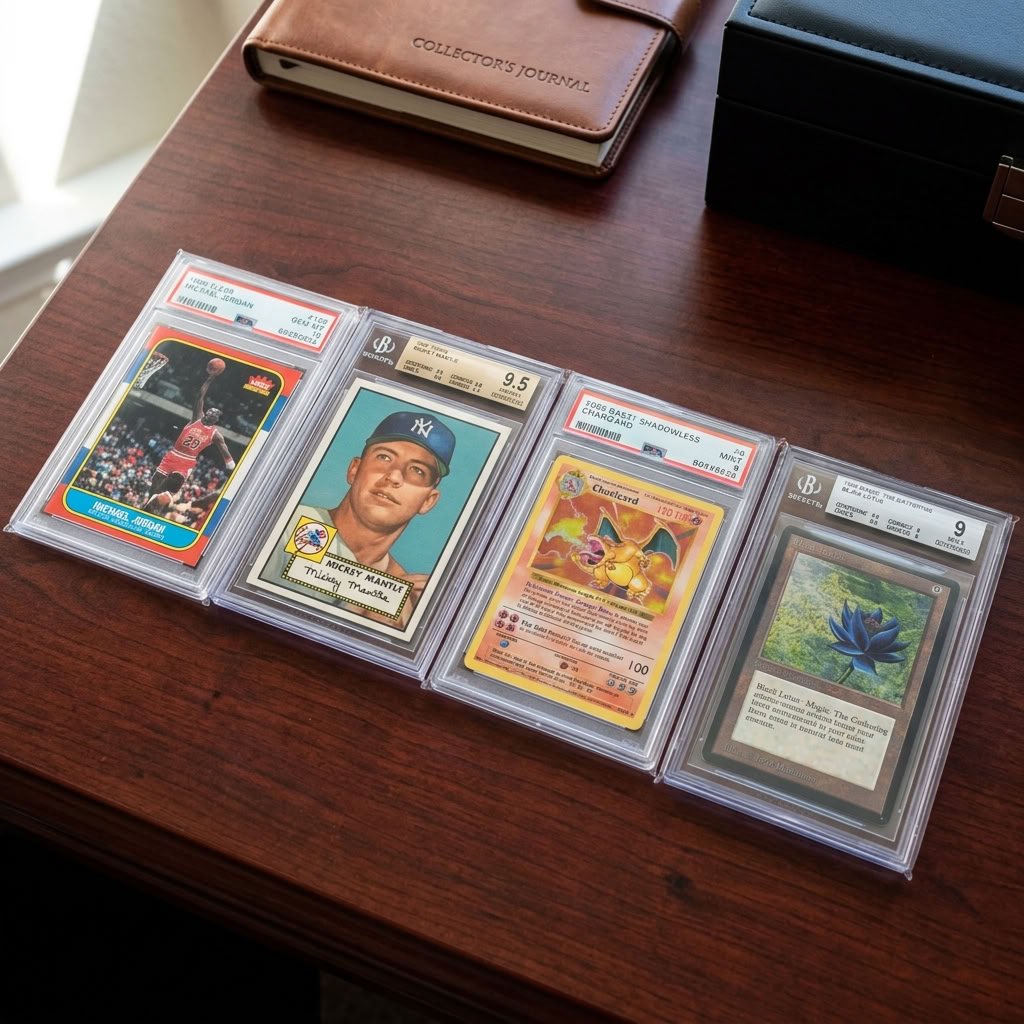
For graded cards, the slab offers some protection, but the paper label inside is still vulnerable to humidity. A sealed slab sleeve adds a layer of defence against moisture infiltration and keeps the label crisp and readable.
Step 5: Choose Archival-Grade Storage Supplies
Not all storage products are created equal, and the difference isn't just about brand names. It's about chemistry. Over a decade, the wrong plastic or cardboard can cause irreversible damage to your cards, even if they are never touched. Understanding why requires a brief look at material science.
The primary enemy is polyvinyl chloride, commonly known as PVC. PVC is a flexible plastic often used in cheap binders and sleeves. To make it pliable, manufacturers add plasticizers. These chemical compounds are not bound to the polymer chain; they slowly migrate to the surface and off-gas over time (nist.gov). This off-gassing releases hydrochloric acid, which can cause card stock to yellow, become brittle, and develop a sticky residue. This is not a theoretical risk; it is a well-documented failure mode in archival science.
The safe alternative is polypropylene. This plastic is chemically stable and does not require plasticizers for flexibility. It is the standard for archival-safe sleeves and holders. When you see a product labelled 'polypropylene,' it means the material will not break down into harmful acids under normal storage conditions. Polyester, or Mylar, is another safe option, offering superior clarity and durability, but it comes at a higher cost.
Cardboard is another hidden danger. Standard cardboard is made from wood pulp that contains lignin, an organic polymer that produces acids as it breaks down. These acids can migrate from the box to the cards inside, causing yellowing and weakening the paper fibres. Archival-safe cardboard is buffered with an alkaline agent, typically calcium carbonate, to neutralize acid production. This is why a simple shoebox is a poor long-term storage solution, while a purpose-built archival box is a worthwhile investment.
This scientific context is often missing from basic guides, but it is the core reason why 'archival-grade' is not just a marketing term. It is a specific, measurable standard that protects your collection from the very materials designed to hold it.
Organizing Bulk Cards with Boxes for Pokemon Cards
For bulk collections, especially large volumes of Pokemon cards, organization is preservation. Boxes for Pokemon cards that are stacked haphazardly invite damage every time you search for a single card.
The best approach is a system of labelled, archival-safe boxes. Sort cards by set, type, or value, and store them vertically rather than flat. Vertical storage prevents the weight of stacked cards from compressing the ones at the bottom.
For cards you handle frequently, keep them in penny sleeves inside the boxes. For cards that complete a set or hold significant value, graduate them to toploaders or magnetic holders. The effort you put into organization now saves you from handling every card repeatedly, which is itself a source of wear.
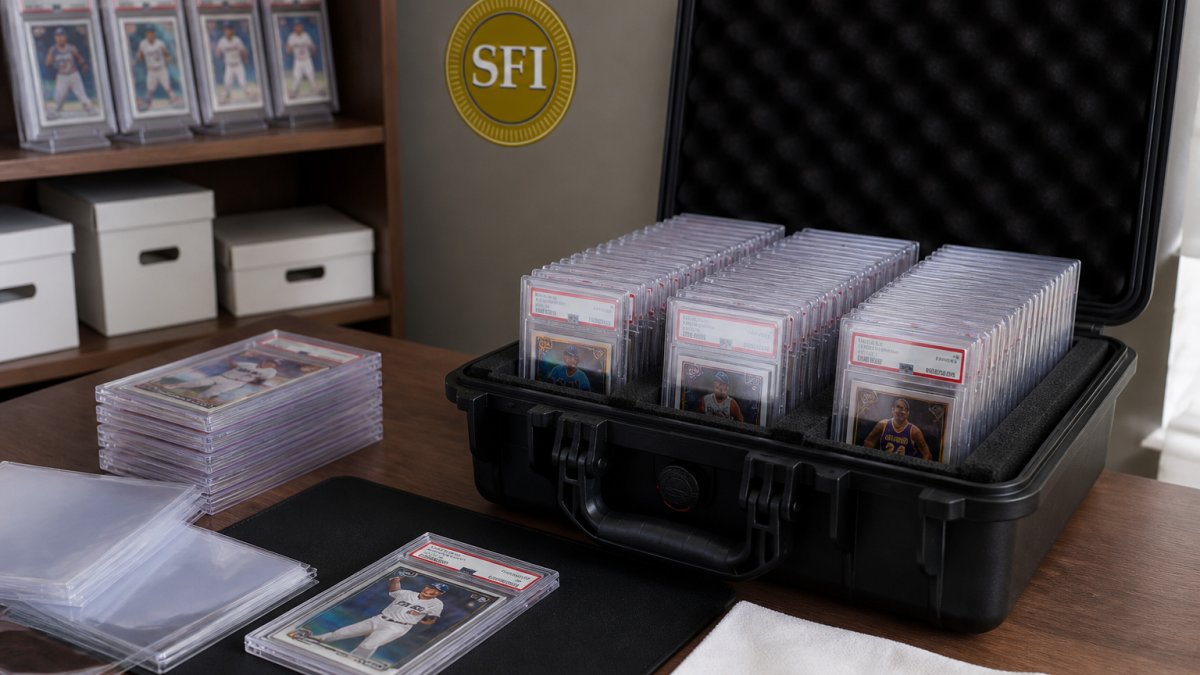
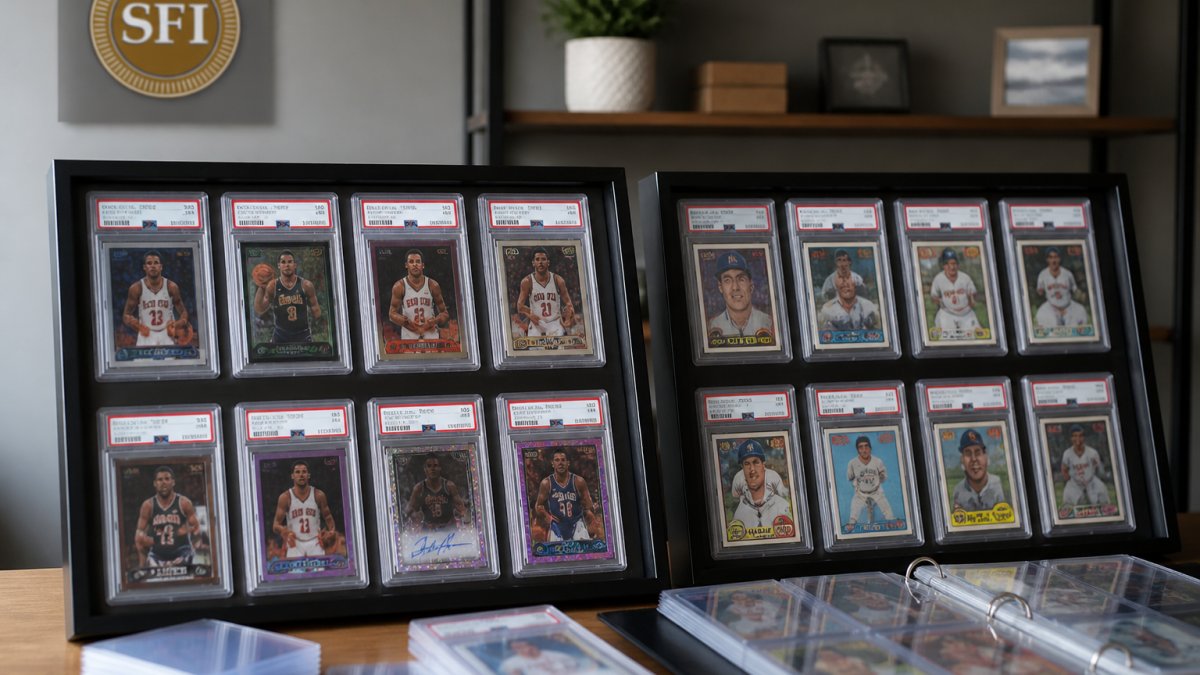
Team bags and card binders round out a complete system. Team bags protect toploaders and slabs from scratches during transport. Card binders with archival-safe pages are excellent for displaying a curated subset of your collection while keeping it protected.
Preserving a collection long-term requires understanding that damage comes from many directions: physical pressure, humidity, light, and improper materials. The collectors who succeed treat preservation as a discipline, not an afterthought. At Superior Fit Sleeves, we have specialized in archival-grade, acid-free protection since 2014, engineering precision-fit sleeves for graded slabs, toploaders, and magnetic cases that keep your cards safe and display-ready. Whether you are protecting a single valuable card or thousands, the right layers make the difference between a collection that holds its value and one that slowly degrades. Get started with Superior Fit Sleeves and give your cards the protection they deserve.
Frequently Asked Questions
What is the best way to protect trading cards for long-term storage?
The best method uses layers. Start with a penny sleeve to protect the surface, then place the card in a rigid holder like a toploader or magnetic case. Store those holders in a sturdy box away from sunlight and moisture. For graded slabs, use a precision-fit slab sleeve to prevent scratches. This system guards against surface wear, bending, and environmental damage simultaneously.
Is it better to store trading cards in binders or toploaders?
Toploaders offer more protection than binder pages. Binders keep cards flat and organized, but the pages can flex, and the cards are exposed to more dust and potential handling damage. For valuable cards, use a penny sleeve inside a toploader. Reserve binders for bulk common cards you plan to trade or sell quickly, not for long-term storage of high-value items.
How do I prevent moisture and humidity damage to my card collection?
Maintain a stable environment between 50-70 degrees Fahrenheit and 40-50% relative humidity. Avoid basements and attics where temperature swings occur. Use silica gel packets inside storage boxes to absorb excess moisture. Check your storage area seasonally, as humidity spikes in summer and winter heating can dry out card stock, leading to warping and edge damage.
Are archival-grade sleeves necessary for long-term preservation?
Yes, for cards you plan to keep for years. Standard PVC sleeves contain plasticizers that off-gas and cause yellowing and surface damage over time. Archival-grade sleeves made from polypropylene or Mylar are acid-free and PVC-free, so they will not react with the card stock. The extra cost is minimal compared to the value loss from a damaged card.