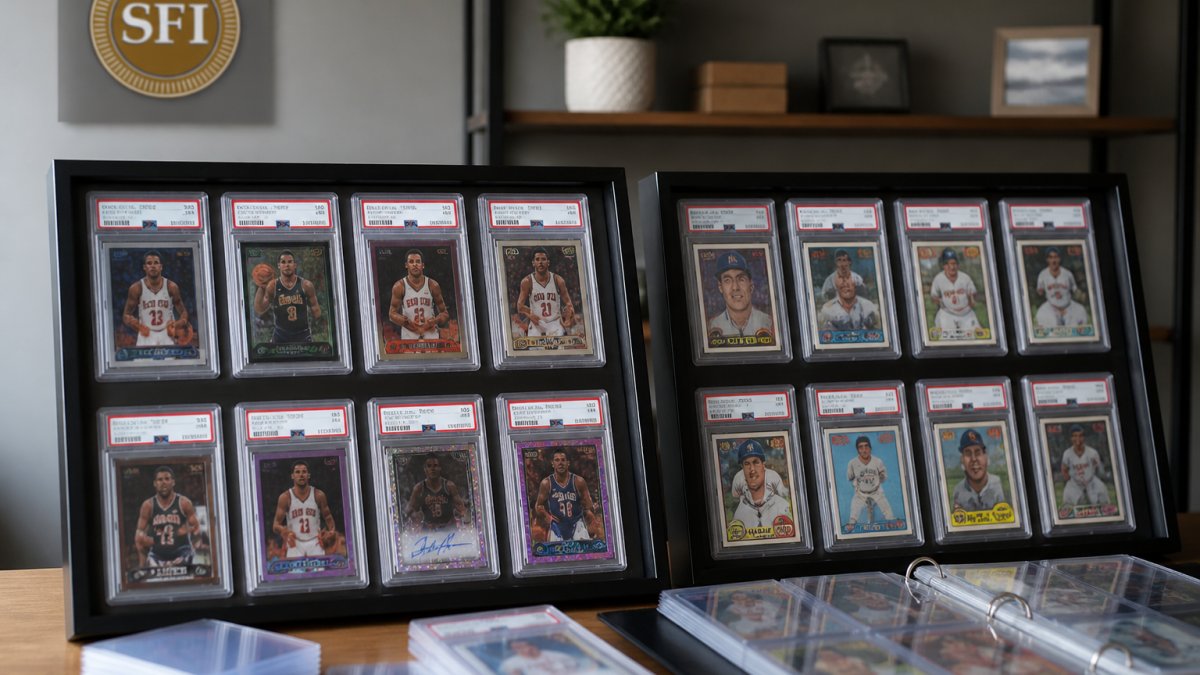
 ultimate-guide
How to Display Graded Trading Cards: 2026 Collector's Guide
Table of Contents
- What You'll Need Before You Display a Single Slab
- Step 1: Choose Between Storage and Display for Your Graded Card Protectors
- Step 2: Pick Your Display Format for a Graded Card Wall Display
- Step 3: Add UV Protection for Trading Cards Before Anything Goes on a Wall
- Step 4: Choose the Best Slab Stands for Collectors Based on Slab Thickness
- Step 5: Control Humidity, Dust, and Security Around Your Display
- Step 6: Organize a Large Graded Slab Collection for Display
- Common Mistakes to Avoid When You Display Graded Trading Cards
- Frequently Asked Questions
Last Updated: September 29, 2026
What You'll Need Before You Display a Single Slab
To display graded trading cards well, start by knowing what you own. Before anything goes on a wall, gather a few basics: a soft microfiber cloth, a level, a stud finder, and a tape measure. You also need the exact dimensions of your slabs, because PSA, BGS, and CGC cases aren't identical, and a mount built for one brand can leave another rattling loose.
Here's your pre-display checklist:
- Sort slabs by grading company and case thickness
- Measure the height, width, and depth of each slab type
- Decide which cards are display pieces and which stay in storage
- Pick a location away from direct sun, heat vents, and high-traffic walkways
- Confirm the wall can hold the hardware you plan to use
Step 1: Choose Between Storage and Display for Your Graded Card Protectors
Storage protects. Display presents. The right call depends on the card, not the collection as a whole.
When Storage Wins
Cards you don't plan to look at regularly belong in storage. That means boxes with silica packs, kept in a cool, dark space. High-value slabs that you're holding as an investment, not a showpiece, fit here too. Dust-proof containment and stable conditions matter more than visibility.
When Display Wins
Display makes sense for cards with personal or visual significance: a rookie card, a signed piece, a set you're actively building. If a card earns a spot where you'll see it daily, display it properly with archival-quality sleeves and a matching mount.
Step 2: Pick Your Display Format for a Graded Card Wall Display
Two formats dominate: wall-mounted and desktop. The wall format suits collectors who want a gallery feel. Desktop and shelf setups suit smaller spaces and frequent handling.
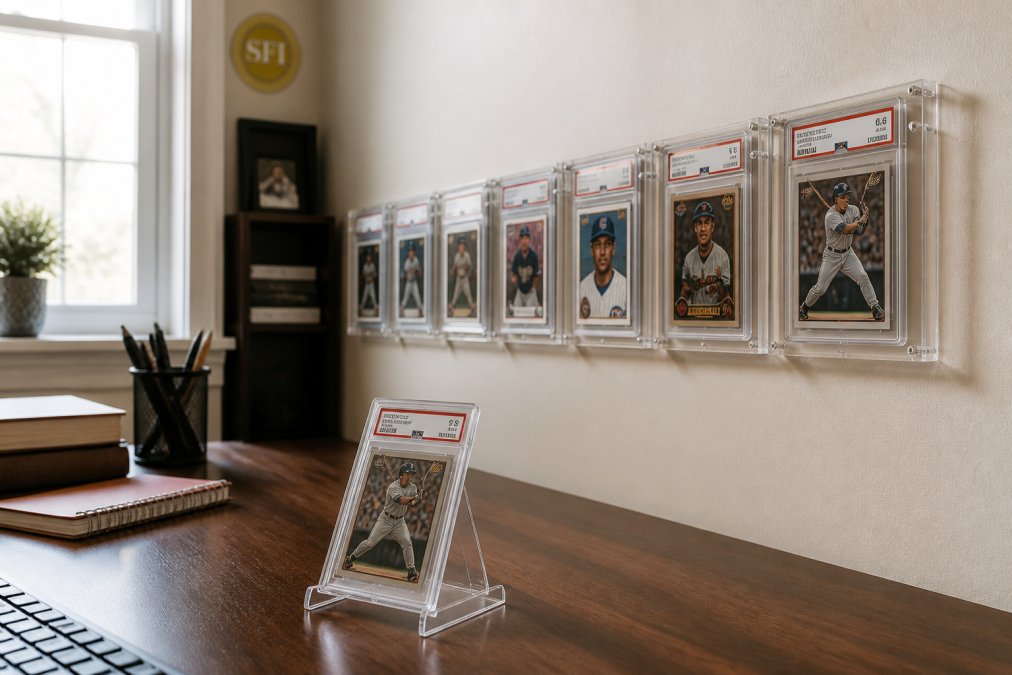
Graded trading cards mounted in clear acrylic frames on a home office wall.
Wall-Mounted Frames and Rails
Wall-mounted frames and rails turn a graded card wall display into a proper showcase. Acrylic display cases with pre-cut slots keep slabs aligned and dust-free. Rails let you slide slabs in and out, which works well if you rotate pieces. Mount into studs or use proper wall anchors, and always check that the frame depth clears your thickest slab.
Desktop and Shelf Display Stands
Desktop stands and shelf displays cost less and require no drilling. An acrylic display case or a simple slab stand holds a card at a readable angle. The trade-off is exposure: shelf displays collect dust faster and sit within reach of pets and kids. Keep them out of direct sunlight and away from heat sources.
Step 3: Add UV Protection for Trading Cards Before Anything Goes on a Wall
UV protection for trading cards is non-negotiable once a slab goes on a wall. Sunlight and even some indoor lighting fade inks over time, and the damage is permanent. No cleaning or re-holding reverses it. Most display guides skip how UV protection actually works, and why two cases that both say "UV protected" can perform very differently.
How UV Damage Actually Happens
Ultraviolet radiation breaks the chemical bonds in printing inks and paper fibers. The visible symptom is fading, but the structural damage starts first: paper embrittles, gloss dulls, and whites yellow. The two UV sources in a typical home are direct and indirect sunlight through windows, and fluorescent or unfiltered LED fixtures.
Reading Acrylic Grades Instead of Trusting the Label
Display acrylic is sold in tiers, and the tier determines real-world protection:
- Standard acrylic: clear and shatter-resistant, but blocks little to no UV on its own.
- UV-filtering acrylic: manufactured with a UV-absorbing additive that blocks most UVA and UVB. This is the grade to look for on any wall-mounted frame or case.
- Museum-grade glazing: the top tier, formulated for archival framing, with the highest blocking performance and the lowest haze.
Layering Protection the Right Way
Protection works best in layers, and each layer does a different job:
- Glazing or case material handles most UV filtration.
- A snug archival sleeve on the slab blocks dust, handling scuffs, and the micro-abrasion that clouds older holders.
- Placement removes the exposure you cannot filter. If a spot gets direct sun at any point in the day, it is the wrong spot, no matter how good the glazing is.
A Practical Light Audit
Before a slab goes up, spend five minutes watching the intended spot at three times of day: morning, midday, and late afternoon. Note where the sun lands and for how long. If a patch of direct light crosses the display at any point, shift the display, add a shade or curtain, or move the card to a wall that only ever sees indirect light.
Step 4: Choose the Best Slab Stands for Collectors Based on Slab Thickness
The best slab stands for collectors match the actual case, not a generic "one size fits all" mount. Slab thickness varies by grading company and by case generation, and a loose fit lets a card slide, tip, and fall.
Step 5: Control Humidity, Dust, and Security Around Your Display
Three threats sit between a displayed slab and long-term condition: moisture, dust, and theft. Most display guides ignore all three in favor of aesthetics. Here is how to actually manage them.
Climate Control: The Risk Nobody Talks About
Graded slabs are sealed, but they are not immune to their environment. Paper and inks inside the holder respond to humidity swings, and the holder itself can fog, cloud, or develop condensation when a cold slab meets warm, damp air. The damage is slow and cumulative, which is why it goes unnoticed until a card looks dull or wavy.
What to aim for:
- Stable, moderate humidity. Most collectors and preservation practitioners target a range roughly between 35% and 50% relative humidity for paper-based collectibles. Avoid rooms with wide swings, like basements, attics, laundry rooms, and bathrooms.
- Stable temperature. Sharp temperature changes drive condensation. Keep displays away from exterior walls, heating vents, radiators, and direct HVAC airflow.
- Air movement without drafts. Gentle ambient circulation prevents pockets of damp air. A ceiling fan on low is fine; a vent blowing directly on a display is not.
Monitoring Without Guesswork
You cannot manage what you do not measure. An inexpensive digital hygrometer placed near the display tells you the actual humidity and temperature instead of relying on feel. Check it seasonally, because conditions shift with weather and heating or cooling cycles. If readings drift outside your target range, a small room dehumidifier or a repositioned display usually solves it.
Dust: The Slow Abrasive
Dust is not just cosmetic. Grit settles on glazing and holders, and every wipe drags those particles across the surface, producing the fine scratches that cloud older slabs. Enclosed acrylic cases cut most of it. Open stands and rails need periodic, gentle dusting with a clean microfiber cloth, working from top to bottom and never pressing hard.
Security: Protecting What You Display
High-value pieces deserve the same care you’d give any valuable object in the home. Display only what you can reasonably protect, and match the security level to the card's value tier.
- Locking display cases. Cabinets and wall cases with keyed or combination locks stop casual handling and opportunistic theft.
- Room-level control. A locked door, or a display in a room not visible from the street, reduces exposure.
- Anchoring. A wall-mounted case that is bolted into studs is far harder to remove quickly than one hung on a single hook.
- Documentation. Photograph every slab and record the certification number before it goes on the wall. That record is what makes a police report and an insurance claim usable if a piece ever goes missing.
- Insurance. For a collection with meaningful value, a scheduled personal property rider or a collectibles policy covers theft and damage that a standard homeowner's or renter's policy may cap or exclude. Check your policy's collectibles limits before you assume you are covered.
The Trade-Off to Accept
The more accessible a display is, the less protected it is. A locked case is safer but handled less. An open rail is easy to rotate but exposed to dust and reach. Decide per card: display pieces you can protect, and keep the irreplaceable ones in controlled storage.
Step 6: Organize a Large Graded Slab Collection for Display
A large collection needs a system, or it becomes clutter. Group slabs by category first: sport, set, grading company, or value tier. Then decide what earns wall space.
A workable approach:
- Tier 1 (display): your best or most meaningful cards, rotated seasonally
- Tier 2 (shelf): solid pieces shown on desktop or shelf stands
- Tier 3 (storage): everything else, boxed and climate-controlled
Common Mistakes to Avoid When You Display Graded Trading Cards
Most display damage comes from a handful of repeat errors. Here's how to sidestep them.
Mistake | Why It Hurts | The Fix |
|---|---|---|
Direct sunlight | Permanent ink fade | UV-filtering case, shaded spot |
Oversized mounts | Slabs shift and crack | Measure thickness first |
Cheap plastics | Clouding and off-gassing | Archival, acid-free materials |
Weak wall hardware | Frame falls, slab breaks | Studs or rated anchors |
Displaying everything | Maximum exposure risk | Display a rotating few |
Frequently Asked Questions
What is the best way to display graded cards without damaging them?
Keep slabs out of direct sunlight and away from heat sources, since UV exposure fades card stock and can cloud older plastic over time. Use a display method that supports the slab evenly, such as a wall frame with a ledge or a weighted slab stand, rather than leaning cards against a wall. Add a UV-filtering layer or place the display in a room with indirect light. Sleeve the slab itself before it goes into any holder so the surface stays free of scuffs when you rotate pieces in and out.
How can I protect my graded cards from UV light while on display?
UV protection for trading cards works on two levels: block the light source and cover the slab. Move displays away from south- and west-facing windows where afternoon sun hits hardest, and use curtains or blinds during peak hours. For the slab itself, a snug archival sleeve combined with a UV-filtering frame or acrylic case cuts the light reaching the card. Rotate high-value pieces out of direct display every few months so no single slab absorbs years of cumulative exposure.
Are wall-mounted displays safe for high-value graded cards?
They are safe when the mounting hardware is rated for the load and anchored into studs or drywall with proper toggle bolts, not just adhesive strips. A single graded slab weighs little, but a frame holding 20 to 30 slabs adds up, and a shelf display can carry several kilograms once loaded. Check that the frame has a lip or channel that keeps slabs from sliding forward, and avoid hanging anything above a doorway, bed, or high-traffic walkway where vibration and bumps are constant.
What are the best slab stands for collectors who rotate their display often?
Look for stands with a wide, weighted base and a groove sized to your slab thickness, since PSA, BGS, and CGC cases differ slightly. A stand that grips the slab at the bottom edge only lets you pull one card out without disturbing the row. Modular acrylic stands that lock together side by side work well if you reorganize often, and clear finishes keep the focus on the card. Test the fit with your thickest slab first, because a stand that wobbles under a heavy BGS case will eventually tip.