 ultimate-guide
Enhance Display Quality for Online Auction Houses
Table of Contents
- Why Crystal Clear Clarity Drives Bidding Confidence
- The Benefits of Ultra-Clear Protective Sleeves for Auction Inventory
- How to Photograph Graded Trading Cards for Maximum Visual Impact
- Technical Specifications for Display Hardware and Mobile Optimization
- Archival-Grade Card Protection and Its Role in Visual Storytelling
- Accessibility and Inclusive Design in Digital Salerooms
- Conclusion
- Frequently Asked Questions
Last Updated: September 14, 2026
Why Crystal Clear Clarity Drives Bidding Confidence
Online auction houses live and die by whether a bidder trusts what they see on screen. When a listing photo looks hazy, washed out, or slightly off-color, buyers hesitate; when it looks sharp and true, they bid with confidence. That gap is where display quality does its quiet work.
The pattern is consistent: clarity sells. A collector scrolling a digital saleroom at midnight judges an item on how it looks, not on the condition report they haven't read yet.
The stakes are higher than most sellers admit. A card that photographs well commands attention from an international clientele; the same card shot poorly gets scrolled past. Display quality is the first layer of trust between seller and bidder.
The Benefits of Ultra-Clear Protective Sleeves for Auction Inventory
Ultra-clear protective sleeves do more than prevent scratches. They remove the visual noise between a card and the camera, which is why archival-grade card protection matters for anyone photographing inventory for sale.
Cheap sleeves yellow, fog, and pick up glare that ruins high-resolution imagery. A sleeve that looks fine in hand can photograph like frosted glass, the difference between a listing that converts and one that stalls.
- Distortion-free surfaces keep card edges and centering visible, which matters for grading comparisons
- Acid-free materials protect against long-term chemical damage that shows up as discoloration
- Precision-cut fit eliminates the loose, baggy look that reads as careless to serious buyers
The benefits of ultra-clear protective sleeves show up in the photos before the sale. A snug, clean sleeve makes a graded slab look like it belongs in a museum case, not a shoebox.
How Sleeve Clarity Affects Perceived Value
Perceived value is set in the first two seconds of viewing. A crystal-clear sleeve signals that the seller takes the item seriously, and that signal transfers to the price a bidder will consider.
Behind hazy plastic, buyers mentally discount the item and assume hidden flaws. Behind a distortion-free sleeve, the slab's label, grade, and surface become the focus, a subtle shift that is measurable in how listings perform.
Superior Fit Sleeves provides precision-cut, ultra-clear materials designed for PSA, BGS, and CGC slabs, removing every barrier between the buyer's eye and the asset.
How to Photograph Graded Trading Cards for Maximum Visual Impact
Learning how to photograph graded trading cards well is the highest-use skill a seller can develop. You don't need a studio, just consistent light, a clean background, a calibrated capture chain, and a sleeve that doesn't fight your camera.
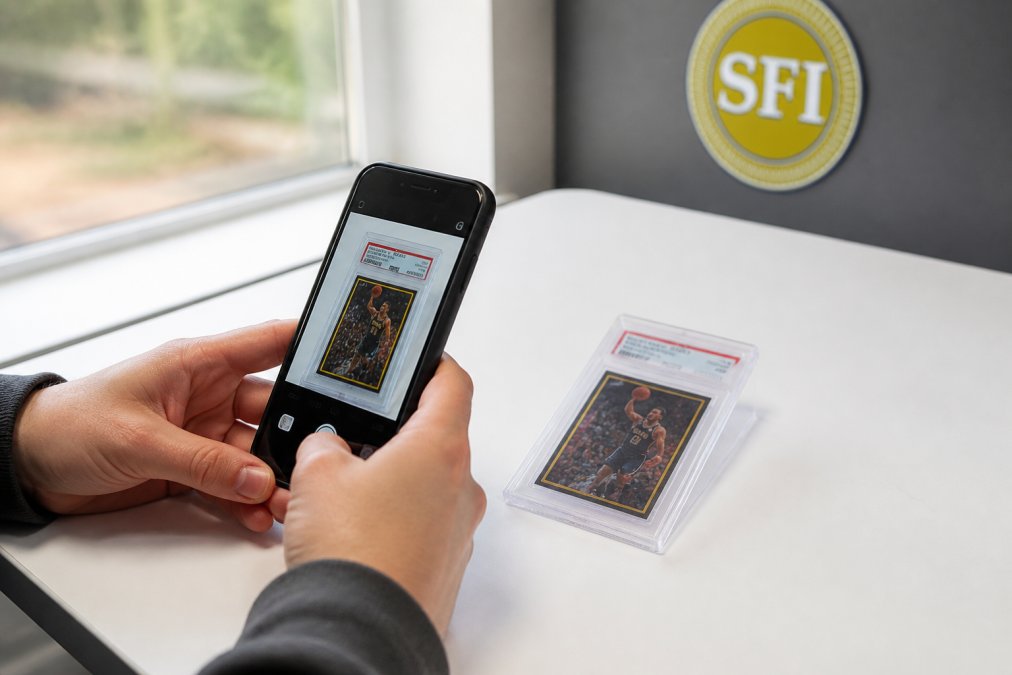
Four controllable variables decide whether a listing converts: color temperature, white balance, resolution, and reflection control. Get those right and the rest is repetition.
The Four Variables That Actually Determine Image Quality
Color temperature. Light is measured in Kelvin: household LEDs run around 2700K (warm), midday daylight roughly 5500K, and fluorescents near 4000K with a green spike (energy.gov). If your light source and white balance disagree, card colors drift, a blue-bordered card can read purple. Pick one temperature and lock your camera to it.
White balance. Phone cameras default to auto white balance, re-evaluating every frame, so two photos of the same slab shot seconds apart can render different colors. For auction listings, that inconsistency is fatal, bidders comparing thumbnails assume the seller is hiding something. Lock white balance manually with a gray card or plain white paper under your actual shooting light.
Resolution. More megapixels does not mean sharper listings; what matters is pixels on the long edge after cropping. Target 1500-2000 pixels, which renders sharply on retina-class displays without bloating file size. A 12-megapixel phone shot with diffused light beats a 50-megapixel shot with a bare bulb, which is full of blown highlights and hard shadows no editing recovers.
Reflection control. Glossy slabs and holo/foil faces act like mirrors. You can't eliminate reflections, only control where they land: on the slab's border is harmless, across the grade label or centering is a listing killer.
A Repeatable Shooting Sequence
Follow this sequence for every slab:
- Set a matte background. White or light gray foam board beats a glossy table, it scatters light instead of bouncing it, killing hot spots.
- Diffuse your light source. A softbox, diffusion panel, or window with sheer curtains eliminates hot spots; bare bulbs create specular highlights that read as damage.
- Shoot straight on. Keep the camera perpendicular to the slab to avoid keystoning, the trapezoidal distortion that makes centering look off even when it isn't, directly affecting how bidders judge a grade.
- Capture the label. The grade and cert number must be legible in at least one photo. Crop tight enough that a bidder can read the cert number without zooming.
- Add a raking-light shot. A low-angle light reveals surface texture and any scratches. This is the shot that separates honest listings from evasive ones.
- Check color accuracy against the physical card before you upload. Hold the card next to your screen under neutral light and compare. If the on-screen color drifts, buyers notice, and trust erodes, that last step separates professionals from everyone else.
Lighting and Angle Techniques for High-Resolution Imagery
High-resolution imagery depends on controlling reflections, not megapixels.
Position your primary light at roughly 45 degrees to the slab, with a fill light or white reflector opposite to soften shadows; the angle pushes the primary reflection off to the side, away from the label and card face. For holo and foil cards, tilt the item 5 to 15 degrees off perpendicular until the rainbow pattern reads cleanly without blowing out the surface.
High-volume sellers often use a two-light setup: a diffused key light at 45 degrees on one side and a diffused fill light at 45 degrees on the other, with the slab on a matte surface. This produces even illumination with no hard shadows and no dominant reflection.
Why This Matters for Bidding Confidence
The technical work above is not about aesthetics; it removes every reason a bidder might hesitate. When color is accurate, resolution sufficient, and reflections controlled, the bidder's eye goes straight to the card, its centering, corners, and surface. That is the moment trust forms and a bid becomes likely.
Auction houses that standardize this sequence build a recognizable visual signature. Bidders learn a saleroom's photos can be trusted, and that trust compounds across every auction.
Technical Specifications for Display Hardware and Mobile Optimization
Display hardware and mobile optimization are where most auction houses quietly lose bidders. A listing that looks stunning on a desktop monitor can look muddy on a phone, and most browsing happens on phones.
Start with color accuracy. A monitor or capture setup that reliably covers the sRGB color space renders card colors closer to reality. Calibrate it and recheck seasonally, because panels drift.
Then address latency reduction and image optimization: compress listing images to web-friendly formats without crushing detail, serve them at the resolution the device needs, and test every listing on a phone before it goes live.
Priority | What to Check | Why It Matters |
|---|---|---|
Color accuracy | Calibrated sRGB display | Buyers see true card colors |
Resolution | 1500-2000px on long edge | Sharp on retina screens |
File weight | Under 500KB per image | Faster load, lower bounce |
Mobile layout | Single-column test view | Most bidders browse on phones |
Latency | Cached image delivery | Snappier gallery scrolling |
Archival-Grade Card Protection and Its Role in Visual Storytelling
Visual storytelling in an auction listing is about sequencing: wide shot, close-up, label, surface detail. Archival-grade card protection makes that sequence possible without the sleeve becoming the story.
But "archival-grade" is one of the most abused phrases in the hobby. Understanding what it means, and how materials behave over years, not weeks, separates a seller who protects inventory from one who merely stores it.
What "Archival-Grade" Actually Means
Three material properties determine whether a sleeve is genuinely archival:
Acid-free and pH-neutral. Paper and cardboard degrade through acid hydrolysis, which is why old comics and cards yellow and become brittle (Saint Croix National Scenic Riverway (U.S. National Park Service)). An acid-free, pH-neutral sleeve won't introduce acids to the card surface.
No plasticizers or PVC. Polyvinyl chloride (PVC) gives cheap sleeves their soft, flexible feel, but over time it releases plasticizers that migrate onto the card surface and cause a greasy, irreversible haze, the most common cause of sleeve-induced damage (loc.gov). Archival sleeves use polyethylene (PE), polypropylene (PP), or polyethylene terephthalate (PET), none of which release plasticizers.
No surface coating that can off-gas. Some sleeves are coated for anti-glare or UV blocking, but coatings can off-gas volatile organic compounds (VOCs) inside a sealed case that react with card inks and foils. For long-term storage, an uncoated, clear sleeve is usually safer.
How Material Choice Affects Photography
Material choice is not just a preservation decision, it is a photography decision. Different plastics have different refractive indices and surface finishes, and those differences show up in listing photos.
- Polyethylene (PE) sleeves are soft and slightly hazy, excellent for storage but they scatter light, softening edge definition in photos.
- Polypropylene (PP) sleeves are clearer and stiffer, photographing well but developing a slight blue cast under some LED lighting.
- Polyethylene terephthalate (PET) sleeves are the clearest of the three and resist scratching better than PP, the closest thing to optically invisible, and the preferred material for high-resolution listing photography.
The Visual Storytelling Sequence
A well-sequenced listing typically uses five to seven images:
- Full slab, straight on, establishes the item and the grade.
- Label close-up, cert number and grade legible.
- Card face close-up, centering and surface visible.
- Corner detail, all four corners, or the two most relevant.
- Raking-light surface shot, reveals texture and any scratches.
- Back of slab, for completeness, especially on high-value items.
- Context shot, optional, but useful for sets or multi-card lots.
Each image depends on the sleeve being optically neutral. If it introduces haze, color cast, or glare, every image inherits that defect and the storytelling breaks down.
Consistency Across Thousands of Listings
A truly archival sleeve stays clear for years, so stored inventory photographs as well next season as today. That consistency lets an auction house build a recognizable visual style across thousands of listings.
This is where Superior Fit Sleeves earns its place. The brand, the original inventor of perfect-fit tapered sleeves since 2014, provides acid-free, distortion-free materials for graded slabs, top-loaders, and magnetic cases. For sellers managing inventory at scale, that consistency is key.
Archival protection and display quality are the same problem viewed from two angles. A sleeve that preserves a card for a decade but photographs poorly costs you money today. A sleeve that photographs beautifully but off-gasses over time costs you money later. The right material, acid-free, plasticizer-free, optically clear, does both jobs at once. ::: Maintaining this standard of clarity extends beyond the protective sleeve to the physical output itself, where professionals must verify print quality to ensure that the final presentation matches the digital representation.
Accessibility and Inclusive Design in Digital Salerooms
Accessibility is the angle most auction platforms ignore, and it costs them bidders. Inclusive design means every listing is usable by people with different vision, motor, and cognitive needs.
Practical steps:
- Write detailed descriptions that stand alone without the image
- Use sufficient contrast between text and background
- Provide alt text that names the item, grade, and key features
- Avoid relying on color alone to signal bidding status
- Keep tap targets large enough for users with limited dexterity
A digital saleroom that works for everyone widens the buyer pool, and a wider pool means stronger final prices. Accessibility and display quality are the same conversation: removing friction between a person and a confident bid.
Conclusion
The hardest part of running an online auction house isn't sourcing inventory. It's making every item look as good on a stranger's phone as it does in your hands.
Superior Fit Sleeves was built for exactly this problem. Our precision-cut, ultra-clear Graded Card Slab Sleeves and Top-Loader Sleeves deliver distortion-free display quality, with archival-grade, acid-free protection that keeps inventory photographing cleanly for years. Collectors trust the hobby standard, and our A+ BBB rating reflects it.
Get started with Superior Fit Sleeves and give every listing the crystal-clear presentation that earns higher bids.
Frequently Asked Questions
How does high-quality photography impact online auction bidding?
High-quality photography directly affects bidding confidence. When auction houses use crystal clear imagery, bidders can inspect condition, centering, and surface details without requesting extra photos. This reduces hesitation and can lead to more competitive bidding. Using archival-grade sleeves during photography prevents glare and distortion, so the card's true condition comes through. Clear visuals also lower return rates and build trust with international clientele who cannot examine items in person.
Why is archival-grade protection important for auction items?
Archival-grade protection uses acid-free, inert materials that will not yellow, fog, or degrade over time. For auction houses, this preserves both the physical condition and the visual clarity of consigned items. Sleeves made from archival materials keep graded slabs and top-loaders looking pristine through repeated handling and photography sessions. This protects the item's value and ensures it photographs well for every listing, which supports stronger final bids and fewer condition disputes.
How can auction houses improve the visual clarity of their listings?
Start with clean, scratch-free protective sleeves for every item. Use diffused lighting at a 45-degree angle to avoid glare on glossy surfaces. Photograph against a neutral background and include close-ups of corners, edges, and centering. For mobile-first display optimization, test how images render on phone screens, since most bidders browse on mobile. Consistent color accuracy across all listing photos also helps remote buyers trust what they see.
How do protective sleeves affect the perceived value of trading cards?
Protective sleeves influence perceived value by shaping how clearly a card presents in photos and in person. Ultra-clear sleeves eliminate haze and distortion, so surface details, gloss, and print quality are visible. When a card looks sharp and well-protected, bidders associate that with careful ownership and higher condition grades. Archival-grade sleeves also signal professionalism, which can justify stronger opening bids and reduce post-sale disputes about condition.