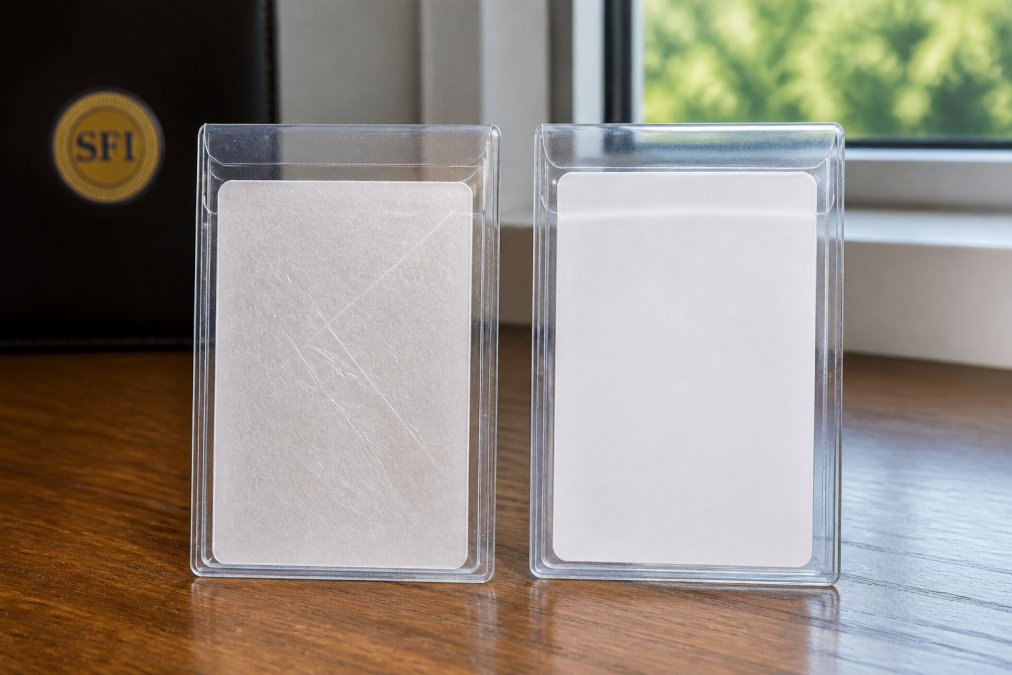
 comparison
Archival-Grade Sleeves vs Standard: Slab Scratch Protection
Table of Contents
- Why Graded Card Protectors Matter for Slab Scratch Protection
- Archival-Grade, Acid-Free Protection vs Standard Sleeves
- How to Remove Scratches from PSA Slabs (and What to Avoid)
- Slab-Specific Fitment: PSA, BGS, CGC, and SGC Sizes
- Best Practices for Storing Graded Cards Long-Term
- Choosing the Right Sleeve Material for Your Collection
- Conclusion
- Frequently Asked Questions
Last Updated: September 16, 2026
Why Graded Card Protectors Matter for Slab Scratch Protection
A graded card slab is only as valuable as its surface. PSA, BGS, CGC, and SGC holders are built to preserve card integrity, but the plastic shell itself scratches, scuffs, and clouds with handling. Slab scratch protection is the practice of shielding that shell with an archival-grade, acid-free sleeve so the case stays crystal-clear for display, resale, and long-term preservation.
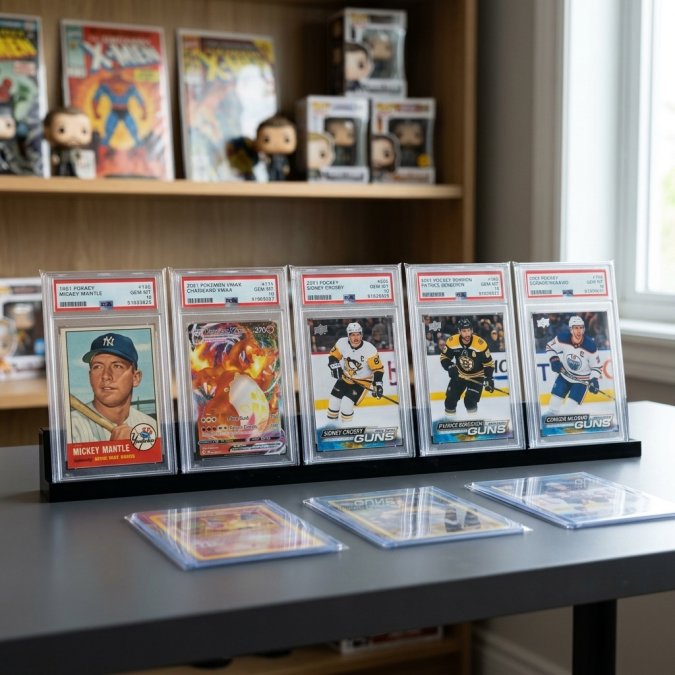
Archival-Grade, Acid-Free Protection vs Standard Sleeves
The difference between archival-grade, acid-free protection and standard sleeves comes down to polymer chemistry, not thickness. Two sleeves can feel identical in the hand and behave completely differently over a decade. Understanding why requires looking at what each plastic is made of and what it does when it sits against a slab for years.
The Three Plastics You'll Actually Encounter
Almost every slab sleeve on the market is made from one of three polymers, and they are not interchangeable for long-term storage:
- Polyvinyl chloride (PVC): The cheapest and most common in general retail. PVC is inherently rigid, so manufacturers add plasticizers, typically phthalate esters, to make it flexible. Those plasticizers are not chemically bonded to the polymer. They migrate out over time.
- Polyethylene terephthalate (PET): A polyester with high optical clarity and good dimensional stability. PET is inherently stiff and does not require plasticizers, so there is nothing to migrate. It is the same family of material used in archival document sleeves and many museum storage enclosures.
- Polypropylene (PP): A softer, more flexible polyolefin that is also plasticizer-free. PP offers excellent scuff resistance and is often chosen for sleeves that see frequent handling.
How PVC Fails: The Migration Sequence
Cheap PVC sleeves fail in a predictable order, and the timeline is measured in years, not weeks:
- Plasticizer migration. Phthalate molecules slowly bloom to the surface of the film. The sleeve feels slightly greasy or tacky, and the film begins to soften.
- Additive leaching onto the slab. The migrated plasticizer deposits on whatever the sleeve touches. On a graded slab, that means the clear plastic shell and, in severe cases, the label area.
- Yellowing. Residual heat, light, and oxygen degrade the PVC backbone itself, producing conjugated double bonds that absorb blue light and reflect yellow.
- Fogging and loss of clarity. Surface haze develops as the leached residue and degraded polymer scatter light. The optical clarity you bought the sleeve for is gone, and the slab underneath now looks worse than it did unsleeved.
- Residue bonding. Given enough time and warmth, the leached material can bond to the slab surface. This is the stage collectors fear most, because the residue is difficult to remove without polishing, and polishing carries its own risk.
Why PET and Polypropylene Don't Do This
PET and polypropylene are both plasticizer-free by construction. Their flexibility comes from the polymer chain itself, not from an additive that can walk out of the film. That single structural difference is the reason archival-grade materials stay clear for decades while PVC sleeves cloud and yellow.
What "Acid-Free" and "Archival-Grade" Actually Mean
These two terms get used interchangeably, but they describe different things:
- Acid-free describes what the material does not contain: no acidic compounds that can off-gas or leach into the item it touches. It is a negative specification.
- Archival-grade describes tested performance: the material is chemically stable, inert, and demonstrated not to degrade the item it protects over an extended period. It is a positive specification, and it implies acid-free as a floor, not a ceiling.
The Practical Takeaway
For any slab you plan to hold for years, the material question is not "is it thick?" or "is it acid-free?", it is "what polymer is this, and does it contain plasticizers?" PVC is a short-term solution at best. PET and polypropylene are the materials that will still look like new on year ten.
How to Remove Scratches from PSA Slabs (and What to Avoid)
Most surface scratches on a PSA slab can be reduced with a fine plastic polish, applied by hand in small circles. Deep gouges that catch a fingernail are permanent. The honest answer to how to remove scratches from PSA slabs is that prevention beats repair every time, because polishing a slab carries real risk.
- Clean the slab with a soft microfiber cloth and distilled water
- Apply a plastic-specific polish to a foam pad, never directly to the slab
- Work in small circular passes with light pressure
- Wipe residue with a fresh microfiber cloth
- Stop immediately if the surface hazes or the label area is affected
Slab-Specific Fitment: PSA, BGS, CGC, and SGC Sizes
Fitment is where most sleeves quietly fail. A sleeve that is too loose slides off in the case and leaves the edges exposed. Too tight, and you are forcing the slab in, which is how micro-abrasions start. The four major grading companies do not use identical outer dimensions, and a universal sleeve rarely fits any of them well.
Why "One Size Fits All" Fails
Graded slabs vary in three dimensions that matter for sleeve fit:
- Outer length and width, which determine whether the sleeve covers the full face and edges.
- Outer thickness, which determines whether the sleeve slides on without forcing.
- Corner and edge geometry, which determines whether the sleeve catches or glides.
General Fitment Characteristics by Grading Company
The exact dimensions of any given holder can vary by production run, so always measure your specific slab before ordering. That said, the general fitment profiles collectors encounter are consistent enough to plan around:
Grading Company | Slab Characteristic | Sleeve Fit Priority |
|---|---|---|
PSA | Standard thickness, squared corners | Snug body, resealable flap |
BGS | Thicker holder, bevelled edge | Extra depth clearance |
CGC | Wider profile | Full-width coverage |
SGC | Slimmer case | Tight, no-slack fit |
How to Measure Your Slab Before You Buy
A caliper or a good ruler is enough. Measure the outer length, outer width, and outer thickness at the thickest point, usually the center of the holder, not the edge. Write the numbers down. Then compare them against the sleeve's stated internal dimensions, not its external dimensions. A sleeve listed as "fits PSA" without internal measurements is a guess, not a specification.
Tapered vs. Straight-Cut Sleeves
A tapered sleeve narrows slightly from the opening to the closed end, which lets the slab slide in easily and then sit snugly once fully inserted. A straight-cut sleeve has uniform dimensions throughout, which means the fit is either loose at the opening or tight all the way down. For slab scratch protection, tapered sleeves generally win because they reduce insertion friction, the single biggest cause of micro-abrasions during sleeving.
Best Practices for Storing Graded Cards Long-Term
Long-term preservation depends on the storage environment as much as the sleeve. Light, humidity, dust, and temperature swings do more cumulative damage than any single handling event. Store slabs upright in a closed box, away from direct sun, in a room with stable conditions.
Moisture Control and Climate Management
Moisture control is the most overlooked variable in graded card storage. High humidity encourages condensation inside the holder; low humidity invites static that attracts dust. A simple hygrometer and a sealed storage box with silica desiccant packs handle most home collections. Aim for a stable range rather than chasing a perfect number.
Choosing the Right Sleeve Material for Your Collection
Superior Fit Sleeves has made perfect-fit tapered sleeves since 2014, and the material conversation is where most buyers get it wrong. The National Archives guidance on preserving plastic-based materials reinforces the same principle: stable, inert materials protect; unstable ones degrade.
Conclusion
Protecting a graded investment is a decision you make once and live with for years. The collectors who avoid resale losses are the ones who treat the slab itself as part of the asset. Superior Fit Sleeves builds precision-cut, archival-grade, acid-free sleeves with crystal-clear, distortion-free clarity, sized specifically for PSA, BGS, CGC, and SGC holders. Get started with Superior Fit Sleeves and keep every slab as clean on year ten as it was on day one.
Frequently Asked Questions
What is the best guard for PSA slabs?
A precision-fit, archival-grade sleeve is the best first layer of defense for PSA slabs. Look for acid-free materials that will not degrade or fog over time, and a snug tapered fit that keeps dust and debris off the surface. For higher-value cards, many collectors add a rigid outer case for impact protection. Combining a clear archival sleeve with a hard shell covers both surface scratches and drop damage.
Do scratches on a PSA slab affect value?
Scratches on the slab itself do not change the grade of the card inside, but they do affect how the card presents and how easily it can be scanned or photographed for resale. Heavy scuffing can make a listing look worn and may reduce buyer confidence. Keeping the slab in a protective sleeve from day one is the simplest way to avoid that problem.
Are archival-grade sleeves necessary for plastic slabs?
They are not strictly required, but they solve two problems standard sleeves do not. Archival-grade, acid-free materials resist yellowing and chemical breakdown over years of storage, and a precision fit keeps the slab surface free of micro-abrasions and dust. If you plan to hold graded cards long term or display them, archival sleeves protect both the slab and your resale presentation.
How do I remove scratches from a PSA slab without damaging it?
Light surface scuffs can sometimes be reduced with a plastic polish made for acrylic, applied with a soft microfiber cloth and gentle circular motion. Deep scratches usually cannot be removed safely at home. Never use abrasive household cleaners or paper towels, which add new micro-abrasions. If the damage is severe, contact the grading company about a reholder rather than trying to fix it yourself.
What is the best way to store graded cards for long-term preservation?
Store graded cards upright in a cool, dry space away from direct sunlight and humidity swings. Keep each slab in an archival-grade, acid-free sleeve, then place them in a rigid storage box or case. Avoid attics, basements, and garages where temperature and moisture fluctuate. Check sleeves periodically for dust buildup and handle slabs by the edges to limit oils and fingerprints on the surface.