 How-to
Do Archival Sleeves Prevent Slab Yellowing?
Last Updated: November 21, 2026
Quick Summary
Archival sleeves cannot stop a slab's own plastic from yellowing because the chemical aging happens inside the polymer. They do help by blocking handling oils, dust, and transfer from unstable nearby materials. Controlling light, heat, and humidity in storage matters more for slowing yellowing.
- Yellowing on a slab usually comes from the case plastic aging, not the card inside.
- UV light, heat, oxygen, and humidity all accelerate plastic yellowing over time.
- Choose polyester, polypropylene, or polyethylene sleeves, and avoid PVC for long-term storage.
- Store slabs in a cool, dark, dry place away from windows and heaters.
- Check the edges and corners first to diagnose what kind of yellowing you are seeing.
Table of Contents
- What Causes Slab Yellowing in the First Place
- What Archival Sleeves Are and Which Materials They Use
- Can an Archival Sleeve Stop a Slab From Yellowing?
- UV Protection for Graded Card Slabs
- How to Store Graded Cards to Limit Discoloration
- Slab Sleeve Material Safety: What to Check on the Label
- Next Steps for Protecting Your Graded Collection
- Frequently Asked Questions
What Causes Slab Yellowing in the First Place
Yellowing on a graded card slab is almost always the plastic case itself changing, not the card inside. That distinction matters because the two problems have different causes and different fixes. A slab that looks amber, cloudy, or dull at the edges is showing signs of polymer degradation. A card that looks yellowed inside a clear slab is a separate issue, usually paper oxidation, acid migration, or light damage to the card, and no outer sleeve will reverse it.
Slab plastic is typically a rigid, clear polymer such as polystyrene, acrylic, or a polycarbonate blend. Each formulation ages differently, but the same handful of stressors drive the change:
- UV and visible light: Ultraviolet light carries enough energy to break polymer chains (Effects of solar UV and climate change on materials). Over months and years, that breakage shows up as yellowing, chalking, and brittleness. Indirect daylight through a window still delivers UV, so a slab on a shelf across the room from a window is not automatically safe.
- Heat: Warmth accelerates every chemical reaction in the plastic, including oxidation. A slab stored in an attic, a garage, or near a heating vent ages faster than one kept in a stable, cool room. Repeated temperature swings are harder on the plastic than a steady cool temperature.
- Oxygen and oxidation: Even without light and with moderate heat, plastic exposed to air slowly oxidizes. This is why some slabs yellow in storage that never saw direct sun; the chemistry is happening at the surface, just slowly.
- Humidity and moisture: High humidity can cloud the surface and drive hydrolysis in some polymers. Damp storage also encourages mold and corrosion on any metal components inside the slab.
- Off-gassing and contact transfer: Some storage materials, certain foams, adhesives, rubber bands, and low-grade plastics release compounds that can deposit on or react with the slab surface. A slab pressed against an unstable material for years can show localized yellowing or haze where contact occurred.
- Formulation and age: Not all clear plastics are equally stable. Manufacturing choices, additives, and the plastic's own age set a baseline for how fast it will change. Two slabs kept side by side in identical conditions can yellow at different rates because of what they are made of.
A practical way to diagnose what you are seeing: check the edges and corners first. Yellowing that starts at the perimeter and works inward usually points to surface oxidation and light exposure. Uniform ambering across the whole face suggests the plastic formulation and age are the main drivers. Cloudiness or a white haze often points to moisture or surface contamination. Localized discoloration where the slab touched another material points to contact transfer or off-gassing.
Watch out: do not assume a yellowed slab means the card inside is damaged. Inspect the card under clean, bright light before drawing conclusions, and keep the slab out of further light while you decide what to do.
What Archival Sleeves Are and Which Materials They Use
An archival sleeve is a protective plastic enclosure designed to be chemically stable and free of harmful additives. The goal is to keep a card or slab away from scratches, dust, and reactive materials. Archival sleeves are usually made from polyester, polypropylene, or polyethylene, and they are often labeled acid-free, pH-neutral, or PVC-free.
Material choice matters. PVC can release compounds that break down over time, which is why many collectors look for PVC-free sleeves. Polyester and polypropylene are common choices because they are more stable.
Can an Archival Sleeve Stop a Slab From Yellowing?
The honest answer is that an archival sleeve can slow some causes of slab yellowing but can’t stop others. Understanding which is which is the whole point, because most articles on archival storage talk about protecting cards, photos, and paper, not the plastic case around a graded card. That is a different problem with a different set of limits.
What a sleeve can do:
- Block handling contact. Finger oils, skin acids, and grit from hands are a real source of surface contamination. A sleeve keeps hands off the slab and reduces the chance that oils sit on the plastic, attract dust, or react with the surface.
- Reduce dust and airborne grime. Dust holds moisture and can carry acidic or reactive particles. A snug sleeve limits what settles on the slab.
- Buffer against contact transfer. A chemically stable sleeve separates the slab from unstable materials nearby, cardboard boxes, foam inserts, rubber bands, and low-grade plastics that may off-gas. This is one of the more underrated benefits, because contact transfer is a common cause of localized haze.
- Add a light-blocking layer if the sleeve is opaque or UV-filtering. A clear sleeve does little for light. A sleeve with UV-blocking additives, or storage in a dark box, does more.
What a sleeve cannot do:
- It cannot stop the slab's own plastic from aging. Oxidation and formulation-driven yellowing happen inside the polymer. An outside sleeve does not change that chemistry. A slab made from an unstable plastic will still yellow in a sleeve, just as it would without one.
- It cannot control temperature or humidity. Those are storage-environment problems. A sleeve is not a barrier against heat or moisture vapor over long periods.
- It cannot reverse yellowing that has already happened. No sleeve, coating, or enclosure restores a yellowed slab. Prevention and slowing are the realistic goals.
- It cannot protect against a bad sleeve. A sleeve made from PVC or an unknown plastic can add its own risk through off-gassing and plasticizer migration, especially if it sits in contact with the slab for years.
Material matters more than the word "archival." Polyester (often sold as Mylar), polypropylene, and polyethylene are the three plastics most often cited as chemically stable for long-term storage. They are generally acid-free and do not contain the plasticizers that make PVC flexible and prone to migration. PVC is the material to avoid for anything stored long term, because its plasticizers can migrate and its breakdown products can affect nearby surfaces.
A useful mental model: the sleeve is a barrier against the outside world, not a shield against the slab's internal chemistry. It buys you time against handling, dust, and contact transfer. It does not buy you time against UV, heat, humidity, or the plastic's own aging; those have to be managed by where and how you store the slab.
Watch out: a sleeve that fits too tightly can trap dust and moisture against the slab surface, which is worse than no sleeve at all. Confirm the sleeve is clean before you insert a slab, and check that it is not pressing grit into the case.
The article breaks down what a sleeve can and cannot do about slab yellowing.
Factor | Can a sleeve help? | Why |
|---|---|---|
Handling contact | Yes | Keeps finger oils and skin acids off the slab |
Dust and grime | Yes | A snug sleeve limits what settles on the slab |
Contact transfer | Yes | Separates the slab from unstable materials nearby |
Light exposure | Partly | Only if the sleeve is opaque or UV-filtering |
Plastic's internal aging | No | Oxidation happens inside the polymer |
Temperature and humidity | No | These are storage-environment problems |
Reversing existing yellowing | No | Prevention and slowing are the realistic goals |
UV Protection for Graded Card Slabs
Ultraviolet light is one of the most common reasons plastics age faster. Even indirect daylight can contribute over time. Keep slabs out of direct sun, and avoid storing them near windows or under bright display lights for long periods.
If you display slabs, consider using a UV-filtering case and limit display time. Rotate pieces off display when you can to reduce light exposure.
How to Store Graded Cards to Limit Discoloration
Good storage habits can slow discoloration. Follow these steps:
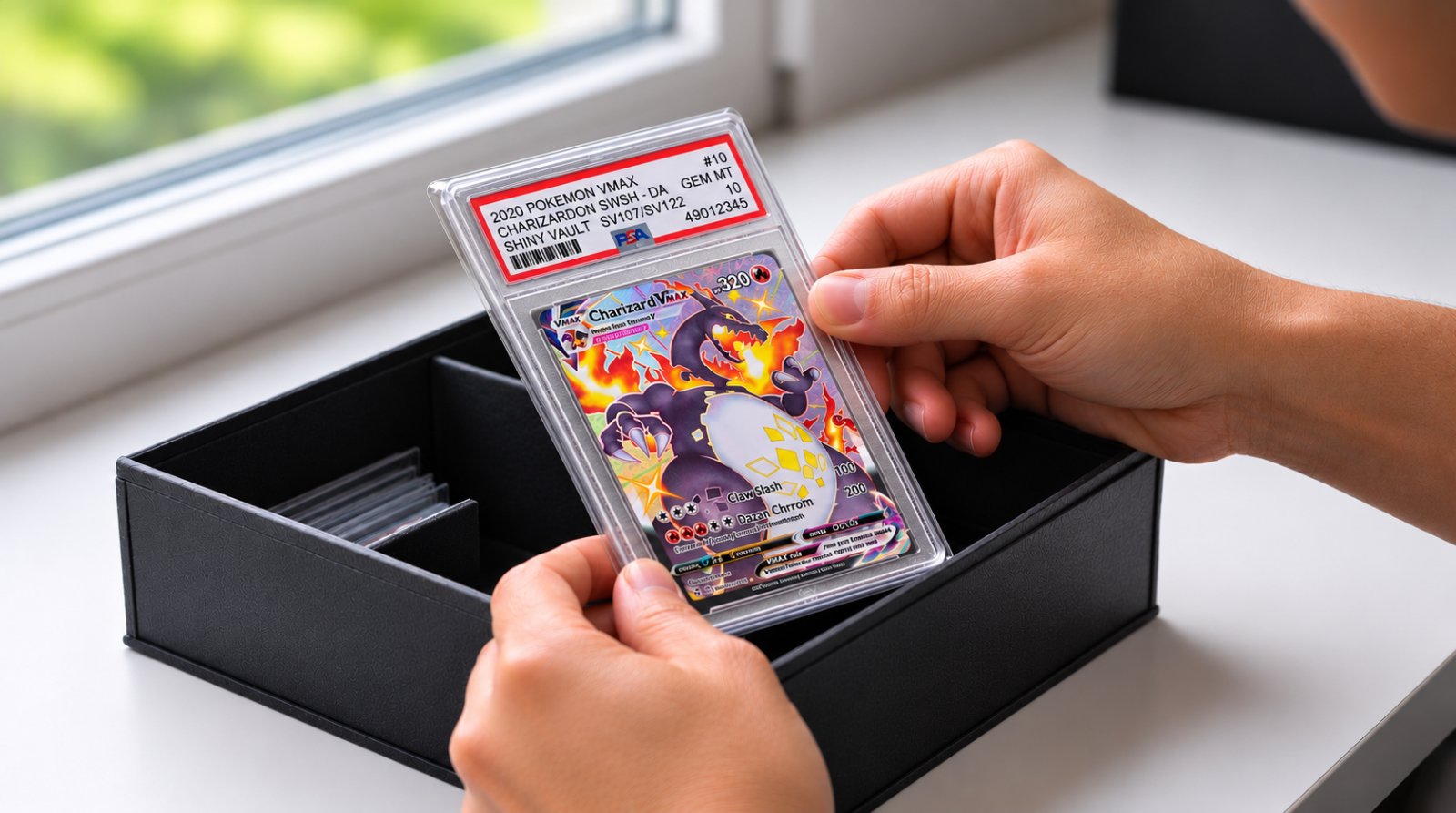
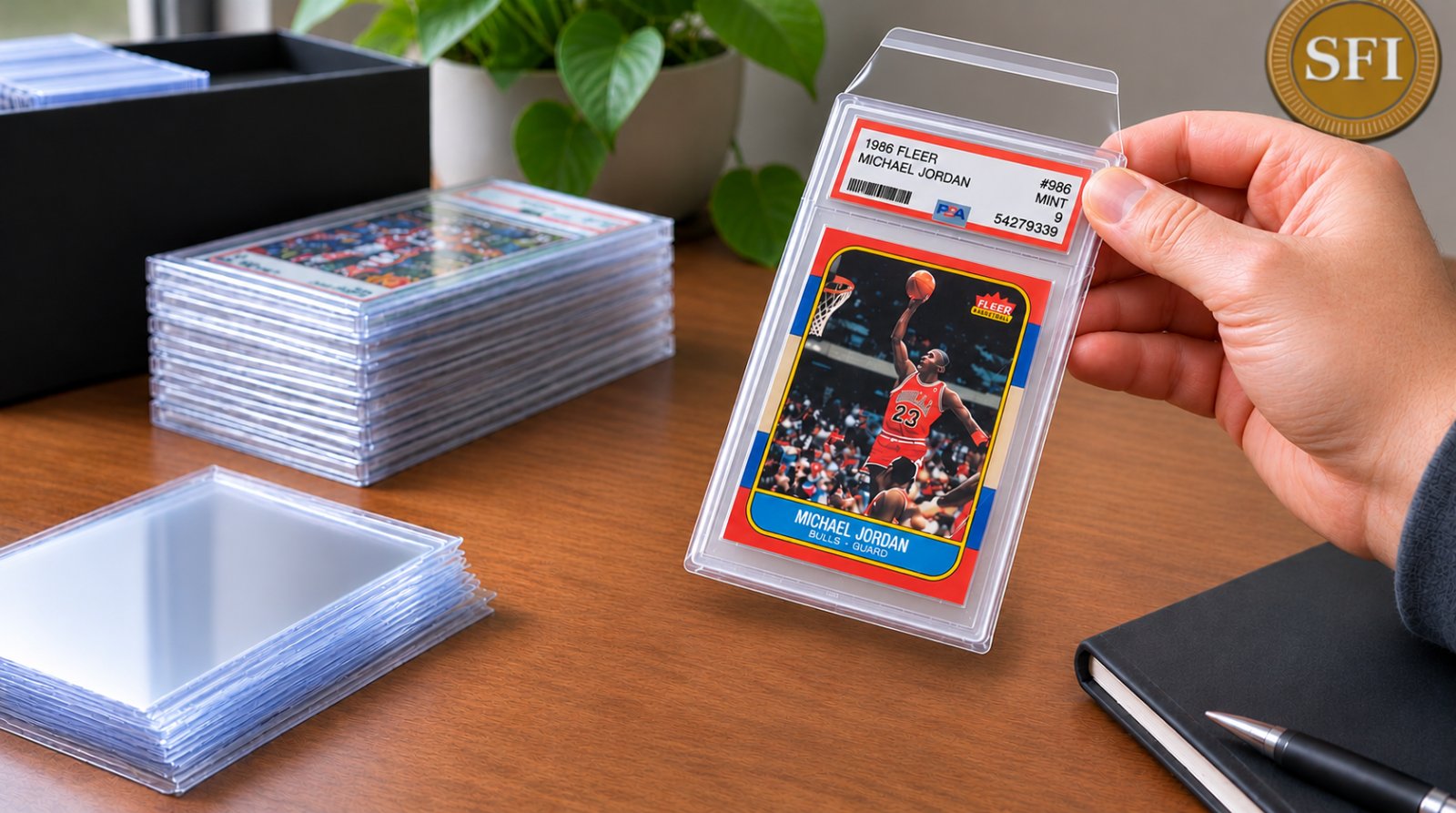
Collector placing a graded card in archival sleeves into a dark storage box away from direct light
- Choose a cool, dark, dry place away from windows and heaters.
- Keep slabs in a sleeve made from archival-safe material.
- Store upright in a sturdy box so pressure does not build on any one slab.
- Check humidity and use a desiccant or dehumidifier if the room feels damp.
- Inspect your collection every few months for clouding, edge changes, or color shifts.
Many collectors find that simple storage changes make a bigger difference than buying a new product. A dark box in a stable room often beats an expensive case left on a sunny shelf.
Slab Sleeve Material Safety: What to Check on the Label
Before you buy a sleeve, look for clear material information. Look for labels like acid-free, PVC-free, polyester, polypropylene, and archival grade. If a seller does not say what the sleeve is made of, treat that as a warning sign.
Also check fit. A sleeve that is too loose can let dust in and allow the slab to shift. A sleeve that is too tight can add stress. Choose a sleeve sized for your slab type, and confirm the fit before you commit to a large order.
- Confirm the material is named on the product page.
- Look for acid-free or pH-neutral wording.
- Check that the sleeve is made for your slab brand and size.
- Avoid sleeves with unknown plastics or no material details.
Next Steps for Protecting Your Graded Collection
Start with the basics: control light, temperature, and humidity, then add archival-safe sleeves to your storage routine. Inspect your slabs regularly, and replace any sleeve that shows wear, clouding, or a loose fit.
If you are ready to act, you can browse Superior Fit Sleeves for graded card slabs to find sleeves sized for PSA, BGS, SGC, CGC, and other slab types. For current prices, check the product page or request a quote, since pricing depends on quantity and delivery. If your slabs are in a thinner, looser holder, a Top-Loader Sleeves option can be a sensible companion for loose cards stored alongside them.
Frequently Asked Questions
Do archival sleeves prevent graded card slabs from yellowing?
Archival sleeves can slow the surface contamination and handling wear that accompany long-term storage, and they help keep a slab clean and clear. They do not reverse yellowing that has already happened inside the slab's plastic, and they cannot guarantee that a slab will never discolor. Yellowing is driven mainly by the slab's own plastic aging, along with light exposure, heat and humidity. A sleeve is one layer of a broader storage approach, so pair it with a cool, dark, dry storage location and periodic inspection.
What causes a graded card slab to turn yellow?
Yellowing in graded card slabs is usually linked to the aging of the plastic itself, which can be accelerated by ultraviolet light, heat and humidity. Over time the plastic can change chemically and lose clarity. Storing slabs in direct sunlight or warm rooms tends to speed this process. Inspect slabs regularly under neutral light so you can spot early clouding or tinting and adjust storage conditions before the discoloration worsens.
What plastic is safest for storing graded cards?
Look for sleeves described as PVC-free and acid-free, typically made from polyester, polypropylene or polyethylene. These materials are generally more chemically stable than older PVC-based plastics, which can release acids over time. Check the product description for the material and any stated archival or pH-neutral properties. Keep in mind that a sleeve's stated materials matter less than how the sleeve is stored, so pair material choice with cool, dark and dry conditions.
How should you store graded cards to reduce discoloration?
Store graded cards in a cool, dry, dark place with stable humidity, away from windows, heaters and bathrooms. Keep slabs upright in a closed container rather than stacked loosely, and avoid storing them against exterior walls where temperature swings are common. Handle slabs by the edges with clean hands, and check your collection periodically for clouding, tinting or warping so you can act early.
,