 how-to
Clean Card Displays: Dealer Presentation Guide
Table of Contents
- Why Clean Card Displays Decide Your Dealer Reputation
- Archival-Grade Card Protection: The Foundation of a Clean Display
- Step 1: Establish Handling Protocols That Prevent Damage
- Step 2: Choose Display Cases and Stands That Elevate Your Table
- Step 3: Organize Inventory by Set, Value, and Visual Flow
- Step 4: Master Lighting and Labeling for Buyer Engagement
- Step 5: Apply Best Practices for Trading Card Merchandising
- Maintaining Your Professional Standard
- Frequently Asked Questions
Last Updated: September 9, 2026
The condition of your product is the first thing a buyer assesses, and it is often the deciding factor between a sale and a walk-by. This guide from Superior Fit Sleeves outlines the exact steps to ensure a clean, smooth, and professional presentation for trading card dealers.
Why Clean Card Displays Decide Your Dealer Reputation
Your reputation is established within the first three seconds of a potential buyer approaching your table, and how your card displays look in that instant is what seals the impression. A collector who sees scratched cases, loose cards, or disorganized binders will immediately question the condition of the cards and the integrity of your pricing.
A clean presentation directly supports your bottom line. When buyers can easily view cards without asking you to remove them from dirty or damaged holders, they handle fewer items and you reduce the risk of theft or accidental damage.
Archival-Grade Card Protection: The Foundation of a Clean Display
Before you arrange a single card, ensure every item is housed in archival-grade materials. The primary threat to unprotected cards is the cumulative effect of dust, oils from handling, and UV light, which causes fading and yellowing.
For graded slabs, you need a sleeve that offers a snug fit without putting pressure on the case. Archival-grade card protection requires acid-free, archival-safe materials to prevent chemical reactions over time. Many dealers use soft sleeves for ungraded cards, but for high-value inventory, rigid protection is non-negotiable.
The standard for serious dealers involves layering protection. A graded slab should go into a fitted sleeve, then into a display stand or case, ensuring the card is safe from scratches and presented cleanly. Graded Card Slab Sleeves from Superior Fit Sleeves are precision-cut to fit standard holders without excess material, keeping your slabs dust-free and crystal-clear under show lighting.
Step 1: Establish Handling Protocols That Prevent Damage
The most common cause of damage at a show is improper handling. Establish a "look, don't touch" policy for your most valuable items, but also have a protocol for when handling is necessary. Always wear cotton gloves or ensure your hands are clean and dry before touching any card or slab outside its protective sleeve.
Keep raw cards in penny sleeves and top-loaders, and only remove them yourself if a serious buyer requests a closer inspection. For graded cards, handle them by the edges of the slab, never by the surface, to prevent finger oils from transferring onto the case.
Step 2: Choose Display Cases and Stands That Elevate Your Table
The hardware you use dictates the visual hierarchy of your table. Trading card display stands for dealers are not one-size-fits-all. The market offers three primary display formats, each with distinct trade-offs.
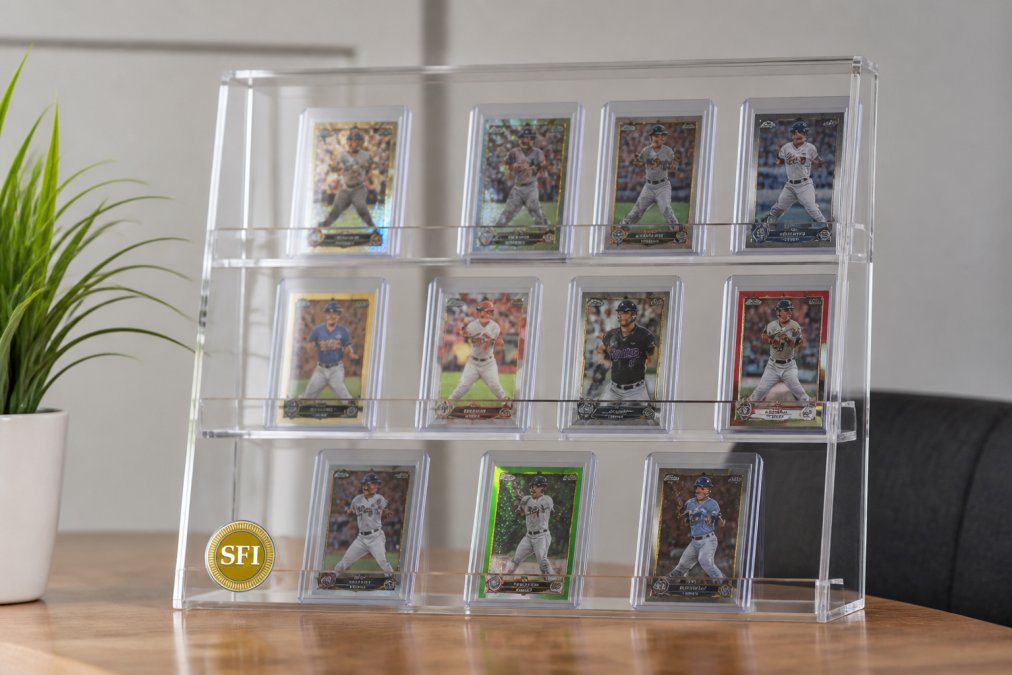
Countertop Acrylic Cases are the workhorse for high-value singles. Look for cases made from cell-cast acrylic rather than extruded acrylic, which tends to yellow and cloud under UV exposure. A quality case should have a base footprint of roughly 4 inches by 6 inches for standard cards, with a riser height of 2 to 3 inches. Avoid snap-lock lids that require pressure to close; opt for a sliding or hinged top.
Tiered Riser Systems are essential for creating depth across a longer table. A three-tier acrylic riser with 2-inch, 4-inch, and 6-inch steps lets you display up to 15 graded slabs in a compact 24-inch footprint. Verify the shelf lip is at least 1/4 inch deep and the slot width accommodates the specific slab thickness, PSA slabs measure approximately 3.125 x 2.5 x 0.25 inches, while CGC slabs are slightly thicker at 0.3 inches (psacard.com).
Wall-Mounted or Backdrop Displays are an underutilized option for dealers with vertical space. A pegboard or slatwall behind your table can hold top-loaders in individual sleeves, creating a high-visibility wall of product. Use clear, acid-free top-loaders with a self-adhesive hanging tab rated for the weight of a filled top-loader, which typically runs 5 to 7 grams for a standard sports card.
UV-protective acrylic is a non-negotiable upgrade for any case under direct show lighting. Standard acrylic blocks roughly 40% of UV rays, while UV-coated acrylic blocks 95% or more, at a cost difference of $2 to $5 per case (nist.gov). Verify that any display case is free of internal seams or ridges that could scratch a slab during insertion. Run a clean microfiber cloth along the interior edges before your first show; if the cloth snags, the case is not safe.
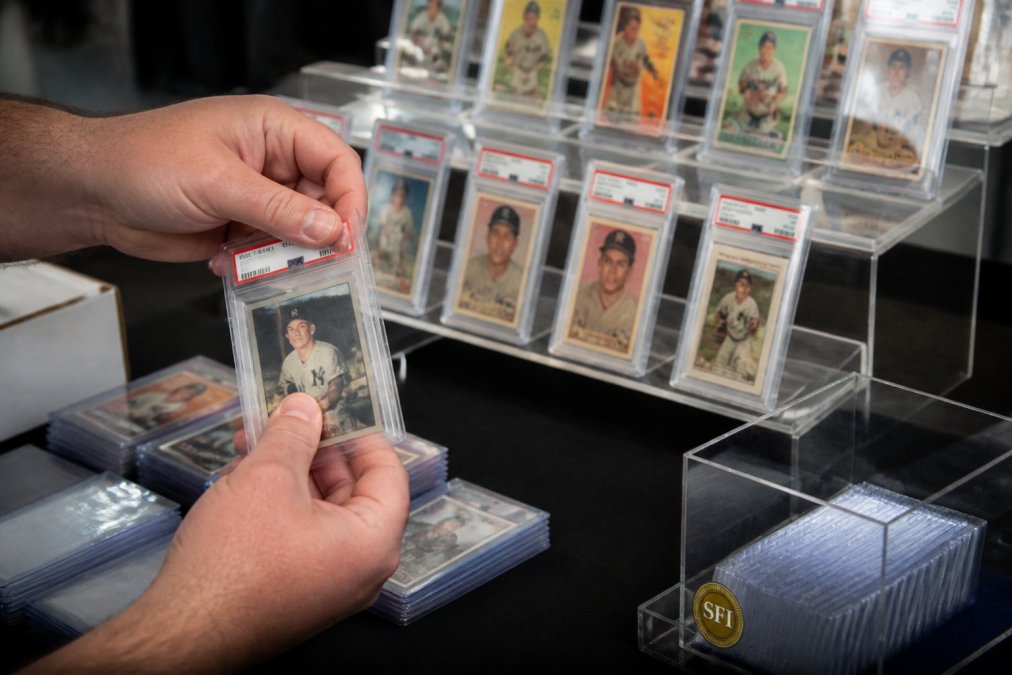
A 24-inch riser holding 15 slabs weighs approximately 8 to 10 pounds. On a standard 6-foot folding table, distribute it evenly to prevent tabletop sag. Use a rigid tabletop overlay, a 1/4-inch plywood board covered with a fitted tablecloth, to create a flat, stable surface. Test your setup at home by gently shaking the table; any display that moves more than a quarter-inch needs additional stabilization, such as museum putty applied to the base of each riser.
Opt for cases with clean lines and a minimal profile. Bulky, scratched, or yellowed plastic detracts from the card condition. Investing in high-quality, crystal-clear cases ensures that the focus remains on the card, not the holder. This is where the precision of Superior Fit Sleeves enhances the presentation, as our precision-cut sleeves fit specific case dimensions without excess material or bubbles. For dealers using magnetic one-touch cases, our Magnetic Card Case Sleeves offer the same snug, scratch-resistant fit, keeping those premium holders looking as sharp as the cards inside them.
Step 3: Organize Inventory by Set, Value, and Visual Flow
Organization is the silent salesman. A table that looks like a random pile of cards will only attract bargain hunters. Curate your inventory to guide the buyer's eye. Organizing by set is the most common method, but also consider organizing by value to create a "showcase" area for high-value inventory.
Most buyers scan from left to right, so place entry-level and common cards on the left, building up to high-ticket items on the right or in a central "glass case" display. This creates a journey, allowing buyers to build confidence in your pricing before reaching premium items.
- By Set: Group base sets together, then variations and inserts. This helps set collectors find what they need quickly.
- By Value: Create a clear price gradient. Use a designated "High-End" section with a sign to signal premium inventory.
- By Team/Player: For sports cards, organizing by popular teams or star players can drive impulse buys from fans.
Step 4: Master Lighting and Labeling for Buyer Engagement
Proper display lighting is critical for showcasing card condition, but it must be managed carefully to prevent environmental damage. Direct sunlight or intense halogen lighting can cause fading over time. Use LED spotlights with UV protection to illuminate displays without generating excessive heat or light damage.
Every card should have a clear, legible price tag. Do not make buyers ask for prices; it creates friction and slows down the sales process. Labels should include the card name, set, condition, and price, minimizing handling as buyers can read details without picking up the card.
Step 5: Apply Best Practices for Trading Card Merchandising
Best practices for trading card merchandising go beyond simple display; they involve the psychology of the buyer. Top dealers understand that booth layout directly influences impulse purchases and perceived value. This section covers the retail science, plus the ergonomic factors that keep you sharp through an 8-hour show day.
The Psychology of Card Display Layouts
The 'left-to-right value gradient' is a proven retail pattern: place entry-level cards ($5-$20) on the left, mid-tier items ($20-$100) in the center, and highest-value slabs ($100+) on the right or in a dedicated glass case. This creates a mental journey, as the buyer's eye moves right, they see increasing quality and price, which normalizes the premium price point by the time they reach your showcase items.
The 'focal point rule' states that the human eye naturally fixates on the brightest or most elevated object in a visual field. Use a single, well-lit centerpiece display, your most impressive card or a complete graded set, positioned at the rear center of your table. Surrounding cards should be arranged in a V-shape radiating from this focal point, guiding the eye outward to supporting inventory.
Digital-Physical Hybrid Displays
Modern dealers have an advantage: the ability to merge physical displays with digital inventory. A simple QR code printed on a small acrylic stand, placed at the corner of your table, can link to a live inventory list or your store's catalog. This allows buyers to check for specific cards you may not have on display, reducing the need for you to dig through stock boxes. It also signals technical sophistication, a dealer with a searchable inventory appears more established and trustworthy.
Use a free QR code generator that creates a static code linking to a Google Sheet or your website's search page. Print the code at 2 inches by 2 inches minimum for reliable smartphone scanning. Place the stand at eye level. Update the linked inventory before each show; a stale or broken link is worse than no link at all.
Ergonomics for Dealers: Protecting Your Body and Your Demeanor
A professional presentation is impossible if you are physically exhausted, hunched over, or visibly uncomfortable. Dealers routinely stand for 8 to 10 hours at expos, and poor booth ergonomics leads to back pain, fatigue, and a strained appearance that buyers interpret as disinterest.
Standard folding tables are 29 inches high, which forces most adults to lean forward to interact with cards. Add 2-inch risers under the table legs to bring the surface to 31 inches, a height that allows you to stand upright with your elbows at a 90-degree angle when handling cards. This single adjustment reduces lower-back strain significantly.
Create a 'dealer zone' behind your table that is at least 24 inches deep. This space allows you to step back, stretch, and access stock without bumping into displays. Place a small stool or anti-fatigue mat in this zone; using it during slow periods lets you rest without leaving your post. An anti-fatigue mat with 1/2-inch thickness reduces leg fatigue by up to 30% compared to standing on concrete or hard flooring.
Position your most frequently accessed items, price guides, common card boxes, and your point-of-sale device, within a 12-inch reach of your dominant hand. Reaching across your body or bending repeatedly to retrieve items creates micro-strains that compound over a weekend. A simple layout test: stand in your dealer position and simulate a transaction. Every item you touch should be reachable without moving your feet more than one step.
Security-Conscious Merchandising
High-visibility displays increase sales, but they also increase theft risk. Keep your highest-value slabs (over $200) in a locked glass case positioned directly in front of your standing position. Mid-tier items can sit on open risers, but arrange them so you have an unobstructed line of sight. Never place open displays at the table's corners, these are blind spots where a buyer can obscure a card with their body while a second person distracts you.
A common pattern among experienced dealers is the 'two-touch rule': any card above $50 is handled by the dealer or the buyer, but never left in a position where it can be picked up and set down without your awareness. For open displays, angle the cards slightly toward your position rather than straight forward. This subtle tilt makes it obvious when a card has been moved, and it discourages casual lifting.
- Rotate Stock: Do not leave the same cards out all weekend. Stock rotation keeps the display fresh for returning customers and protects your cards from prolonged light exposure.
- Create 'Grab Bins': Have a clearly marked box of lower-value cards for browsing. This encourages tactile engagement without risking your high-value inventory.
- Security-Conscious Merchandising: Place your most valuable display cases closest to your position. Keep a clear line of sight to all open displays to deter theft.
Maintaining Your Professional Standard
Maintaining a professional standard is an ongoing process, not a one-time setup. At the end of each show, break down your display carefully, checking each card for any signs of damage or wear. This is the time to decide which cards stay in the main display for the next event and which should be rotated out.
The difference between a good dealer and a great one is consistency. By implementing these handling protocols and display strategies, you ensure a clean, smooth, and professional presentation for trading card dealers that builds a loyal customer base. When your cards are protected with archival-grade materials and displayed with precision, your collection does the selling for you.
Your collection represents a significant investment, and presenting it correctly protects that value. At Superior Fit Sleeves, we provide the archival-grade, acid-free protection that ensures your cards remain in pristine condition, ready for display at any moment. Our precision-cut sleeves for graded slabs, top-loaders, and magnetic cases are engineered to provide a snug, crystal-clear fit that enhances your professional presentation. Search for the right fit for your collection and give your cards the protection they deserve.
Frequently Asked Questions
How do I keep my card displays clean and dust-free during a show?
Use a microfiber cloth to wipe down display cases and stands before the show opens. Handle cards with clean, dry hands or wear cotton gloves. Store loose sleeves in a sealed bag when not in use. For a quick refresh between customers, use a soft brush attachment on a handheld air blower to remove dust from slabs and cases without touching the surface.
What is the difference between standard sleeves and premium fit sleeves for dealer displays?
Standard sleeves are often loose, baggy, and can create glare, which looks unprofessional on a dealer table. Premium fit sleeves are precision-cut to the exact dimensions of PSA, BGS, CGC slabs, and top-loaders, providing a snug, crystal-clear fit. This helps eliminate distortion and dust accumulation, contributing to a clean, smooth presentation that can signal careful handling to buyers.
Why is archival-grade protection important for maintaining a professional card display?
Archival-grade protection matters because it prevents environmental damage that ruins a card's condition and your display's look. Acid-free, archival-safe materials do not degrade or yellow over time, protecting cards from chemical reactions. UV protection in premium sleeves prevents fading from direct sunlight or display lighting. This maintains the card's grade and ensures your inventory looks pristine, which is essential for building buyer trust and justifying premium pricing.
How should I organize my cards to improve visual appeal and sales at an expo?
Organize your display by set, team, or player to make visual search easy for buyers. Group high-value chase cards at eye level in a locked case. Use tiered trading card display stands to create depth and ensure every card is visible without overlap. Rotate stock during the show to keep the display looking fresh. Clear, consistent pricing labels reduce friction and encourage customer engagement.