 ultimate-guide
Boxes for Pokemon Cards: Storage & Protection Guide
Table of Contents
- Why the Right Box Matters for Pokemon Card Storage
- Types of Boxes for Pokemon Cards
- Best Card Storage for Graded Slabs
- How to Organize Your Pokemon Card Collection
- Archival Safe Card Storage Supplies and Protection
- Long-Term Preservation: Preventing Damage and Warping
- Frequently Asked Questions
Last Updated: August 29, 2026
Why the Right Box Matters for Pokemon Card Storage
Protecting your Pokemon card collection starts with choosing the right storage solution. Poor storage choices lead to warping, fading, moisture damage, and permanent loss of card value. The foundation of any serious collection is archival-grade protection: acid-free materials that won't degrade your cards chemically, combined with physical protection from humidity fluctuations and UV exposure.
At Superior Fit Sleeves, we understand that collectors need more than just a box, they need a complete preservation system. The right boxes for pokemon cards work alongside precision-fit protective sleeves to create a multi-layer defense against damage.
Types of Boxes for Pokemon Cards
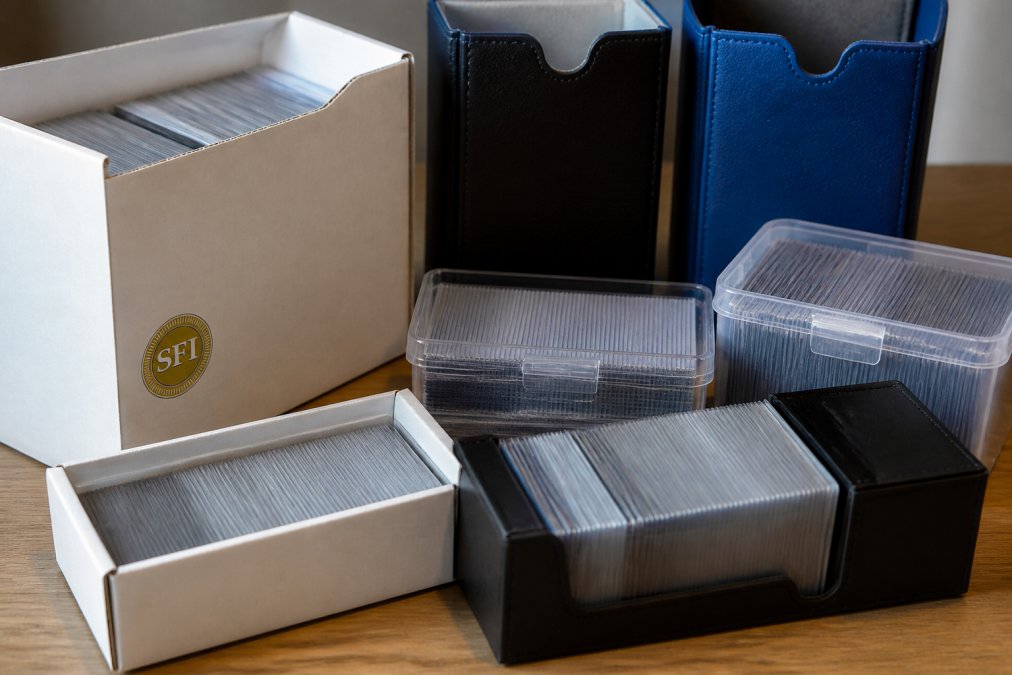
Storage solutions for pokemon cards fall into distinct categories, each serving different collection sizes and preservation goals.
Deck Boxes vs. Bulk Storage Boxes
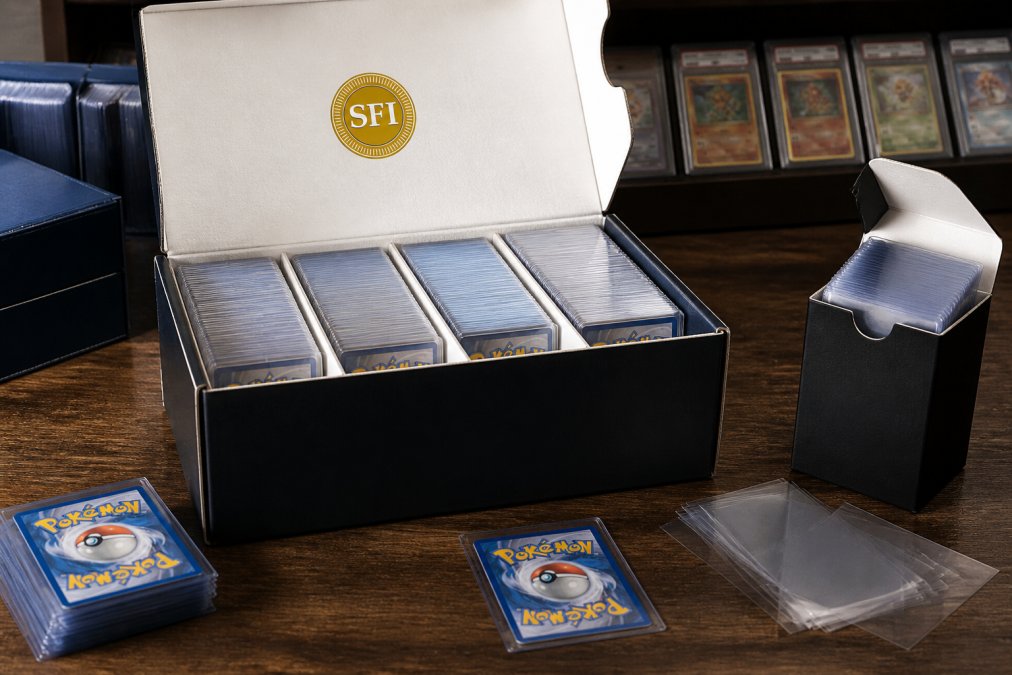
A deck box holds 60-100 cards and works best for active decks or small curated collections. These compact containers fit easily on shelves and feature hinged lids with dividers. Bulk storage boxes accommodate 1,000+ cards and serve collectors with extensive collections, using stackable design for space efficiency.
The choice depends on your collection size and access patterns. Active players typically prefer deck boxes for convenience. Serious investors and graded card collectors often use bulk storage for long-term preservation, paired with individual protective sleeves for high-value cards.
Acid-Free Cardboard vs. Plastic Storage
Only acid-free cardboard deserves consideration for serious collections. Standard cardboard contains lignin and compounds that acidify over time, degrading card stock. Acid-free cardboard maintains neutral pH levels and won't chemically damage your cards.
Plastic storage boxes provide superior moisture resistance and durability. Quality plastic containers resist warping and maintain structural integrity across temperature fluctuations. The trade-off is that plastic boxes can trap moisture if not paired with humidity control measures.
For graded slabs and high-value cards, acid-free cardboard paired with archival-quality sleeves offers the best long-term protection. For bulk storage of standard cards, sturdy plastic boxes with dividers provide practical organization without sacrificing preservation.
Best Card Storage for Graded Slabs
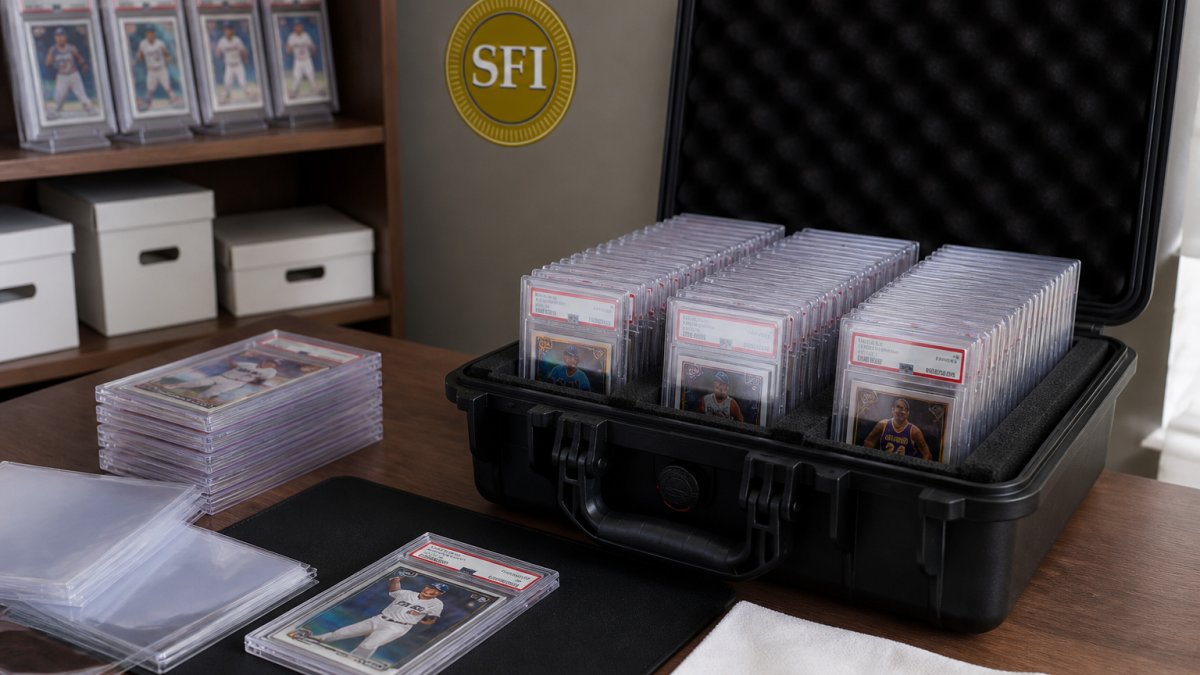
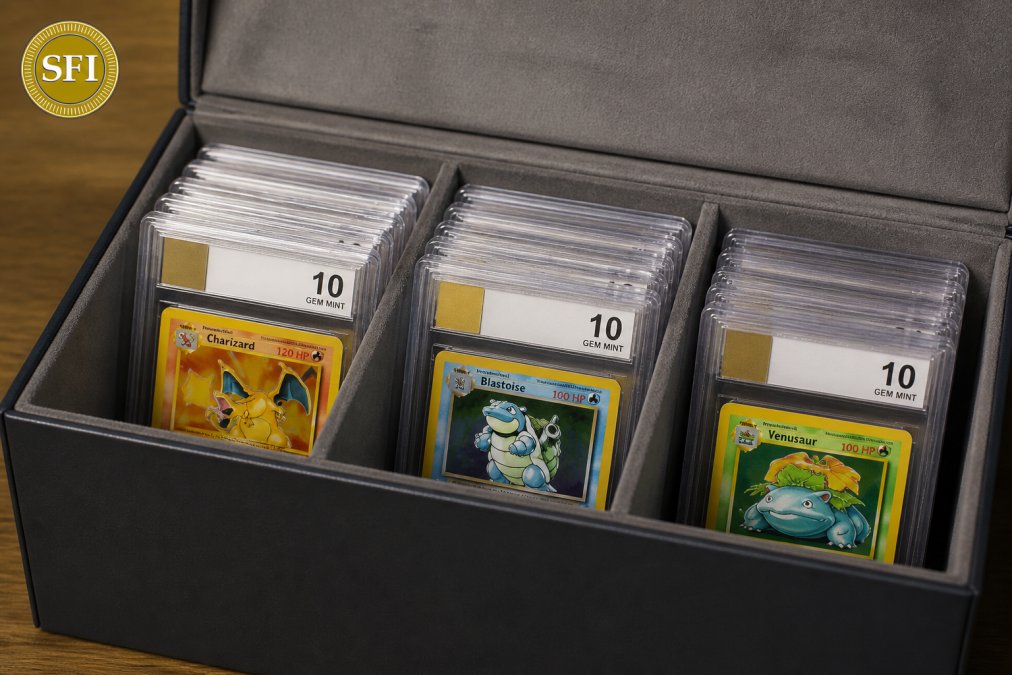
Graded cards in PSA, BGS, or CGC slabs require specialized storage that protects your investment while maintaining display quality. Dedicated slab storage boxes feature individual compartments or soft dividers that cradle each slab without pressure, preventing corner damage to the plastic case.
One critical consideration is slab-specific protective sleeves. Standard card sleeves don't fit graded slabs properly. Superior Fit Sleeves manufactures specialized graded card slab sleeves that fit each major grading company's case dimensions, protecting the slab from dust and fingerprints while maintaining crystal-clear visibility of the card and grade label.
Temperature stability matters more for graded collections than for raw cards. Store graded slabs in climate-controlled environments where temperature stays between 65-75°F and humidity remains between 40-50%. Basements and attics are poor choices due to seasonal temperature swings.
How to Organize Your Pokemon Card Collection
Organization transforms a collection from a pile of cards into an inventory you can access, display, and protect efficiently. The system you choose depends on collection size, the mix of graded and raw cards, and whether you prioritize display or preservation.
Systematic Categorization Methods
The most effective organization systems combine primary and secondary sorting layers. Set-based organization works best for completionists building full sets. Within each set box, use secondary sorting by card number or rarity. Type-based organization (Pokémon, Trainer, Energy) suits competitive deck builders who need quick access to specific card functions. Rarity-first organization prioritizes card value protection by separating holos and reverse holos into premium storage. Hybrid systems combine two methods, for example, primary sort by set, secondary sort by rarity within each set.
Inventory Tracking and Documentation
For graded cards and high-value raw cards, create a detailed inventory spreadsheet that includes card name, set, rarity, grade, acquisition cost, current estimated market value, storage location, and condition notes. Assign each graded slab a unique ID number. Store the spreadsheet in cloud backup to prevent data loss. Update estimated values quarterly using market data from TCGPlayer or eBay sold listings.
For raw cards, maintain a separate inventory of cards valued above $50, including photos of front and back for high-value cards.
Space-Saving Box Organization Techniques
Vertical card orientation in bulk boxes saves space compared to horizontal stacking. Stand cards upright like books on a shelf, using acid-free dividers to create sections. This orientation distributes weight evenly and lets you locate specific cards quickly.
Compartmentalized divider systems create micro-zones within a single box. Use removable dividers to create 4-8 compartments, each dedicated to a specific set or rarity tier. Stacking and nesting works for deck boxes, stack identical boxes vertically, securing them with acid-free tape. Tiered shelving organizes multiple boxes by frequency of access, storing frequently accessed boxes at eye level.
Rotation and Accessibility Planning
Implement a rotation system for display cards. Keeping cards under constant light fades colors and weakens cardstock. Rotate display cards every 3-6 months, storing the off-display cards in climate-controlled darkness.
For cards in top-loaders or magnetic cases, store them vertically in boxes designed for that orientation. Maintain a "working inventory" of cards you handle frequently separate from your preservation collection to protect high-value cards from unnecessary handling.
Archival Safe Card Storage Supplies and Protection
Building a complete storage system requires multiple protective layers. Protective sleeves form the first defense layer. Superior Fit Sleeves' precision-cut design eliminates air gaps, providing snug protection without compression.
Top-loaders offer rigid protection for individual high-value cards, preventing bending and providing UV protection. Pair top-loaders with archival sleeves to prevent the plastic from directly contacting card stock.
Magnetic one-touch cases combine rigid protection with display appeal, perfect for showcasing your best cards while protecting them from handling. Desiccant packs absorb excess moisture inside sealed boxes, place small packets inside bulk storage boxes and replace every 6-12 months. UV-blocking storage boxes protect cards from light damage.
Long-Term Preservation: Preventing Damage and Warping
Long-term card preservation requires attention to environmental conditions and storage practices. The difference between a collection that maintains value and one that deteriorates comes down to consistency in these fundamentals.
Humidity Control: The Critical Foundation
Humidity control is the single most important factor in preventing warping and moisture damage. Cards are made from wood pulp cardstock that absorbs moisture from the air. Expansion and contraction causes permanent warping, the card becomes wavy or bent and never returns to flat.
The optimal humidity range for card storage is 40-50% relative humidity (RH). Humidity below 30% causes cardstock to become fragile and prone to cracking (peer-reviewed research). Humidity above 60% promotes mold growth and accelerates chemical degradation.
Measuring humidity is the first step. Purchase an inexpensive digital hygrometer and place it in your storage area. Check readings weekly initially, then monthly once you establish baseline conditions.
Desiccant packs are the most practical humidity control tool for sealed boxes. Place one 5-gram packet per 100 cards in bulk storage boxes. For deck boxes holding 60-100 cards, use a single 2-gram packet. Replace desiccant packs every 6-12 months, or when they appear saturated.
For climate-controlled rooms, use a whole-room dehumidifier if ambient humidity consistently exceeds 55%. Set the dehumidifier to maintain 45% RH. Avoid storage in high-humidity zones like basements, bathrooms, and laundry rooms. Instead, store cards in climate-controlled bedrooms, closets, or dedicated storage rooms where HVAC systems maintain consistent humidity.
Temperature Stability and Stress Prevention
Temperature stability prevents stress on card materials. Rapid temperature changes cause cards to expand and contract at different rates than their sleeves and boxes, creating internal pressure that weakens the cardstock.
Maintain storage temperatures between 65-75°F year-round (si.edu). Avoid temperature fluctuations greater than 10°F in a 24-hour period. For graded slabs, temperature stability is even more critical, rapid changes create condensation inside sealed cases.
Climate-controlled storage rooms are ideal for serious collectors. A dedicated closet with a small wall-mounted air conditioning unit maintains stable temperature and humidity. For collectors without climate control, use insulated storage containers in interior rooms away from exterior walls and windows.
Light Exposure and Color Preservation
Light exposure fades colors permanently. Sunlight and bright artificial light contain ultraviolet (UV) rays that break down the chemical bonds in card ink and cardstock. Even indirect sunlight through windows causes noticeable fading over 6-12 months.
Store cards in complete darkness or under UV-filtered lighting (the NIH). Opaque storage boxes provide darkness automatically. If you display cards, use UV-filtering acrylic or glass cases that block 99% of UV rays.
Implement a rotation system for display cards. Keep cards on display for no more than 3-6 months at a time, then rotate them into dark storage. For your absolute best cards, keep them in darkness permanently.
Handling Protocols and Surface Protection
Handling practices matter more than many collectors realize. Oils from your hands transfer to cards, creating permanent marks. Fingerprints on cards are nearly impossible to remove and permanently reduce card condition grades.
Always wear cotton gloves when handling valuable cards. Avoid touching the card surface; handle cards by the edges only. Minimize handling by storing cards in sleeves or cases immediately after acquisition. Each removal and reinsertion risks surface damage and dust contamination.
Chemical Exposure and Material Selection
Chemical exposure from surrounding materials accelerates card degradation. Never store cards in boxes made from treated wood, standard cardboard, or PVC plastic.
Acid-free cardboard maintains neutral pH and won't introduce contaminants. Look for boxes labeled "acid-free" or "archival-grade." Polypropylene (PP) plastic is safe for long-term card storage and is chemically inert. Polyethylene terephthalate (PET) is also safe. Avoid polyvinyl chloride (PVC) plastic, which releases harmful compounds as it degrades.
Acid-free dividers and sleeves are essential. Standard paper dividers contain acid that migrates onto cards. Use only archival-grade dividers and sleeves specifically labeled for card storage.
Pest and Mold Prevention
Pest and mold prevention requires vigilance in humid climates. Maintain humidity below 55% to prevent mold growth. Inspect storage areas monthly for signs of pests or mold.
Sealed boxes with desiccant packs provide excellent pest protection. Insects cannot enter sealed containers, and low humidity inside the box prevents mold growth. For additional protection in pest-prone areas, place sealed storage boxes on shelves elevated off the floor, away from walls.
If you discover mold on cards, isolate affected cards immediately and increase humidity control in your storage area. Mold damage is often permanent, prevention is far more effective than treatment.
| Preservation Factor | Best Practice | Monitoring Method | Impact on Collection |
|---|---|---|---|
| Humidity Control | 40-50% RH using desiccant packs or dehumidifier | Digital hygrometer checked monthly | Prevents warping, mold, and moisture damage |
| Temperature | 65-75°F, consistent year-round | Thermometer checked monthly | Eliminates stress from expansion/contraction |
| Light Exposure | Darkness or UV-filtered light; rotate display every 3-6 months | Visual inspection for fading | Prevents permanent color fading and cardstock weakening |
| Handling | Cotton gloves; minimize handling; use sleeves as barriers | Inspection before and after handling | Eliminates oils and surface marks |
| Storage Materials | Acid-free cardboard, polypropylene plastic only | Check box labels and material specs | Prevents chemical degradation |
| Pest/Mold Prevention | Sealed boxes; humidity below 55%; elevated storage | Monthly visual inspection | Protects from biological damage |
Frequently Asked Questions
What is the best box for Pokemon cards?
The best box depends on your collection type. For graded slabs, choose acid-free storage with UV protection and moisture resistance. For raw cards, deck boxes with dividers offer portability, while bulk storage boxes work for larger collections. Look for archival-quality materials and proper card capacity sizing to prevent warping and damage.
How do I store graded Pokemon cards safely?
Store graded slabs in acid-free, archival-quality boxes with protective sleeves designed for your specific slab type (PSA, BGS, CGC). Keep boxes in a climate-controlled environment away from direct sunlight and humidity fluctuations. Use precision-fit sleeves to prevent shifting inside the slab case, and store boxes horizontally to minimize pressure on the cards.
Are cardboard or plastic boxes better for card storage?
Acid-free cardboard boxes are superior for long-term preservation because they don't off-gas chemicals that damage cards. Plastic boxes offer better moisture resistance and visibility but must be polypropylene-based to avoid yellowing. For serious collectors, acid-free cardboard with proper humidity control outperforms standard plastic storage solutions.
What makes archival-grade storage different from regular boxes?
Archival-grade boxes are acid-free, lignin-free, and buffered to prevent chemical degradation of cards over decades. They resist yellowing, warping, and moisture absorption. Regular boxes contain acids that migrate into cards, causing discoloration and brittleness. For valuable collections, archival supplies are an investment in preventing mint condition loss and protecting card value long-term.
This article was written using GrandRanker