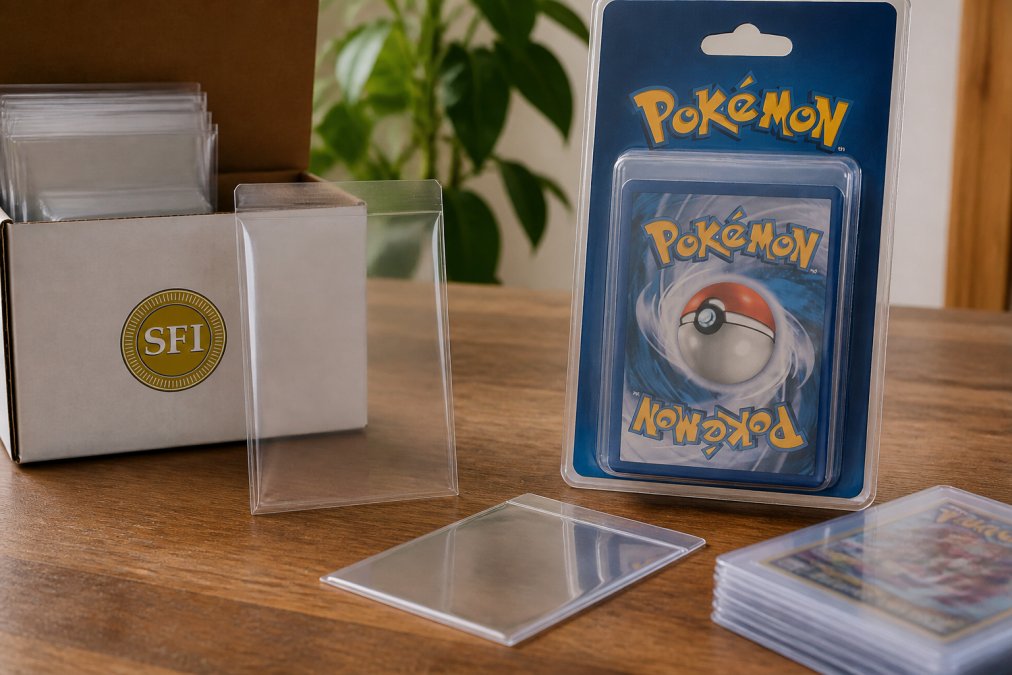
 listicle
Best Pokemon Blister Pack Sleeves: 2026 Guide
Table of Contents
- Why Blister Pack Sleeves Matter for Sealed Collection Storage
- Material Quality: PET, PVC-Free, and Acid-Free Options Compared
- Sizing and Fit: Matching Sleeves to Blister Pack Dimensions
- Protecting Pokemon Blister Packs From Damage: Scuffs, Dust, and UV
- Best Sleeves for Graded Slabs and Display Cases
- Step-by-Step Guide to Sleeving Your Blister Packs
- Environmental Storage: Humidity, Temperature, and Light Control
- Conclusion: Preserving Your Investment for the Long Term
- Frequently Asked Questions
Last Updated: September 7, 2026
Why Blister Pack Sleeves Matter for Sealed Collection Storage
The market for sealed Pokemon products has matured into a serious investment category, yet most collectors still treat booster packs and blister packs with less care than a single graded card. A sealed blister pack with creased cardboard or a scuffed plastic window can lose a meaningful portion of its value, and the damage is almost always preventable.
Blister pack sleeves are protective polypropylene or archival film covers designed to fit around sealed retail packaging, guarding the cardboard backing, plastic front, and booster pack inside from abrasion, dust, and UV exposure. At Superior Fit Sleeves, we have specialized in precision-fit protective sleeves since 2014, and the same engineering that protects graded slabs applies directly to sealed blister packs.
Blister pack damage is rarely dramatic; it is cumulative. Tiny scuffs from sliding packs across a shelf, micro-abrasions from stacking, and gradual yellowing from ambient light compound over years. By the time you notice the damage, the window for selling at peak condition has closed.
Material Quality: PET, PVC-Free, and Acid-Free Options Compared
Material science is where cheap sleeves fail. The plastic you wrap around your sealed collection matters more than thickness alone, especially over a 10- or 20-year holding period.
The chemistry of plastic degradation. Most clear plastic films are made from polymers mixed with plasticizers, chemical compounds that add flexibility. Over time, these plasticizers migrate to the surface, a process called exudation. When that plastic contacts your blister pack's cardboard backing, the migrating plasticizers can be absorbed into the paper fibers, causing yellowing, stiffness, and a greasy residue that is nearly impossible to remove. This is the primary failure mode of low-quality PVC-based sleeves.
PET (polyethylene terephthalate) is the archival standard because it is a polyester that does not require plasticizers for flexibility at the thicknesses used in protective sleeves. It is rigid, crystal clear, and chemically inert, the same family of plastic used in Mylar, the default choice for archival storage in museums and libraries for decades. Its low acid content and resistance to hydrolysis make it suitable for decades-long storage.
Polypropylene is a polyolefin and is also considered archival-safe when manufactured without plasticizers. However, it is softer and more flexible than PET, offering less rigid impact protection and more permeability to gases and moisture vapor. For short-term display or storage under stable conditions, polypropylene is acceptable; for long-term sealed investment storage, PET's lower permeability and higher rigidity make it the superior choice.
PVC (polyvinyl chloride) is the material to avoid at all costs. It is manufactured with high levels of plasticizers, often 30-40% of the material by weight, to make it flexible. Those plasticizers are not chemically bonded to the PVC polymer, so they migrate to the surface over time, creating a sticky film that can fog the plastic window of your blister pack and chemically interact with the cardboard backing. Additionally, PVC degrades when exposed to UV light, releasing hydrochloric acid, which accelerates yellowing and embrittlement. The Library of Congress explicitly excludes PVC from its list of acceptable plastic enclosures.
Acid-free and archival-grade are terms that separate safe sleeves from risky ones, but they are not interchangeable. "Acid-free" refers specifically to the pH of the material, it means the sleeve will not introduce acid to the item it protects. "Archival-grade" is a broader claim that typically includes acid-free status plus chemical stability, no plasticizers, and passing the Photographic Activity Test (PAT). The PAT is a standardized test developed by the Image Permanence Institute that measures whether a material will cause fading or staining in photographs over time. It is the gold standard for any plastic that will contact collectible paper or cardboard. For sealed Pokemon collection storage, the Library of Congress's guidance on plastic enclosures emphasizes that only materials passing the PAT are safe for long-term archival contact.
Material | Clarity | Plasticizers | Chemical Stability | Archival Safety | Best Use |
|---|---|---|---|---|---|
PET | Ultra-clear | None | High; resists hydrolysis | Safe; passes PAT | Long-term sealed storage |
Polypropylene | Clear | None (if quality) | Moderate; more gas-permeable | Safe; passes PAT | Short-to-medium display |
PVC | Clear initially | 30-40% by weight | Low; degrades, releases HCl | Unsafe | Avoid entirely |
How to verify what you are buying. Sellers rarely label sleeves with their polymer type. Look for explicit claims of "PET" or "Mylar" on the packaging. If a product only says "acid-free" or "archival," contact the manufacturer and ask for the material specification sheet. A reputable manufacturer will disclose the polymer type and confirm that the product passes the PAT. If they cannot or will not provide that information, treat the product as suspect. The cost difference between a verified archival PET sleeve and a generic polypropylene sleeve is often less than a few cents per unit, negligible compared to the value of the sealed product it protects.
Sizing and Fit: Matching Sleeves to Blister Pack Dimensions
Blister packs come in several standardized retail formats, but the dimensions are not as uniform as most collectors assume. A sleeve that fits a 2023 Scarlet & Violet single-pack blister will not fit a 2016 Evolutions blister, and neither will fit a three-pack blister from the Sword & Shield era. Getting the fit right requires measuring the actual product, not relying on the product name.
The three critical measurements. Before ordering sleeves, measure three dimensions of your blister pack with a ruler or calipers: width (horizontal dimension of the cardboard backing), height (vertical dimension of the cardboard backing), and depth (maximum protrusion of the plastic bubble from the back of the cardboard to the front of the bubble). The depth measurement is the one most collectors skip, and it is the most important. The plastic bubble protrudes anywhere from 0.5 to 1.5 inches depending on the product. A flat sleeve designed for a single card or a graded slab will not accommodate this protrusion without stretching or tearing.
Common dimension ranges by format. Based on measurements of modern English-language Pokemon products, here are the approximate ranges you will encounter:
- Single-pack blisters (modern, 2020-present): Cardboard backing typically measures 5.5 to 6.0 inches wide by 8.0 to 8.5 inches tall, with a bubble depth of 0.5 to 0.75 inches.
- Single-pack blisters (Sun & Moon era, 2017-2019): Similar width and height, but some products featured a wider cardboard footer that adds 0.5 to 1.0 inch to the height.
- Three-pack blisters: These are significantly larger, typically 6.5 to 7.0 inches wide by 9.0 to 9.5 inches tall, with a bubble depth of 0.75 to 1.0 inch. The bubble often holds three booster packs side by side, making it wider than a single-pack bubble.
- Checklane blisters (the small hanging packs sold at checkout counters): These are smaller, typically 4.0 to 4.5 inches wide by 6.0 to 6.5 inches tall, with a shallow bubble depth of 0.4 to 0.5 inches.
These are ranges, not universal standards. Pokemon has used different packaging suppliers and regional formats over the years, so always measure the specific product you intend to sleeve.
How to measure correctly. Place the blister pack flat on a table with the cardboard backing facing down. Measure the width and height of the cardboard only, do not include any hanging tab if you plan to store the pack upright with the tab removed. For depth, measure from the table surface to the highest point of the plastic bubble. Add 1/8 inch to each dimension to allow for easy insertion without excess slack.
The fit test. A proper fit should be snug but not tight. You should be able to slide the blister pack in without forcing it, and the sleeve should hold the pack securely once sealed. To test a sleeve before committing to a bulk order: insert the blister pack, hold the sleeved pack vertically and gently shake it, if the pack slides more than 1/4 inch, the sleeve is too loose. Check the corners of the cardboard; if they are bending or the cardboard is bowing, the sleeve is too small. If the sleeve is stretched so tightly over the bubble that it creates a "tenting" effect or distorts the view of the booster pack, the sleeve is too shallow.
Why generic "trading card" sleeves fail. Standard trading card sleeves are designed for single cards that are 2.5 by 3.5 inches with negligible thickness. They are not dimensionally compatible with blister packs. Using them requires folding or stretching, which introduces creases and stress points that can transfer to the product. Similarly, team bags (the clear polypropylene bags used by sports card collectors) are often too wide and too short for modern blister packs, leaving the top of the cardboard exposed.
The case for custom-fit sleeves. A purpose-built sleeve for blister packs is cut to accommodate the specific width, height, and depth of the format. The benefit is not just protection, it is consistency. When every pack in your collection is sleeved in a sleeve that fits precisely, the collection presents uniformly on a shelf or in a storage box. There is no excess material bunching at the edges, no loose corners that can catch on adjacent packs, and no risk of the pack shifting inside the sleeve during handling.
For collectors with a mix of modern and vintage product, measuring each format before ordering is the only reliable approach. Many sellers list interior dimensions, and those numbers are what matter, not the product name on the packaging. If a seller only lists the product name without interior dimensions, ask for the measurements before purchasing, a sleeve that fits a 2023 blister pack will not fit a 2003 one.
Protecting Pokemon Blister Packs From Damage: Scuffs, Dust, and UV
Surface damage is the primary enemy of sealed Pokemon blister packs, and it comes from three directions.
Scuffing happens whenever two packs touch. Stacking unprotected blisters means the plastic windows grind against the cardboard backs of the packs above them, creating the cloudy, scratched appearance that immediately signals mishandling.
Dust is more insidious. Fine particles settle into the crevices where the plastic meets the cardboard, acting as an abrasive whenever the pack is moved. Dust also attracts moisture, which can lead to warping.
UV protection is the factor most collectors underestimate. Ambient indoor light, not just direct sunlight, causes gradual fading of printed colors on the cardboard backing. A sleeve with UV inhibitors adds a measurable layer of defense. According to the Smithsonian's preservation guidelines, light damage is cumulative and irreversible, making prevention the only effective strategy.
Best Sleeves for Graded Slabs and Display Cases
The line between protecting a sealed blister pack and protecting a graded slab is thinner than most collectors realize. Both require the same core qualities: archival-safe material, precision fit, and optical clarity. For graded slabs from PSA, BGS, CGC, and similar services, the sleeve must accommodate the rigid slab dimensions without being so loose that the slab rattles. A tapered, precision-cut design holds the slab securely while remaining easy to insert and remove. The same engineering applies to magnetic one-touch cases and top-loaders, which have their own standardized dimensions.
Superior Fit Sleeves produces specialized sleeves for graded card slabs, top-loaders, and magnetic cases, each precision-cut to match the specific case profile. The benefit of a purpose-built sleeve over a generic bag is consistency: no excess material bunching at the edges, no distortion from an imperfect fit, and a clean presentation that does not detract from the card itself. For collectors displaying both sealed blister packs and graded slabs side by side, uniform, clear sleeves across the entire collection create a professional presentation that also protects every item equally.
Step-by-Step Guide to Sleeving Your Blister Packs
The process takes under a minute per pack once you have the right sleeve size. Rushing it is the most common cause of torn sleeves and damaged corners.
- Inspect the blister pack for existing damage. Sleeving a pack that is already scuffed will not repair it, and you should document any flaws before storage.
- Open the sleeve fully. Pinch the open end between your thumb and forefinger and blow gently to separate the layers if they are stuck together.
- Hold the blister pack by its edges, avoiding pressure on the plastic window. Fingerprints on the plastic are visible through a clear sleeve.
- Slide the pack in slowly, cardboard side first. Let the pack glide rather than pushing it, which can crease the cardboard.
- Seal the sleeve. Resealable options allow future access; self-sealing permanent options are better for long-term storage where you will not need to remove the pack.
- Store upright, never flat-stacked. Vertical storage prevents weight from pressing on the plastic windows.
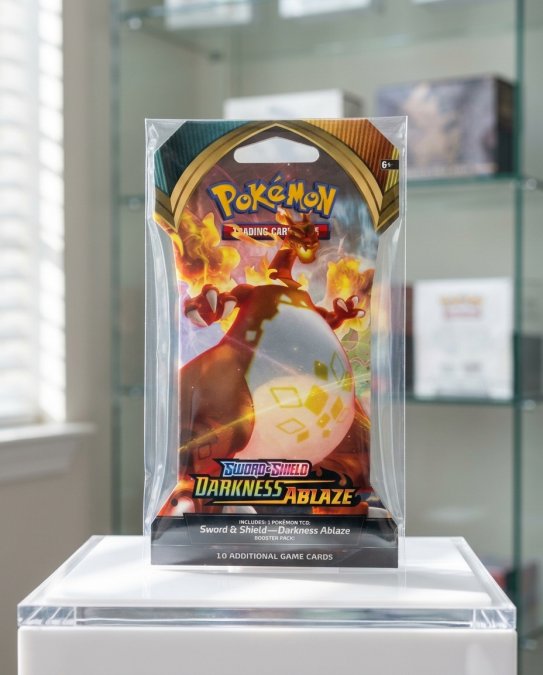
Close-up of a collector's hands carefully sliding a Pokemon blister pack into a clear protective sleeve at a desk, with other sealed products and a bright desk lamp nearby
The single most important step is the last one. Storing sleeved packs flat negates much of the protection, because the weight of stacked packs transfers through the sleeve and still presses on the product inside.
Environmental Storage: Humidity, Temperature, and Light Control
Sleeves handle abrasion and dust, but the surrounding environment determines whether your collection degrades from the inside out.
Temperature stability matters more than a specific target number. Rapid swings between hot and cold cause the plastic in both the packaging and the sleeve to expand and contract, accelerating stress fractures and adhesive failure. A climate-controlled room is sufficient for most collections.
Humidity is the greater risk. High humidity promotes cardboard warping and can cause the plastic window to fog from condensation trapped against it. Low humidity, below roughly 30 percent, makes cardboard brittle and prone to cracking at the folds. the National Archives' guidelines on storage conditions recommend stable, moderate humidity for paper-based collectibles, which applies directly to the cardboard backing of blister packs.
Light control is straightforward: store sealed product away from windows and direct light sources. Even with UV-protected sleeves, minimizing total light exposure over the collection's lifetime is the safest approach.
Conclusion: Preserving Your Investment for the Long Term
The sealed Pokemon market rewards patience and punishes neglect. A blister pack stored properly for ten years can appreciate substantially, while the same pack stored unprotected may lose value through scuffing, fading, and warping. The difference comes down to a few dollars in protective supplies and a few minutes of careful handling.
Start with the fundamentals: archival-grade, acid-free material, a precision fit that does not shift, and stable environmental conditions. For collectors who want the same protection for graded slabs and magnetic cases, Superior Fit Sleeves offers the full range of protective solutions, from graded card slab sleeves to top-loader and magnetic case options. Protecting your collection is protecting your investment, and the right sleeves make that protection effortless.
Frequently Asked Questions
Are sleeved Pokemon packs better for long-term storage?
Yes. A sleeved booster or blister pack has an extra layer of protection against scuffs, dust, and surface wear. The original packaging is cardboard-backed, which is prone to edge wear and scuffing during handling. A fitted archival sleeve acts as a barrier, keeping the cardboard backing clean and the plastic window clear. For sealed Pokemon collection storage, this preserves the pack's condition, which matters for display and resale value.
What is the difference between PET, PVC-free, and acid-free sleeves?
PET sleeves are rigid, crystal-clear, and do not contain plasticizers that can migrate and damage packaging over time. PVC-free is important because PVC can off-gas and cause yellowing or chemical damage. Acid-free materials prevent the cardboard backing from becoming brittle or discolored. For protecting Pokemon blister packs from damage, choose sleeves that are both acid-free and PVC-free to ensure archival-quality protection.
Are Pokemon blister packs worth keeping sealed?
Sealed products generally hold higher value than opened packs because they guarantee the contents are untouched and authentic. A sealed blister pack also offers better protection for the cards inside. The investment potential depends on the set and its popularity. Keeping the pack in a protective sleeve helps maintain its condition, which is a key factor collectors and investors evaluate when determining a sealed product's market value.
Will a sleeve for a PSA slab fit a Pokemon blister pack?
No. PSA slab sleeves are sized for the rigid plastic grading case, not for the larger, irregular shape of a Pokemon blister pack. Blister packs have a cardboard backing that is wider and longer than a standard slab. You need sleeves specifically designed for blister packs to get a snug, protective fit.