 blog
blog
BCW Sleeves Alternative for Graded Cards: 2026 Guide
Table of Contents
- Why Collectors Look Beyond BCW for Graded Card Sleeves
- Slab Dimensions and Fitment: What the Numbers Actually Mean
- Tapered Fit Sleeves for Slabs: The Design That Changed the Standard
- Acid-Free Sleeves for Trading Cards: Why Material Matters Long-Term
- Protecting Graded Card Slabs from Scratches and Environmental Damage
- Graded Guard Compatibility and Resealable Adhesive Strip Features
- Graded Card Sleeves for Comics, Magazines, and Top-Loaders
- Conclusion
Last Updated: August 28, 2026
Collectors searching for a reliable bcw sleeves alternative for graded cards have more options than ever, but most guides stop at listing products without explaining what separates quality from cheap alternatives. At Superior Fit Sleeves, we've spent over a decade engineering precision-fit protective solutions for graded slabs. The differences come down to material science, dimensional accuracy, and long-term archival safety. This guide covers fitment, acid-free polypropylene construction, adhesive strip integrity, and compatibility across PSA, BGS, and CGC holders. A sleeve that fits poorly, yellows within two years, or uses degrading adhesive can damage the investment it was supposed to protect.
Why Collectors Look Beyond BCW for Graded Card Sleeves
BCW products are widely distributed and familiar, but familiarity isn't precision. Graded card slabs have specific dimensional requirements that a one-size-fits-most approach cannot reliably meet. PSA, BGS, and CGC holders differ in thickness, width, and edge profile. A sleeve sized for one grading company's slab will fit another's too loosely, allowing the holder to shift and accumulate micro-scratches during handling and storage.
Serious collectors also question archival safety. Standard polypropylene sleeves vary in quality. Some off-brand options contain trace plasticizers that migrate into the slab surface over time, causing fogging or adhesion. For a collection representing hundreds or thousands of dollars, that's an unacceptable risk. The bcw sleeves alternative conversation is fundamentally about precision: dimensional accuracy, material purity, and fitment that holds a slab securely without stress on case edges.
Slab Dimensions and Fitment: What the Numbers Actually Mean
Fitment is the single most important specification in graded card sleeve selection. A sleeve that's too wide lets the slab rattle and pick up scratches. A sleeve that's too tight stresses the case edges and risks damage during insertion or removal.
| Grading Company | Approximate Slab Width | Approximate Slab Thickness | Sleeve Fit Priority |
|---|---|---|---|
| PSA | ~3.5 inches | ~0.21 inches | Snug width, moderate depth |
| BGS (Beckett) | ~3.5 inches | ~0.27 inches | Snug width, deeper pocket |
| CGC (cards) | ~3.5 inches | ~0.18 inches | Snug width, shallow depth |
| CGC (comics) | Varies by grade tier | Thicker than card slabs | Specialized comic slab sleeve |
PSA, BGS, and CGC Slab Size Differences
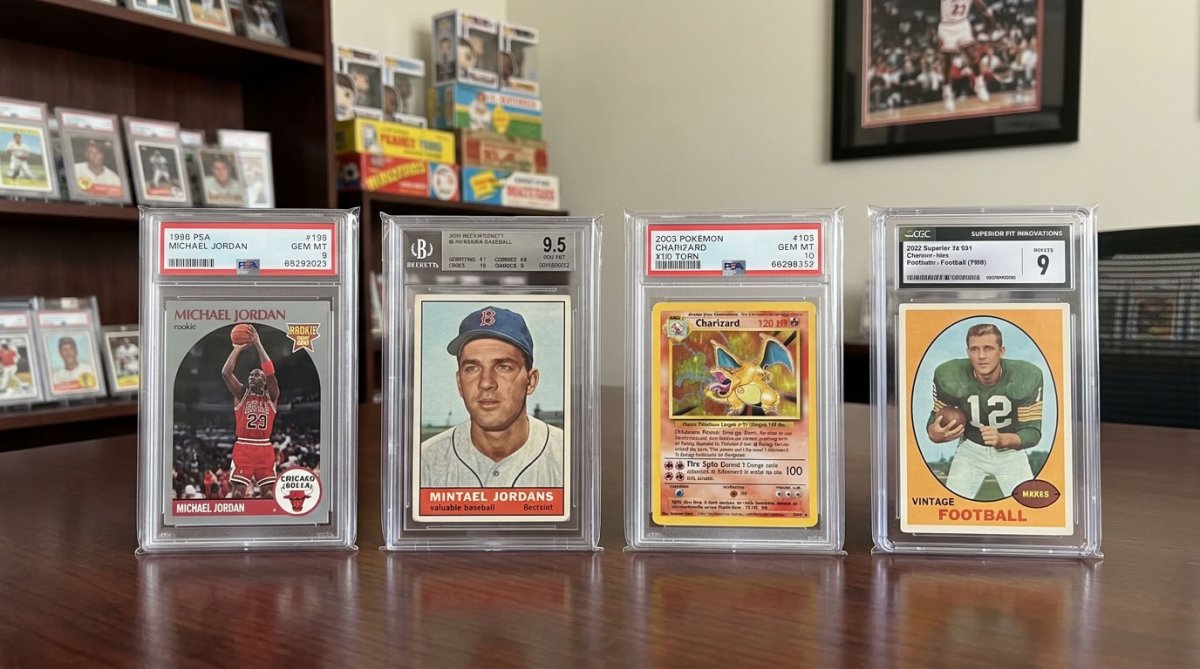
PSA slabs are the most common in sports cards, but they're not the thinnest. BGS holders run noticeably thicker due to their sub-grade label design. CGC card slabs sit at the thinner end of the spectrum. A sleeve engineered for PSA fitment will gap visibly around a CGC slab, defeating the purpose of protective cover entirely. Sleeve manufacturers who offer grading-company-specific sizing matter. Generic sleeves sized to the widest common slab will never fit the thinner ones snugly.
How Fitment Affects Display and Resale Value
A loose-fitting sleeve signals that a seller doesn't take condition seriously. On secondary markets, presentation matters. Slabs displayed in crystal clear, snug-fitting sleeves photograph better and signal professional stewardship, directly influencing offers and sale prices.
Poor fitment also creates practical hazards. When a slab shifts within its sleeve, edge-to-edge contact between plastic surfaces generates micro-abrasions over hundreds of handling events. Those scratches accumulate on the slab surface and reduce display clarity, affecting graded card appeal even when the card inside is untouched.
Tapered Fit Sleeves for Slabs: The Design That Changed the Standard
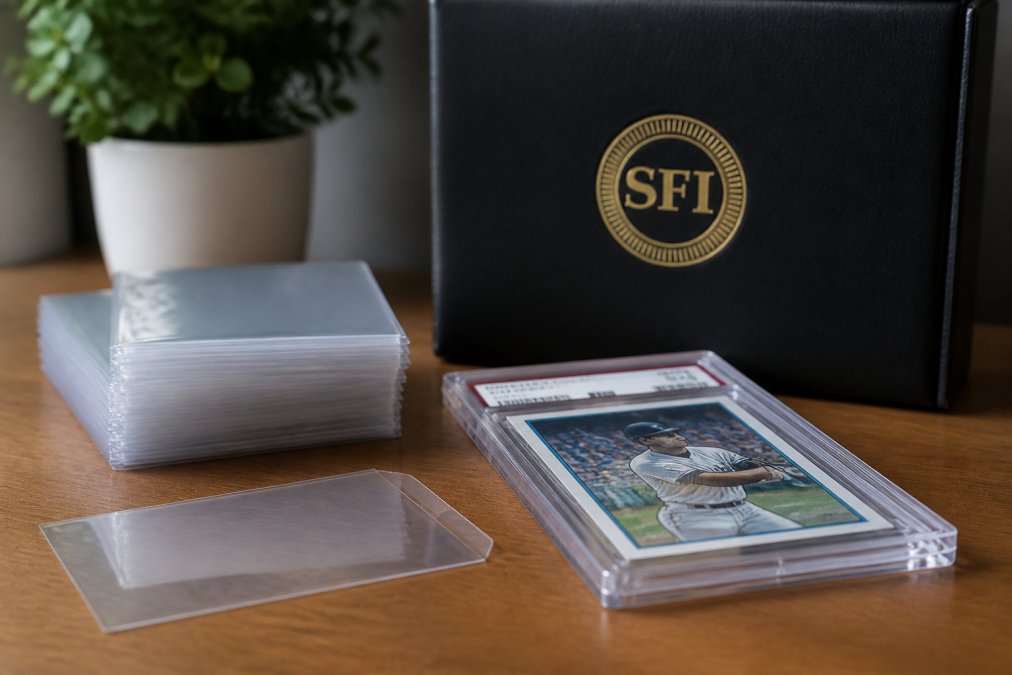
The most significant engineering advancement in graded card sleeve design is the tapered fit. Unlike straight-cut sleeves that form a simple rectangular tube, tapered fit sleeves are wider at the opening and narrower toward the base. This geometry allows easy insertion while providing a secure hold once the slab is seated.
Superior Fit Sleeves invented this tapered sleeve design in 2014, and it remains the defining characteristic of precision-grade slab protection. The taper allows the slab to slide in without resistance at the opening, then seats snugly as it reaches the narrower base. The result is a slab that doesn't rattle, doesn't shift during display or transport, and can be removed cleanly without prying or bending the sleeve.
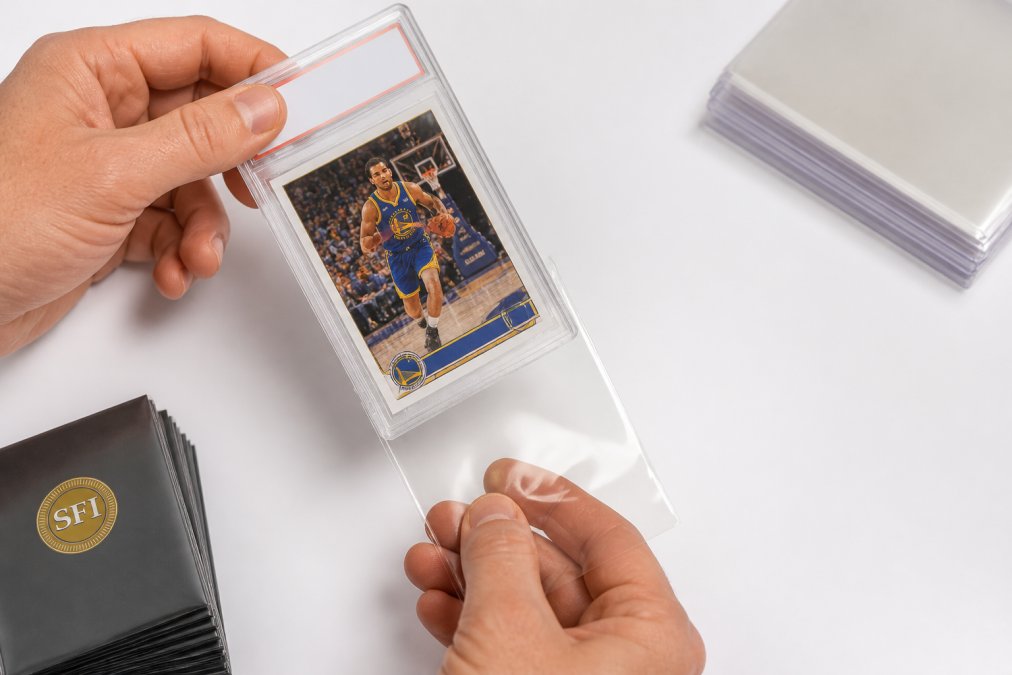
With a standard straight-cut sleeve, you often have to work the slab in, leaving fingerprints across the display face. With a tapered design, the slab drops in on the first attempt. That matters for handling frequency: a collector who accesses their slabs regularly will accumulate far less surface contamination on a tapered sleeve than on a tight straight-cut alternative.
This design is now the benchmark against which other protective solutions are measured. Any bcw sleeves alternative worth considering should be evaluated on whether it uses a tapered geometry or a straight-cut design, because that single variable determines most of the user experience.
Acid-Free Sleeves for Trading Cards: Why Material Matters Long-Term
Acid-free sleeves for trading cards describe a specific material standard that determines whether your sleeve protects or slowly damages what's inside it.
Acid-free polypropylene is a polymer formulation that contains no acidic compounds capable of migrating to adjacent surfaces. Standard plastics, particularly lower-grade PVC alternatives, contain plasticizers that off-gas over time. In an enclosed sleeve environment, those gases contact the slab surface and, over years, can cause fogging, surface adhesion, or chemical etching of the holder's finish.
Archival-safe, acid-free polypropylene avoids this entirely. The material is chemically inert relative to the surfaces it contacts, which is why it's the standard for long-term storage of collectibles, documents, and photographic materials. According to the Library of Congress preservation guidelines, archival-safe polypropylene is among the recommended materials for long-term storage of paper and plastic collectibles precisely because it does not introduce reactive compounds into the storage environment.
Long-Term Adhesive Degradation: A Risk Most Collectors Overlook
Resealable sleeves with adhesive strips introduce a separate long-term risk. The adhesive strip that keeps a sleeve closed is not neutral. Over time, particularly in environments with temperature fluctuation or moderate humidity, adhesive compounds can migrate through the sleeve material and contact the slab surface (loc.gov).
The visible result is sticky residue on the slab case that attracts dust and is difficult to remove without risking scratches. The less visible result is chemical interaction between the adhesive and the slab's polycarbonate or polystyrene surface, which can cause micro-pitting or surface hazing.
The solution is a resealable adhesive strip formulated specifically for archival applications: one that maintains its seal without off-gassing or migrating under normal storage conditions.
UV Protection vs. Standard Polypropylene
For a graded card displayed near a window, UV exposure causes cumulative fading of the card's colors and can yellow the slab's internal label over time.
For collectors who display slabs rather than store them in dark boxes, UV-protective sleeves offer meaningful long-term preservation benefit over standard polypropylene.
Protecting Graded Card Slabs from Scratches and Environmental Damage
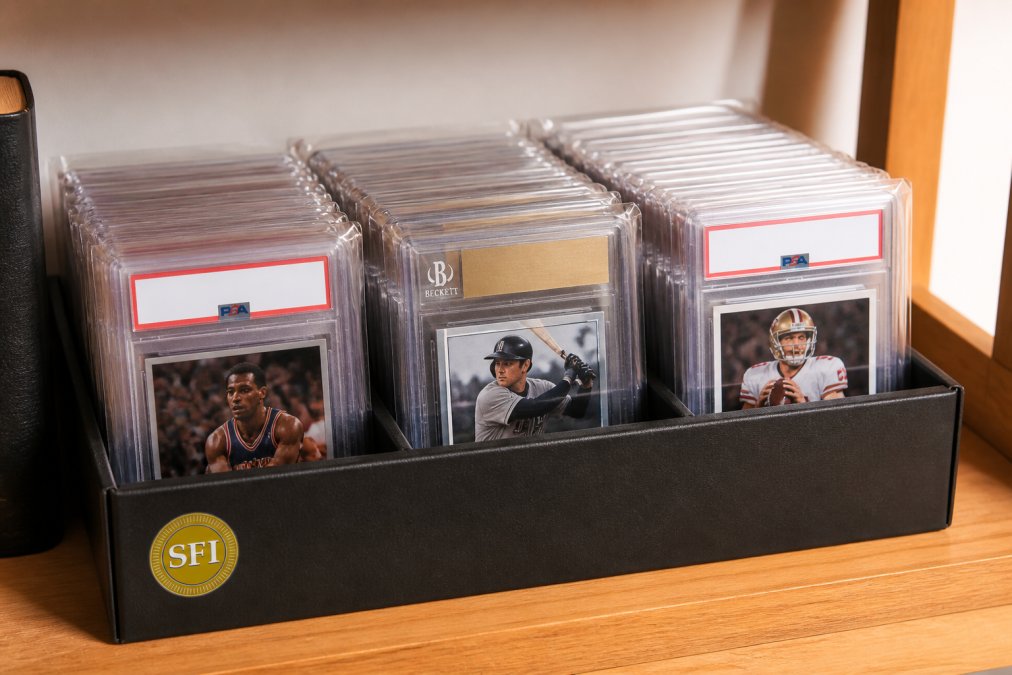
Protecting graded card slabs from scratches starts at the sleeve material level. The full protection picture includes dust accumulation, moisture exposure, and fingerprint contamination during handling, all of which degrade display quality.
Scratch Resistance and Dust Protection During Handling
Scratch resistance comes from two factors: material hardness and fitment precision. A harder polypropylene film resists surface marking when the sleeve contacts other surfaces during storage or transport. Precise fitment prevents the slab from moving inside the sleeve, eliminating internal abrasion that occurs when a loose slab slides against the sleeve walls.
Dust protection is a function of the seal. An open-top sleeve accumulates dust on the slab surface continuously. A resealable adhesive strip closure keeps the interior environment clean between handling sessions. For display-oriented collectors, this is particularly important: dust on a slab surface scatters light and reduces the apparent clarity of the holder.
Moisture Resistance and Fingerprint Prevention
Moisture resistance is relevant in high-humidity storage environments and transport in variable weather conditions. Polypropylene is inherently moisture-resistant, but the quality of the sleeve's seal determines whether moisture can enter through the opening. A well-designed resealable adhesive strip creates a barrier that prevents ambient humidity from cycling in and out of the sleeve interior.
Fingerprint prevention is a handling issue as much as a material one. A sleeve with enough surface clarity that fingerprints are immediately visible prompts cleaning, combined with a material smooth enough that prints wipe cleanly without smearing, provides the best practical solution.
Graded Guard Compatibility and Resealable Adhesive Strip Features
Graded guards are rigid outer holders designed to add structural protection to a slab. They're commonly used by collectors who ship high-value cards or transport slabs to shows and events. A sleeve must be thin enough to allow a slabbed card to fit inside a graded guard without forcing the guard open or stressing its hinge mechanism.
The resealable adhesive strip must also be positioned to clear the graded guard's closure mechanism. A strip placed too high on the sleeve opening can interfere with the guard's lid, making it impossible to close properly. Sleeve manufacturers who design with graded guard compatibility in mind position the adhesive strip to avoid this conflict.
According to the Professional Sports Authenticator's collector resource guides, proper slab storage and transport practices are among the most frequently asked questions from collectors, and sleeve compatibility with protective outer holders is a recurring concern. Selecting a sleeve designed with these real-world use cases in mind is the difference between a sleeve that works in practice and one that works only in ideal conditions.
Graded Card Sleeves for Comics, Magazines, and Top-Loaders
The graded card sleeve market has expanded well beyond sports cards. CGC and CBCS graded comics present a dimensional challenge that standard card slab sleeves cannot address: comic slabs are significantly larger, thicker, and heavier than card slabs, requiring purpose-built sleeves with correspondingly larger dimensions and stronger adhesive strips.
Graded magazine slabs are even larger, and the collector community for graded magazines is growing as more collectors recognize the investment value of high-grade vintage publications. Top-loaders present different requirements: a sleeve must fit the rigid plastic holder precisely, provide enough depth to cover the full height of the top-loader, and use an adhesive strip that doesn't interfere with card insertion or removal.
Superior Fit Sleeves addresses all three categories with purpose-built product lines: Graded Card Slab Sleeves engineered for PSA, BGS, CGC, and other major grading companies; Top-Loader Sleeves sized for standard rigid holders; and Graded Comic Book and Magazine Slab Sleeves for oversized graded collectibles. Collectors with mixed collections don't need to compromise with a single generic sleeve across all holder types.
The fitment logic is straightforward: match the sleeve specification to the specific holder type, not to a general category. Precision fitment requires precision categorization, and that's the standard any serious bcw sleeves alternative for graded cards should meet.
Protecting a graded card collection requires more than finding any sleeve that fits loosely around a slab. The real challenge is sourcing archival-safe, precision-fit protection that works across PSA, BGS, CGC, and other holder types without compromising display clarity or long-term material integrity. Superior Fit Sleeves has engineered purpose-built solutions for every major slab type since 2014, with acid-free polypropylene construction, tapered fitment geometry, and resealable adhesive strips designed for archival storage. Visit Superior Fit Sleeves and find the exact sleeve for your collection.
Frequently Asked Questions
Q: What sleeves does PSA recommend for graded card slabs?
A: PSA does not publish a single official sleeve brand recommendation, but the collector community consistently favors precision-fit polypropylene sleeves designed specifically for PSA slab dimensions. The key criteria are an archival-safe, acid-free material, a snug tapered fit that prevents the slab from shifting, and crystal-clear clarity that does not distort the label or card underneath. Generic penny sleeves are too loose and can trap moisture, which makes purpose-built graded card sleeves the preferred choice for long-term storage.
Q: What is the difference between resealable and non-resealable slab sleeves?
A: Resealable slab sleeves have an adhesive strip along the flap that lets you seal and reopen the sleeve without damaging it. This is useful for collectors who rotate display pieces or frequently inspect their slabs. Non-resealable sleeves are typically open-top and rely on a snug fit alone to keep the slab in place. For long-term storage, resealable sleeves provide an additional barrier against dust and moisture. The adhesive quality matters here, low-grade adhesives can degrade and leave residue on the slab over time.
Q: Are archival-safe sleeves necessary for long-term slab storage?
A: For any collection with real monetary or sentimental value, archival-safe sleeves are worth using. Standard plastic sleeves can contain PVC or acidic compounds that off-gas over years, potentially fogging the slab surface or degrading the protective holder itself. Acid-free, polypropylene sleeves eliminate that risk. Graded slabs already provide a sealed environment for the card inside, but the outer slab surface still needs protection from environmental damage, scratches, and UV exposure during display or storage.
Q: Do tapered sleeves improve the appearance of graded cards on display?
A: Tapered fit sleeves are cut to follow the contour of a graded slab rather than using a uniform rectangular pocket. This removes the excess plastic that bunches at the corners of standard sleeves, giving the slab a clean, professional look whether it is displayed upright or stored flat. Collectors who sell graded cards also report that a well-fitted sleeve signals careful ownership, which can support buyer confidence. The difference is visible immediately when comparing a tapered sleeve against a generic oversized alternative.
This article was written using GrandRanker