 blog
blog
Acid-Free Sleeves vs PVC Sleeves for Cards: 2026 Guide
Table of Contents
- Acid-Free Sleeves vs PVC Sleeves for Cards: Quick Comparison Table
- Why PVC Sleeves Damage Trading Cards Over Time
- Polypropylene vs PVC Sleeves: Material Composition Explained
- How to Identify PVC in Card Sleeves Before You Buy
- Soft Sleeves vs Rigid Holders: Which Protects Better?
- Long-Term Card Storage Best Practices for Collectors
- Choosing Archival-Grade Sleeves for Graded Slabs and Top-Loaders
- Frequently Asked Questions
Last Updated: September 10, 2026
Acid-Free Sleeves vs PVC Sleeves for Cards: Quick Comparison Table
The choice between acid-free sleeves and PVC sleeves for cards comes down to one hard fact: PVC will eventually destroy the cards you're trying to protect. Acid-free sleeves, typically made from polypropylene, are chemically inert and won't react with card stock, inks, or coatings. This guide from Superior Fit Sleeves breaks down the material science, the warning signs of degradation, and the storage habits that separate a collection that survives 30 years from one that doesn't.
Most collectors learn this lesson the expensive way: a valuable rookie card goes into a cheap sleeve, sits for five years, and comes out with a greasy sheen and muted colors. That's not wear, it's permanent chemical damage.
Below, we'll show you how to tell the two materials apart before you buy, what happens inside a PVC sleeve over time, and which storage setups hold up.
| Factor | Acid-Free (Polypropylene) Sleeves | PVC Sleeves |
|---|---|---|
| Chemical stability | Inert, non-reactive | Unstable, releases plasticizers |
| Long-term effect on cards | No reaction | Yellowing, image offset, brittleness |
| Clarity over time | Stays clear | Clouds and discolors |
| Best for | Graded slabs, top-loaders, long-term storage | Short-term handling only |
| Off-gassing risk | None | High, especially in heat |
| Recommended by archivists | Yes | No |
Why PVC Sleeves Damage Trading Cards Over Time
PVC sleeves damage cards because the plastic doesn't stay chemically stable. Polyvinyl chloride requires plasticizers to stay flexible, and those plasticizers migrate out of the plastic over months and years, depositing directly onto the card surface.
The result is image offset: the card's ink and coating bond to the sleeve, and pulling it free can lift part of the print. A common mistake is assuming a card that looks fine after a year in PVC is safe, the damage is cumulative and often invisible until it's irreversible.
What most guides miss is that the process accelerates with heat and humidity. A collection stored in a warm garage degrades far faster than one kept in a cool, dry room. Library of Congress guidance on plastic storage materials notes that unstable plastics release acidic vapors that can damage paper-based materials in enclosed spaces.
Polypropylene vs PVC Sleeves: Material Composition Explained
Polypropylene is a thermoplastic polymer built from simple, stable molecular chains. It contains no plasticizers, which is why it's considered archival-grade and safe for long-term contact with paper and card stock. PVC is also a thermoplastic, but requires additives to stay pliable, and those additives are the problem.
That's the core of the polypropylene vs PVC sleeves debate: one material is inert, the other reactive by design, and that difference determines whether a sleeve protects your card or slowly attacks it.
Material composition also affects physical behavior. Polypropylene resists moisture and holds its shape without additives. PVC feels softer and clings more, which some collectors mistake for a better fit, but that cling is the plasticizer at work, exactly what you don't want touching a card's surface.
How Chemical Leaching and Off-Gassing Affect Card Preservation
Chemical leaching is the migration of plasticizers and stabilizers out of the plastic onto whatever it touches. Off-gassing is the release of volatile compounds into the air inside a sealed holder. Both happen continuously in PVC and both harm cards.
The damage compounds in enclosed spaces. A card sealed in a PVC sleeve inside a box inside a closet has nowhere for the released vapors to escape, so they concentrate against the card surface. National Archives guidance on storage enclosures recommends inert materials specifically to avoid this buildup in long-term storage.
How to Identify PVC in Card Sleeves Before You Buy
You can identify PVC in card sleeves by three quick tests: smell, feel, and label. PVC has a distinct chemical or "new shower curtain" odor, feels softer and clingier than polypropylene, and rarely carries an explicit "acid-free" or "archival" claim.
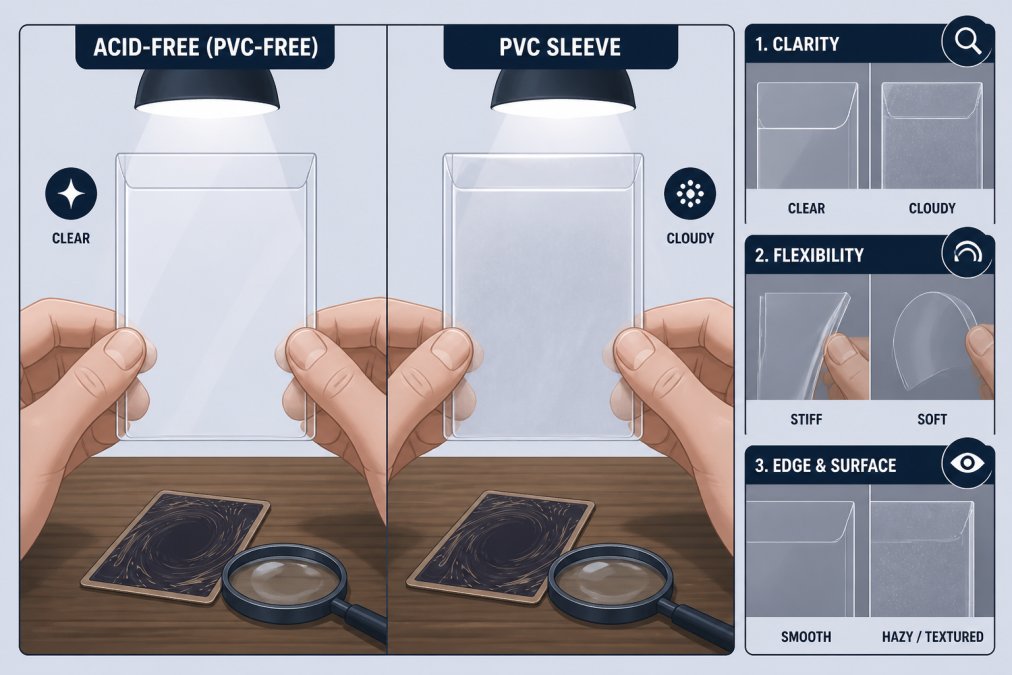
Here's a practical checklist you can run at the store or when a shipment arrives:
- Smell the sleeve. A sharp plastic odor suggests PVC.
- Check the label for "acid-free," "archival," or "polypropylene."
- Squeeze it. PVC clings and feels tacky; polypropylene stays crisp.
- Look for a recycling code. PVC is marked 3; polypropylene is marked 5.
- Bend it. PVC whitens at the fold; polypropylene doesn't.
- Check clarity. PVC often looks slightly cloudy straight out of the pack.
If a sleeve fails two or more of these checks, don't use it on anything you care about.
Signs of Plastic Degradation: Yellowing, Brittleness, and Discoloration
Plastic degradation shows up as yellowing, brittleness, and discoloration, usually in that order: the sleeve turns amber, develops a cloudy haze, then cracks when flexed. By the time brittleness sets in, the plasticizer has left the plastic and is sitting on your cards.
Discoloration on the card itself is the real warning sign. If white borders look cream-colored or the surface has a faint oily film, damage has started, move that card to an acid-free sleeve immediately, though existing discoloration won't reverse.
Soft Sleeves vs Rigid Holders: Which Protects Better?
Rigid holders protect against physical damage; soft sleeves protect against surface contact. The best setup uses both: a soft acid-free sleeve as the chemical barrier, then a rigid holder for structural support. Neither alone covers everything.
Soft sleeves, often called penny sleeves, are thin and flexible. They prevent scratches and handling marks but offer almost no rigidity. Rigid holders, including top-loaders and magnetic one-touch cases, resist bending and drops but can trap moisture if the card inside isn't already sleeved.
Here's the part most buying guides get wrong: thickness does not equal archival safety. A 2-mil and a 6-mil polypropylene sleeve are both chemically inert, extra thickness only adds puncture resistance and stiffness. A thick, clingy PVC sleeve is more dangerous than a thin polypropylene one because its plasticizer reservoir is larger. Collectors who assume "thicker = better" end up buying heavy-gauge PVC sleeves that damage cards faster than cheap thin ones.
A practical way to think about it:
| Sleeve Type | Typical Thickness | Chemical Stability | Best Use |
|---|---|---|---|
| Penny sleeve (polypropylene) | 1-2 mil | Inert | Inner layer, handling |
| Premium soft sleeve (polypropylene) | 2-4 mil | Inert | Inner layer, display |
| PVC soft sleeve | 2-8 mil | Reactive | Short-term handling only |
| Top-loader (rigid PVC or PET) | 12-35 pt | Varies by material | Outer structural layer |
| Magnetic one-touch (acrylic) | Rigid | Inert | Display and storage |
Note the units: soft sleeves are measured in mil (thousandths of an inch), rigid holders in pt (points, where 1 pt = 0.001 inch). A 35-pt top-loader is 0.035 inch thick, far thicker than any soft sleeve, but that thickness is structural, not chemical. A PVC top-loader will still off-gas; a PET or acrylic one will not.
The two also differ in how they meet the card's surface. Thin sleeves sit flush and can trap microscopic moisture if the card wasn't fully dry. Rigid holders leave an air gap, reducing surface contact but creating a sealed microclimate where released vapors concentrate. That's why the inner sleeve matters: it's the chemical barrier; the rigid holder is only mechanical.
| Protection Type | Soft Sleeve | Rigid Holder |
|---|---|---|
| Scratch prevention | Yes | Yes |
| Bend resistance | No | Yes |
| Chemical barrier | Yes, if acid-free | Only with inner sleeve |
| Display quality | Moderate | High |
| Best paired with | Rigid holder | Soft sleeve |
Long-Term Card Storage Best Practices for Collectors
Long-term card storage best practices start with three rules: use only inert materials, control the environment, and keep cards out of direct light. Everything else is secondary.
Start with the material layer. Every card that touches plastic should touch acid-free, archival-grade material first. Then control the environment. Stable temperature and low humidity do more for preservation than any single product.
Here's a storage setup that holds up over decades:
- Acid-free sleeves on every card, including those inside rigid holders
- Rigid holders for anything worth more than the cost of the holder
- Sealed storage boxes kept in a cool, dark, dry space
- Desiccant packs in humid climates, replaced on a schedule
- Annual inspection of a sample of cards for early degradation signs
Humidity, Temperature, and Their Impact on Off-Gassing
Off-gassing accelerates sharply with heat and humidity, which is why climate control matters as much as the sleeve itself. Every 10-degree rise speeds up chemical reactions, including the breakdown of unstable plastics, and high humidity adds moisture that can react with released compounds and stain card surfaces.
But the mechanism is more specific than most guides admit. PVC plasticizers, typically phthalate esters, migrate out of the polymer matrix through diffusion, and the rate depends on temperature and polymer chain mobility. Heat increases chain mobility, letting plasticizer molecules escape faster. Humidity matters because absorbed water vapor acts as a plasticizer itself, softening the polymer and speeding diffusion. That's why a PVC sleeve in a humid climate degrades faster than the same sleeve in a dry one, even at the same temperature.
The practical numbers collectors should know:
- Below 65°F and under 50% relative humidity is the widely cited target range for paper-based collections, based on guidance from preservation organizations like the Library of Congress and the National Archives.
- Above 75°F, plasticizer migration in PVC roughly doubles for every additional 15°F, following the general rule that reaction rates double per 10°C (18°F) of temperature increase.
- Above 60% relative humidity, mold risk on card stock rises sharply, and any acidic compounds released by degrading plastic become more mobile and more likely to stain.
A common mistake is storing a collection in an attic or garage because it's out of the way, those spaces swing wildly in temperature and humidity and are the worst environment for anything in plastic. A closet in a climate-controlled room is far safer. If you must use a non-climate-controlled space, use sealed bins with fresh desiccant and inspect more often.
A Simple Inspection Schedule That Catches Damage Early
Because off-gassing damage is cumulative and often invisible until it's irreversible, inspection timing matters as much as method. A workable schedule:
- Every 6 months: smell a sample of stored sleeves. A faint chemical or "new shower curtain" odor means plasticizer is migrating.
- Every 12 months: pull a sample card and check the surface under angled light for a greasy sheen or muted color.
- Every 24 months: replace any sleeve showing yellowing, cloudiness, or tackiness, regardless of how the card looks.
If you find a card with early surface film, move it to a fresh acid-free sleeve immediately. The film won't reverse, but stopping the exposure prevents further damage. Document the date and sleeve type so you can trace which products failed.
Choosing Archival-Grade Sleeves for Graded Slabs and Top-Loaders
Archival-grade sleeves for graded slabs and top-loaders need to do two jobs: protect the holder and present the card clearly. Superior Fit Sleeves has made precision-fit tapered sleeves since 2014, engineered specifically for graded slabs from PSA, BGS, and CGC, plus top-loaders and magnetic one-touch cases. The fit is snug without being tight, a loose sleeve lets dust and moisture in, while a too-tight one stresses the holder.
What sets archival-grade products apart is the material claim, not the marketing. Look for explicit language about acid-free composition and clarity that holds up over time. American Institute for Conservation guidance on storage materials outlines how conservators evaluate plastics for long-term contact with collection items, and the same principles apply to a card collection worth protecting.
For collectors running a mix of slab brands, the practical question is whether one sleeve line fits all of them. Precision-cut tapered designs solve this by matching the actual dimensions of major grading company cases rather than using a one-size-fits-all approach. That same logic extends to the rest of a collection: Graded Card Slab Sleeves cover encapsulated slabs, Top-Loader Sleeves fit standard rigid holders, and magnetic one-touch cases have their own dedicated fit.
Frequently Asked Questions
Is acid-free the same as PVC-free?
No. Acid-free means the material has a neutral pH and won't introduce acidic compounds that accelerate paper degradation. PVC-free means the plastic contains no polyvinyl chloride, which is the material that off-gasses hydrochloric acid and plasticizers. A sleeve can be acid-free but still contain PVC. For full protection, look for sleeves that are both acid-free and PVC-free, typically made from polypropylene or polyester.
How can I tell if my card sleeves are archival-safe?
Check the product label for terms like 'archival-grade,' 'acid-free,' and 'PVC-free.' If the packaging doesn't specify the material, it's likely PVC or an unknown plastic. You can also smell the sleeves: PVC has a distinct chemical or plastic odor, while polypropylene is nearly odorless. When in doubt, contact the manufacturer and ask for the material composition and any archival certifications.
What happens to trading cards stored in PVC sleeves?
Over months to years, PVC sleeves release plasticizers and hydrochloric acid through off-gassing. This causes cards to yellow, develop a greasy film, and suffer image offset where ink transfers to the sleeve surface. The damage is irreversible. Cards stored in PVC sleeves for extended periods can lose significant value, especially high-grade cards where surface condition drives the grade.
What type of card sleeves are best for long-term storage?
Polypropylene and polyester (Mylar) sleeves are the best choices for long-term storage. Both are chemically inert, PVC-free, and acid-free. For graded slabs, use precision-fit sleeves designed for PSA, BGS, or CGC holders. For raw cards, pair a soft polypropylene penny sleeve with a rigid top-loader or magnetic one-touch case. Store in a cool, dry place away from direct sunlight to minimize degradation.
The hard part of card preservation isn't buying sleeves. It's knowing which ones will still be protecting your collection a decade from now, and most cheap options won't. Superior Fit Sleeves builds archival-grade, acid-free sleeves with precision-cut tapered fits for graded slabs, top-loaders, and magnetic cases, so your cards stay clear, stable, and display-ready. Get started with Superior Fit Sleeves and give your collection the protection it actually deserves.